Elegoo Centauri Carbon 2 vs Snapmaker U1
Technical comparison · Fused filament fabrication (FFF/FDM)
Choose Elegoo Centauri Carbon 2 if you are looking for an enclosed, budget-friendly CoreXY printer (~€349–399) capable of reaching high temperatures (up to 350 °C nozzle). Choose Snapmaker U1 if you need a slightly larger build volume (270 × 270 × 270 mm) and want to print in multi-color natively without external accessories thanks to its multi-extruder system.
| Parameter | ||
|---|---|---|
| Identity | ||
| Launch year | 2026 | 2026 |
| Use tier | F2 — Intermediate | F2 — Intermediate |
| Price | ||
| Price (€) | ~349–399 € | 849 € |
| Universal specs | ||
| Dimensions (W×D×H) (cm) | 50 × 48 × 74.3 cm | 58.4 × 49.9 × 73 cm |
| Weight (kg) | 19.35 kg | 18.2 kg |
| Work area (mm) | 256 × 256 mm | 270 × 270 mm |
| Z-axis height (mm) | 256 mm | 270 mm |
| Power (W) | 1100 W | 1150 W |
| Maximum speed | 500 mm/s | 500 mm/s |
| Declared precision | 0.1 mm | 0.04 mm |
| Category specs | ||
| Footprint X×Y (short side) (mm) | 256 mm | 270 mm |
| Build height Z (mm) | 256 mm | 270 mm |
| Kinematics | CoreXY | CoreXY |
| Max nozzle temperature (°C) | 350 °C | 300 °C |
| Max bed temperature (°C) | 110 °C | 100 °C |
| Max print speed (mm/s) | 500 mm/s | 500 mm/s |
| Enclosed chamber | Yes | No |
| Filament sensor | Yes | Yes |
| Auto bed leveling | Mesh | Mesh |
| Standard nozzle diameter (mm) | 0.4 mm | 0.4 mm |
| Multi-extruder | No | Yes |
| Native Klipper | Yes | Yes |
| Input shaper | Yes | Yes |
| Multicolor printing | Yes | Yes |
| Multicolor requires accessory | Yes | No |
| Max colors | 4 | 4 |
| Ecosystem | ||
| Cloud dependency | No | No |
| Software notes | The proprietary Elegoo OS, built on Klipper architecture, manages full-auto calibration routines and AI-assisted monitoring. The machine is primarily supported by Elegoo Slicer (an Orca Slicer derivative), ensuring optimal control over material profiles and dynamic color changes. Users can also natively use Orca Slicer or export G-code from third-party alternatives like Cura. The intuitive touchscreen and Wi-Fi connectivity enable seamless remote management and direct job queuing over the local network. | The primary software is Snapmaker Orca, an optimized version of the popular OrcaSlicer, which provides native management of the four toolheads and factory-calibrated material profiles. The printer can also be seamlessly managed via the Snapmaker mobile app for remote monitoring, taking advantage of the built-in 1080p camera. The internal firmware is built on Klipper, Moonraker, and Fluidd, which Snapmaker has made open-source, allowing experienced users to customize the machine and integrate it into complex workflows. |
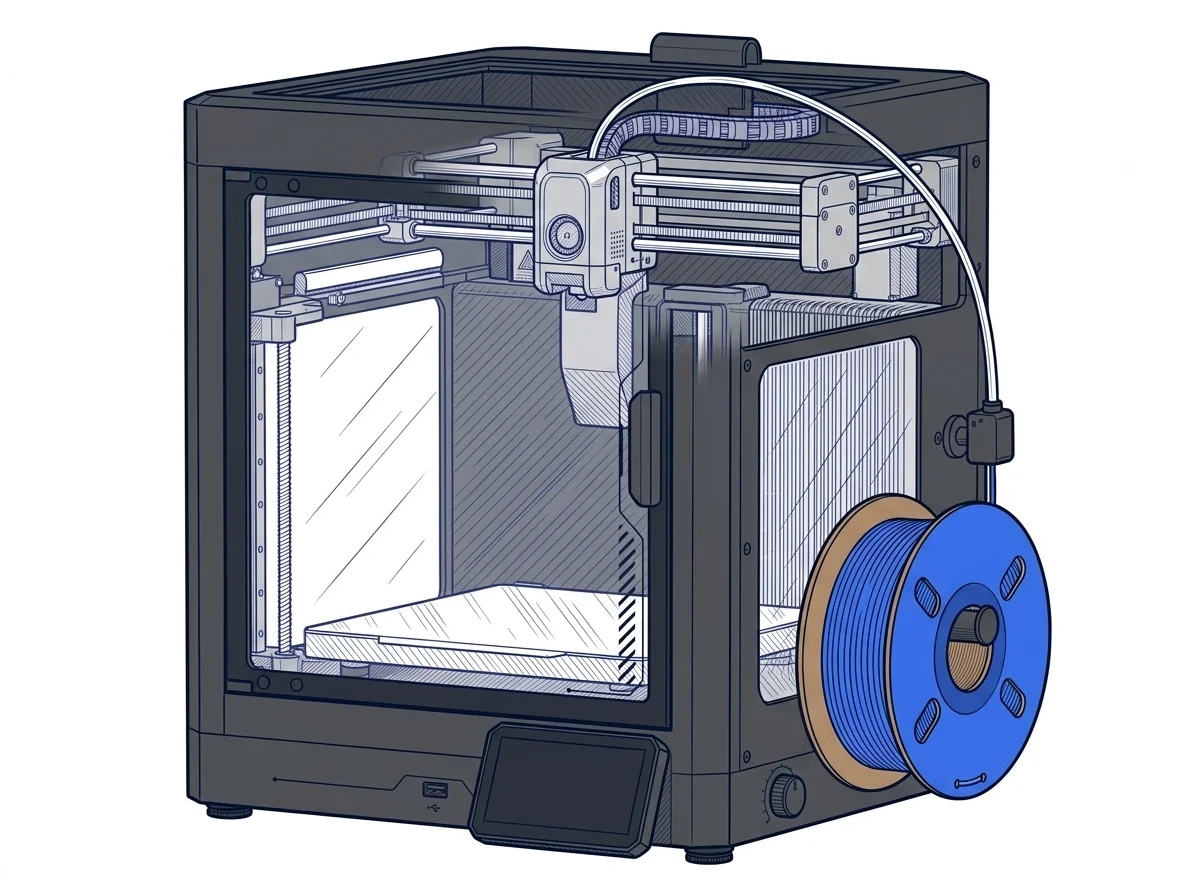
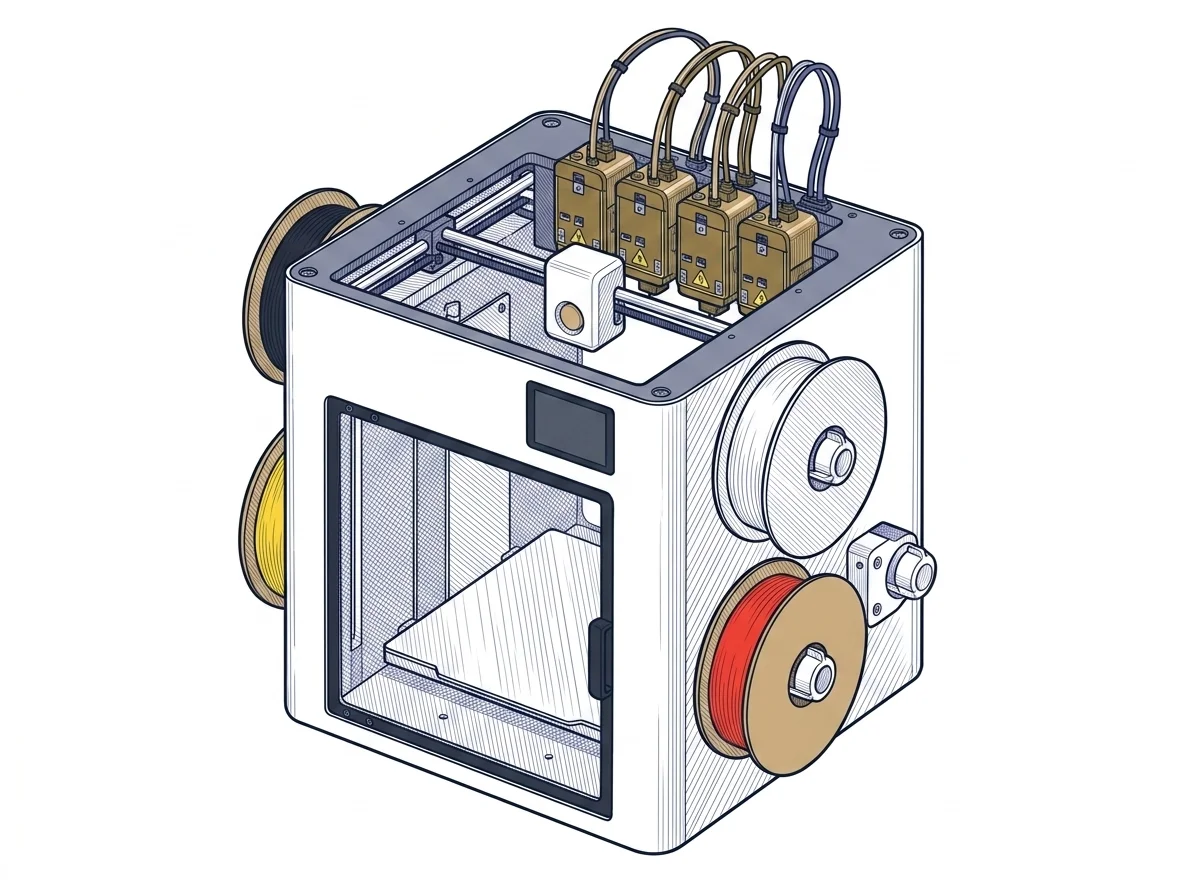
The differences that matter
- Multi-color Management: Snapmaker U1 utilizes a native multi-extruder system to manage up to 4 colors without external hardware, whereas Elegoo Centauri Carbon 2 requires a separate add-on module.
- Enclosure and Temperatures: Elegoo features a standard enclosed chamber and higher maximum temperatures (350 °C nozzle, 110 °C bed), compared to Snapmaker's open architecture (300 °C nozzle, 100 °C bed).
- Build Volume and Precision: Snapmaker U1 offers a slightly larger print volume (270 × 270 × 270 mm vs 256 × 256 × 256 mm) and better claimed precision (0.04 mm vs 0.1 mm).
- Price: Elegoo is positioned as the budget option at roughly €349–399, less than half the €849 cost of the Snapmaker.
Which one to choose
Choose Centauri Carbon 2 if…
Choose Elegoo Centauri Carbon 2 for printing technical materials thanks to its enclosed chamber and a hotend that reaches 350 °C. Its significantly lower price point (~€349–399 vs €849) makes it ideal for users wanting a Klipper ecosystem with AI monitoring without investing in native multi-extrusion, while still retaining 4-color capabilities via a dedicated add-on accessory.
Choose U1 if…
Choose Snapmaker U1 if your priority is seamless multi-color printing via its integrated four-extruder setup, which eliminates the need for accessory modules. Despite lacking an enclosed chamber, it justifies its €849 price tag by offering a larger build volume (270³ mm vs 256³ mm), higher claimed precision (0.04 mm), and a fully open-source Klipper/Moonraker/Fluidd firmware stack.
Where to buy
Paid link: the price for you does not change. Methodology
As an Amazon Associate I earn from qualifying purchases.
Filaments for these printers
The most chosen spools among the materials both printers can print according to their specifications.
- ELEGOO PLA PLA1.75 mm1 kg Check the price on Amazon →
- Bambu Lab PLA PLA1.75 mm1 kg Check the price on Amazon →
- SUNLU PETG (Polyethylene Terephthalate Glycol) PETG (Polyethylene Terephthalate Glycol)1.75 mm1 kg Check the price on Amazon →
- SUNLU PLA PLA1.75 mm1 kg Check the price on Amazon →
- OVERTURE PETG (Polyethylene Terephthalate Glycol) PETG (Polyethylene Terephthalate Glycol)High speed1.75 mm1 kg Check the price on Amazon →
Paid link: the price for you does not change. Methodology
As an Amazon Associate I earn from qualifying purchases.
MakerSpecs is an independent atlas. We don't sell products: the purchase links are the same as on the two product sheets and don't influence the verdict. The sheets have the complete data.