Anycubic Photon Mono 4 vs Creality HALOT-MAGE 8K
Technical comparison · Resin 3D printing
Two resin printers with monochrome LCD screens, priced about €200 apart. The difference that decides it is the build plate: 153 × 87 mm against 228 × 128 mm, meaning one or a few parts per run against a full plate.
| Parameter | ||
|---|---|---|
| Identity | ||
| Launch year | 2024 | 2023 |
| Use tier | F2 — Intermediate | F2 — Intermediate |
| Price | ||
| Price (€) | ~180–250 € | 419 € |
| Universal specs | ||
| Dimensions (W×D×H) (cm) | — | 33.3 × 27 × 60.8 cm |
| Weight (kg) | — | 12 kg |
| Work area (mm) | 153.4 × 87 mm | 228 × 128 mm |
| Z-axis height (mm) | 165 mm | 230 mm |
| Power (W) | — | 100 W |
| Voltage (V) | — | 24 V |
| Maximum speed | 1.17 mm/min | 40 mm/s |
| Declared precision | 17 μm | 29.7 μm |
| Category specs | ||
| Build area XY (short side) (mm) | 87 mm | 128 mm |
| XY resolution (µm) | 17 µm | 29.7 µm |
| Light source | Mono LCD | Mono LCD |
| Print speed (mm/h) | 70.2 mm/h | 40 mm/h |
| Tilt / peel system | Standard FEP | Standard FEP |
| Ecosystem | ||
| Cloud dependency | No | No |
| Software notes | The device is fully compatible with the main third-party slicing software options on the market, including widely popular solutions such as Chitubox and Lychee Slicer, alongside the proprietary Anycubic Photon Workshop application. This flexibility allows users to manage advanced exposure parameters, supports, and tolerance compensation without proprietary constraints. File preparation occurs primarily via offline transfer using a USB port, ensuring a stable workflow independent of active network connections. Managing print profiles for various commercial resins is highly intuitive, facilitating the optimization of layer-by-layer curing times for both standard materials and advanced formulations. | The system supports the proprietary HALOT BOX ecosystem, developed to optimize digital model transition and support generation. The electronic architecture is fully compatible with widely distributed third-party formats and programs such as CHITUBOX and Lychee Slicer, ensuring workflow flexibility. Connectivity features file transfer via an integrated USB port and remote management through wireless networks, relying on the mobile application for progress monitoring without binding the user to exclusive cloud infrastructure dependencies. |
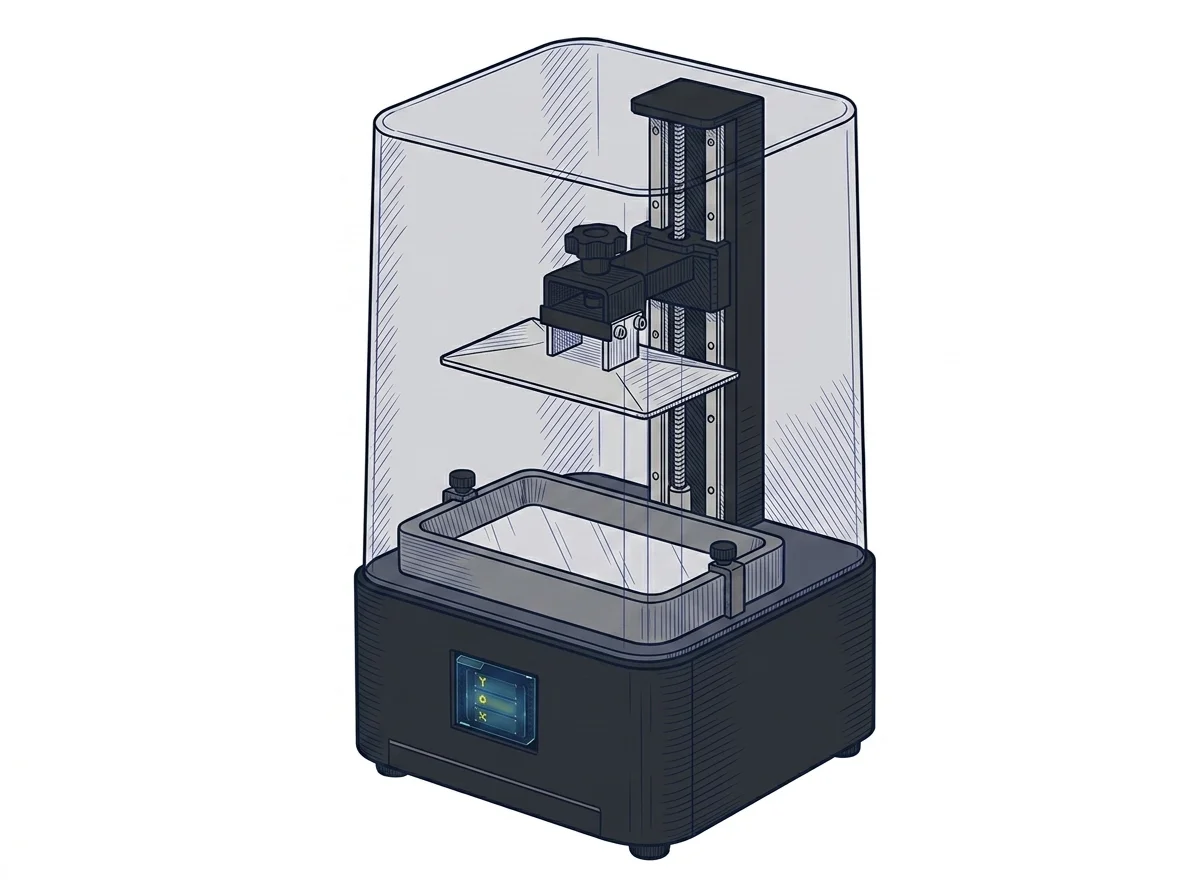

The differences that matter
- Build plate → 153 × 87 mm against 228 × 128 mm: one full plate in a single print against several prints for the same batch.
- XY resolution → 17 µm against 29.7 µm (manufacturer's stated values): the Mono 4 has the finer pixel for small detail.
- Connectivity → the Mono 4 takes files over USB; the HALOT-MAGE 8K adds Wi-Fi and an app to follow the print.
- Price → about €215 against €419: the HALOT-MAGE 8K costs €204 more.
Which one to choose
Choose Photon Mono 4 if…
you print small, detailed parts, one or a few per session, and want to spend as little as possible. At 70 mm/h against 40, a tall part finishes sooner. The limit is height: the Z axis reaches 165 mm.
Choose HALOT-MAGE 8K if…
you fill the plate with several parts in one print, or print tall parts up to 230 mm. It costs €204 more and runs at 40 mm/h, so the same height takes longer.
Where to buy
Paid link: the price for you does not change. Methodology
MakerSpecs is an independent atlas. We don't sell products: the purchase links are the same as on the two product sheets and don't influence the verdict. The sheets have the complete data.