Anatomy of a high-flow hotend: how bi-metal and CHT designs work to print at 500 mm/s
High-flow hotends — from the Volcano geometry to CHT designs with a three-channel insert — melt filament fast enough to sustain print speeds above 300–500 mm/s. Here's how they work, where they differ from a standard hotend, and what changes in practice.
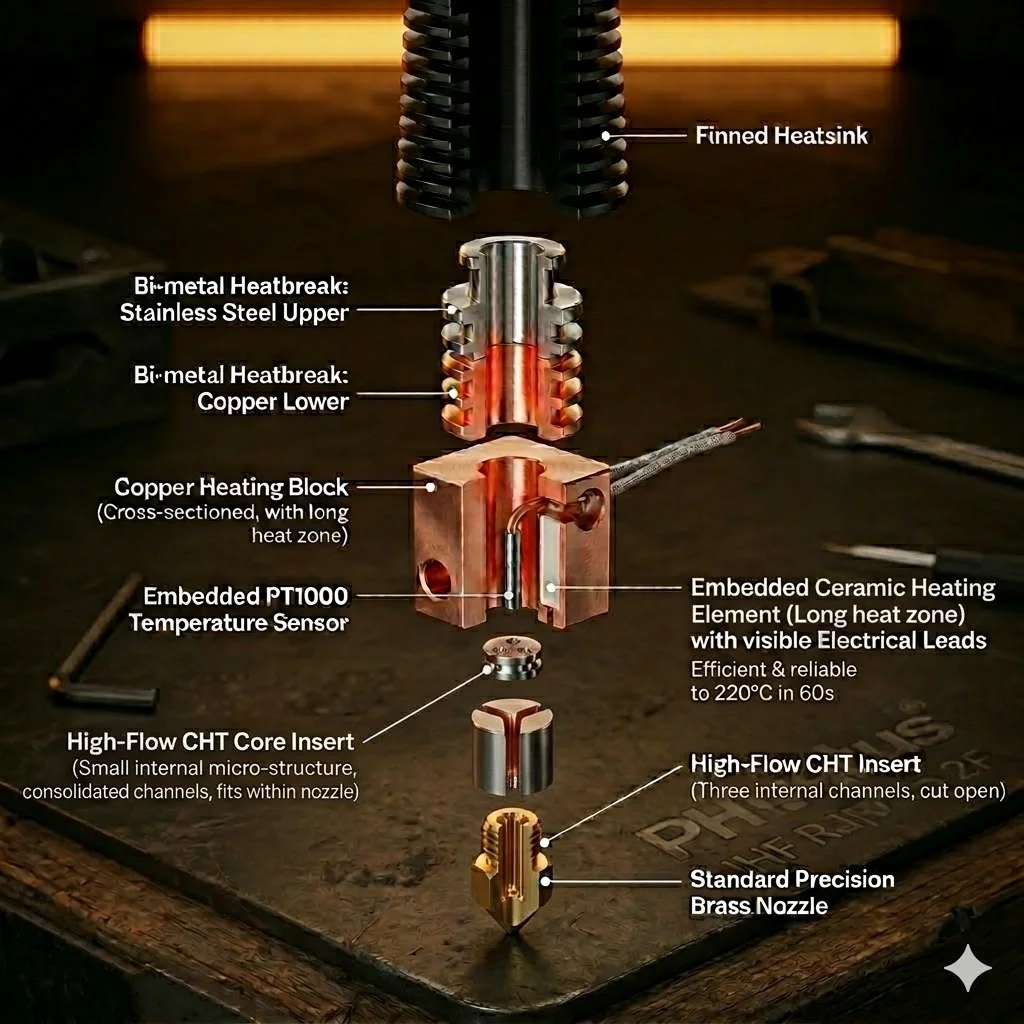
In summary
- A standard hotend melts between 10 and 15 mm³/s of filament; a high-flow hotend reaches 30–60 mm³/s or more, depending on the design.
- The difference is not just temperature: it's the length of the melt zone and the thermal conductivity of the filament channel.
- Bi-metal designs separate the cold zone (stainless steel, low conductivity) from the hot zone (brass or copper, high conductivity) to eliminate partially melted filament plugs.
- The Volcano extends the hot zone to increase filament residence time; the CHT uses a multi-channel insert to increase the contact surface area.
- Maximum volumetric flow rate — not travel speed — is the parameter that matters: 500 mm/s with a 0.4 mm nozzle is only achievable if the required flow rate falls within the hotend's limit.
In fused filament 3D printing print speed is often limited not by motors or firmware, but by the hotend's ability to melt filament fast enough to deliver fluid material to the nozzle without interruption. Understanding what happens inside the hotend is the prerequisite for choosing the right component and correctly calibrating a fast machine.
What volumetric flow rate is and why it's the real limit
Volumetric flow rate (in mm³/s) describes how many cubic millimetres of filament are melted and extruded per second. It is calculated as:
flow rate = nozzle cross-sectional area × linear extrusion speed
With a 0.4 mm nozzle and a layer height of 0.2 mm, printing at 200 mm/s requires approximately 16 mm³/s; at 500 mm/s this rises to around 40 mm³/s. A standard hotend with a 20 mm aluminium heater block barely reaches 15–18 mm³/s before the filament comes out partially melted — this phenomenon is called heat creep in transition zones or, more seriously, grinding on the extruder gear slipping against filament that fails to advance.
Raising the block temperature only helps up to a point: beyond the material's limits the polymer degrades. The engineering solution is to increase the amount of heat transferred to the filament per unit of time — and this is achieved in three distinct ways.
Standard hotends: structural limitations
A conventional hotend (such as the E3D V6 or Bambu Lab stock) has:
- A heatbreak in stainless steel, 20–26 mm long, with an internal bore of 1.75 or 2.85 mm.
- A heater block in aluminium approximately 20 mm long in the hot zone.
- A nozzle in brass or steel.
The effective melt zone is short: the filament enters cold, heats up only in the last 10–15 mm before the nozzle, and residence time at process temperature is limited. For PLA at 200 mm/s this works; for PETG or ABS at 300 mm/s the margin thins; for high-viscosity materials (PC, filled PA, rigid TPU) or higher speeds, the structure can't cope.
The bi-metal design: thermally separating the zones
The bi-metal heatbreak — popularised by manufacturers such as Slice Engineering (Copperhead) and then widely adopted in the aftermarket — combines two materials in a single component:
| Zone | Material | Purpose |
|---|---|---|
| Upper section (cold zone) | Stainless steel | Low conductivity → thermal barrier towards the extruder |
| Lower section (hot zone) | Copper or brass | High conductivity → rapid heat transfer to the filament |
The boundary between the two materials is welded or threaded with tight tolerances. The practical effect is twofold: the risk of heat creep (filament softening too early and jamming the cold zone) is reduced, and the heating rate in the hot zone — where it's needed — is increased. A hotend with a bi-metal heatbreak can gain 5–10 mm³/s of flow rate compared to an equivalent all-stainless-steel unit, all other parameters being equal.
The Volcano: more length, more residence time
E3D introduced the Volcano block as a direct solution to the flow rate problem. The logic is straightforward: extending the heater block from 20 mm to approximately 60 mm means the filament spends more time in contact with the hot surface before reaching the nozzle. Residence time increases, melting is more complete, and maximum flow rate rises to approximately 25–35 mm³/s with common materials.
The trade-off is vertical resolution: Volcano nozzles have longer internal passages, making them less precise for thin layers. They are suited to rapid prints with a layer height of 0.3 mm or more, and less suitable for fine work at 0.1 mm. The heavier block also increases thermal inertia — temperature transients are slower, which can make firmware speed-profile management more critical.
The CHT: contact surface area tripled
The CHT (Core Heating Technology) insert takes a completely different approach: instead of extending the path, it splits the molten filament into three separate channels inside the nozzle, multiplying the contact surface with the hot metal without modifying the external length of the block.
The insert is a small metal seat that screws inside a compatible nozzle (usually standard MK8 or V6 format) and features three Y-shaped channels. The filament arrives as a solid cylinder, enters the insert and — in the melt zone — is distributed across three paths with a collectively greater surface area. The flow rate reported by manufacturers and independent measurements is 30–50 mm³/s on standard 0.4–0.6 mm nozzles, with a normal-length heater block.
The advantage over the Volcano is compatibility: it does not require changing the block, and it maintains the vertical precision of short nozzles. The disadvantage is that the insert adds mechanical resistance to flow: at low speeds the difference is negligible, but it should be considered if an extruder with limited torque is being used.
Quick comparison table
| Type | Typical flow rate (PLA, 220°C) | Block length | Compatibility |
|---|---|---|---|
| Standard (e.g. V6) | 10–18 mm³/s | ~20 mm | Universal |
| Bi-metal heatbreak | 15–25 mm³/s | ~20 mm | Drop-in (same block) |
| Volcano | 25–35 mm³/s | ~60 mm | Requires firmware support |
| CHT insert | 30–50 mm³/s | ~20 mm | Compatible with standard nozzles |
| Volcano + CHT | 45–60+ mm³/s | ~60 mm | Advanced combination |
Values are indicative and depend on material, temperature, and nozzle. For verified data on individual products, consult the catalogue sheets.
What really happens at 500 mm/s
Consumer printers claiming 500 mm/s (Bambu Lab X1C, Creality K1 Max, Qidi Q1 Pro) do not use a conventional hotend: they feature high-conductivity copper heater blocks, bi-metal heatbreaks, and in some cases proprietary geometries that approach the CHT logic. The combination allows flow rates of 35–50 mm³/s.
But there is a key detail: 500 mm/s is the axis travel speed on straight segments. The actual average print speed — accounting for accelerations, decelerations, perimeters, and short moves — is much lower. Core XY printers with lightweight kinematics (H-bot or Cartesian with a compact head) can afford accelerations of 10,000–20,000 mm/s² precisely because the head is light: in this context the high-flow hotend is there to sustain flow rate peaks on fast segments, not a constant average speed of 500 mm/s.
A 40 mm³/s CHT hotend on a 0.4 mm nozzle with 0.2 mm layers can sustain approximately 500 mm/s in a straight line. Dropping to 0.3 mm layers reduces the sustainable speed; increasing to a 0.6 mm nozzle raises it. Firmware (Klipper with pressure advance, Marlin with linear advance) manages transients to avoid under-extrusion in curves.
Materials and tools for a retrofit
To upgrade an existing hotend to high flow, the components typically involved are:
- Bi-metal heatbreak compatible with the block in use (verify thread pitch and diameter)
- CHT insert for the nozzle type fitted (MK8, V6, Volcano)
- Nozzle in brass (standard printing), hardened steel (abrasive filaments), or X-nozzle steel with coating (fibre-filled filaments)
- Heater block in copper if replacing the standard aluminium block
- Heater cartridge of at least 60 W if increasing the thermal mass of the block
- Thermistor appropriate for the process temperature (NTC 100k for the majority; PT1000 for hotends at 300°C+)
Before starting: always measure the current hotend's maximum flow rate with an extrusion-at-temperature test (gradually increase mm/s until grinding or under-extrusion is observed) to establish a baseline against which to compare the retrofit result.
Calibration notes after the upgrade
A high-flow hotend installed without recalibrating the firmware brings no benefits and can worsen quality. The parameters to review:
- Extruder steps/mm: unchanged if the drive mechanism is not altered.
- Pressure advance / linear advance: must be recalibrated — a more fluid hotend responds differently to transients.
- Process temperature: with copper blocks the read temperature may differ from the actual one; run a temperature tower after the swap.
- Retraction: usually reduced with a bi-metal heatbreak (less oozing), but must be tested case by case.
To explore machine selection based on material type and flow requirements, the 3D printing of special materials section collects machine categories with already-certified high-performance hotends.