Creality K1 vs Snapmaker Original
Technical comparison · Fused filament fabrication (FFF/FDM)
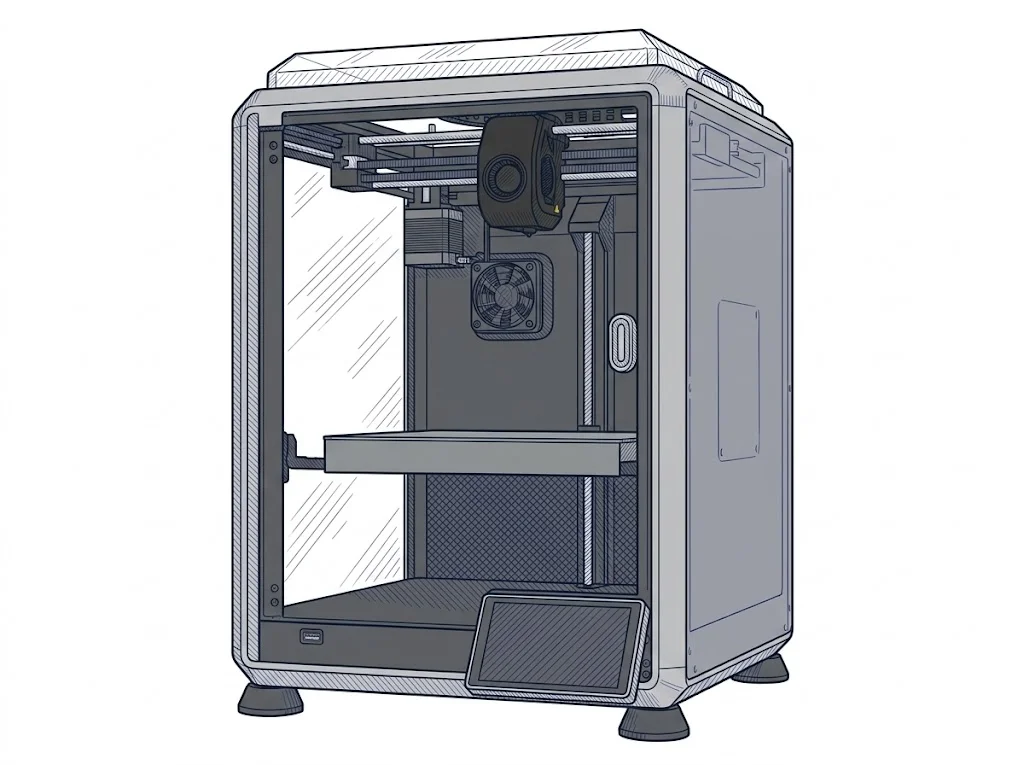
These are not machines for the same job: the Creality K1 is a dedicated 3D printer, enclosed and running Klipper; the Snapmaker Original 3-in-1 is a single machine that prints, mills and laser-engraves, which is why its 3D printing happens in a cube only 125 mm on a side.
| Parameter |
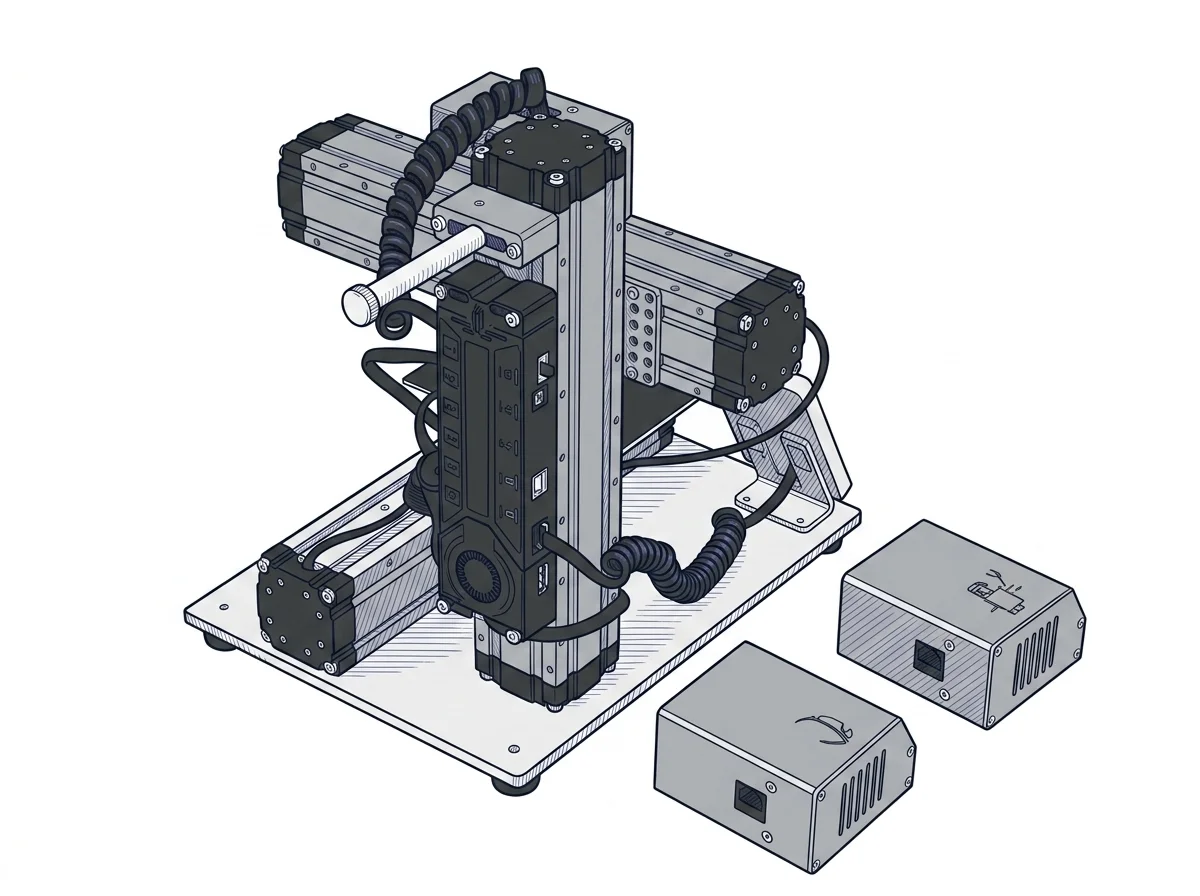 Original
Snapmaker
F2 · Intermediate |
|
|---|---|---|
| Identity | ||
| Launch year | 2023 | 2017 |
| Use tier | F2 — Intermediate | F2 — Intermediate |
| Price | ||
| Price (€) | 329 € | ~400–850 € |
| Price updated on | 06/2026 | — |
| Universal specs | ||
| Dimensions (W×D×H) (cm) | 35.5 × 35.5 × 48 cm | 27.2 × 33.5 × 28.9 cm |
| Weight (kg) | 9.6 kg | 4.5 kg |
| Work area (mm) | 220 × 220 mm | 125 × 125 mm |
| Z-axis height (mm) | 250 mm | 125 mm |
| Power (W) | 350 W | — |
| Maximum speed | 600 mm/s | 100 mm/s |
| Declared precision | 0.1 mm | 0.005 mm |
| Category specs | ||
| Footprint X×Y (short side) (mm) | 220 mm | 125 mm |
| Build height Z (mm) | 250 mm | 125 mm |
| Kinematics | CoreXY | Cartesian |
| Max nozzle temperature (°C) | 300 °C | 250 °C |
| Max bed temperature (°C) | 100 °C | 80 °C |
| Max print speed (mm/s) | 600 mm/s | 100 mm/s |
| Enclosed chamber | Yes | No |
| Filament sensor | Yes | No |
| Auto bed leveling | Mesh | — |
| Standard nozzle diameter (mm) | 0.4 mm | 0.4 mm |
| Multi-extruder | No | No |
| Native Klipper | Yes | No |
| Input shaper | Yes | No |
| Multicolor printing | No | No |
| Max colors | — | 1 |
| Ecosystem | ||
| Cloud dependency | No | No |
| Software notes | Pre-installed Klipper firmware with Creality OS interface. Wi-Fi connectivity and built-in 4.3" touch screen. | Natively compatible with Snapmaker Luban, the proprietary software specifically designed to manage the machine's three different functions within a single environment. The printer is based on standard Marlin firmware and supports G-code formats, allowing the use of third-party slicers like Cura or Simplify3D for 3D printing. For CNC and laser operations, it is possible to use external programs such as Autodesk Fusion 360, LaserGRBL, or LightBurn, exporting compatible toolpaths via the interface or USB port. |
The differences that matter
- Dedicated 3D printing against three functions in one → the K1 does one thing, the Snapmaker adds milling and laser
- 220×220×250 mm against 125×125×125 → 22 cm parts fit on the K1 and not on the Snapmaker
- About 625 € against 329 € → the Snapmaker costs about 296 € more
Which one to choose
Choose K1 if…
The K1 is for whoever only wants to 3D print, with a 220×220 mm plate and 250 mm of height at 329 €. The chamber is enclosed, there is a filament sensor and the Klipper firmware has input shaper, with a stated speed of up to 600 mm/s. The trade-off: it only does 3D printing.
Choose Original if…
The Snapmaker Original is for whoever has room for one machine and also wants to mill and laser-engrave, all handled by Snapmaker Luban; for milling and laser, Fusion 360, LaserGRBL or LightBurn can be used too. The trade-off: in 3D printing the volume is 125×125×125 mm, the stated speed 100 mm/s, the nozzle reaches 250 °C and the chamber is open. It costs about 625 € and dates from 2017.
Where to buy
Paid link: the price for you does not change. Methodology
Filaments for these printers
The most chosen spools among the materials both printers can print according to their specifications.
- ELEGOO PLA PLA1.75 mm1 kg Check the price on Amazon →
- Bambu Lab PLA PLA1.75 mm1 kg Check the price on Amazon →
- SUNLU PETG (Polyethylene Terephthalate Glycol) PETG (Polyethylene Terephthalate Glycol)1.75 mm1 kg Check the price on Amazon →
- SUNLU PLA PLA1.75 mm1 kg Check the price on Amazon →
- OVERTURE PETG (Polyethylene Terephthalate Glycol) PETG (Polyethylene Terephthalate Glycol)High speed1.75 mm1 kg Check the price on Amazon →
Paid link: the price for you does not change. Methodology
As an Amazon Associate I earn from qualifying purchases.
MakerSpecs is an independent atlas. We don't sell products: the purchase links are the same as on the two product sheets and don't influence the verdict. The sheets have the complete data.