Bambu Lab P2S vs Elegoo Centauri Carbon 2 Combo
Technical comparison · Fused filament fabrication (FFF/FDM)
Same 256 mm cube of build volume, same CoreXY frame, an enclosure on both: on the spec sheet these two are hard to tell apart. What separates them is colour and floor space. Anyone printing single-colour PLA or PETG can skip both — these are machines for people who actually run multi-material jobs.
| Parameter | ||
|---|---|---|
| Identity | ||
| Launch year | 2025 | 2026 |
| Use tier | F2 — Intermediate | F2 — Intermediate |
| Price | ||
| Price (€) | 519 € | 439 € |
| Universal specs | ||
| Dimensions (W×D×H) (cm) | 39.2 × 40.6 × 47.8 cm | 50 × 48 × 74.3 cm |
| Weight (kg) | 14.9 kg | 19.35 kg |
| Work area (mm) | 256 × 256 mm | 256 × 256 mm |
| Z-axis height (mm) | 256 mm | 256 mm |
| Power (W) | 1200 W | 1100 W |
| Voltage (V) | — | 240 V |
| Maximum speed | 600 mm/s | 500 mm/s |
| Declared precision | — | 0.1 mm |
| Category specs | ||
| Footprint X×Y (short side) (mm) | 256 mm | 256 mm |
| Build height Z (mm) | 256 mm | 256 mm |
| Kinematics | CoreXY | CoreXY |
| Max nozzle temperature (°C) | 300 °C | 350 °C |
| Max bed temperature (°C) | 110 °C | 110 °C |
| Max print speed (mm/s) | 600 mm/s | 500 mm/s |
| Enclosed chamber | Yes | Yes |
| Filament sensor | Yes | Yes |
| Auto bed leveling | Mesh | Mesh |
| Standard nozzle diameter (mm) | 0.4 mm | 0.4 mm |
| Multi-extruder | No | No |
| Native Klipper | No | — |
| Input shaper | Yes | Yes |
| Multicolor printing | Yes | Yes |
| Multicolor requires accessory | Yes | No |
| Max colors | 20 | 4 |
| Ecosystem | ||
| Cloud dependency | No | No |
| Software notes | The official slicer is Bambu Studio, available for macOS, Windows, and Linux. The printer also accepts standard G-code exported from third-party slicers such as PrusaSlicer, SuperSlicer, and Cura, though certain advanced Bambu-specific features — including RFID-based filament detection and some automatic calibration modes — are only available within Bambu Studio. Remote control is handled via the Bambu Handy mobile app and desktop app; push notifications require cloud connectivity. | The machine is compatible with major slicing software on the market. The manufacturer recommends using Elegoo Slicer, specifically optimized to leverage the CoreXY kinematics, multi-color printing via the CANVAS system, and vibration compensation algorithms (Input Shaping). Alternatively, popular slicers like Orca Slicer and Cura can be used, offering broad flexibility to users who prefer established workflows. The integrated dual-band Wi-Fi connectivity allows direct transfer of G-code files to the 8 GB internal memory without physical cards, while the internal camera enables remote monitoring and time-lapse video recording, simplifying the management of the printing process even from a distance. |
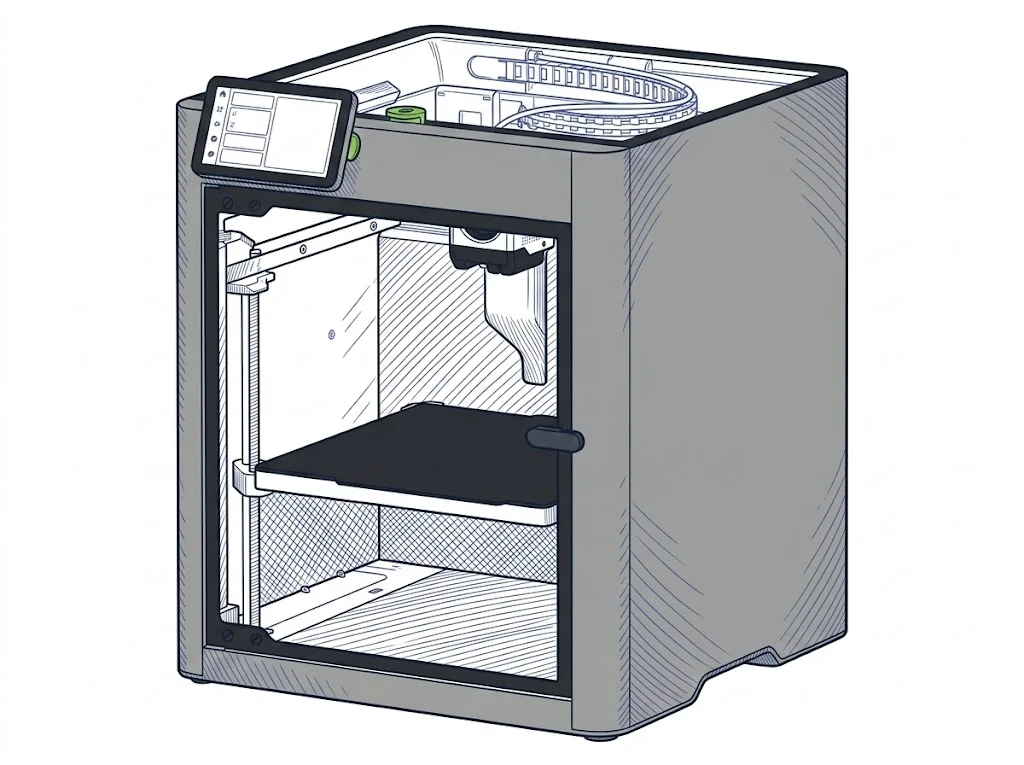
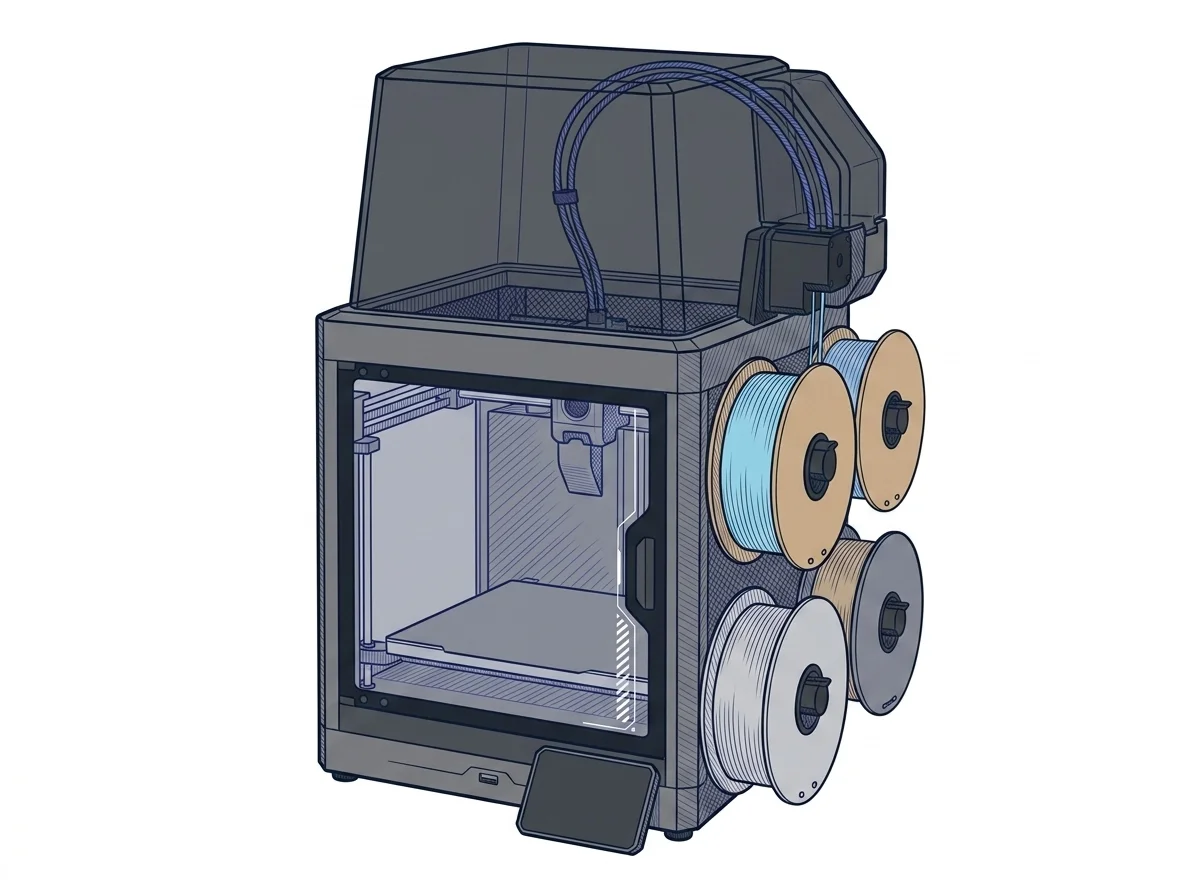
The differences that matter
- Colour: the Centauri Carbon 2 Combo ships with its four-filament system; the P2S quotes up to 20 colours, but only once the AMS is bought separately.
- Footprint: 39 × 41 × 48 cm against 50 × 48 × 74 cm, 14.9 kg against 19.35 kg. Elegoo's multi-colour tower wants a surface of its own.
- Hotend: 350 °C against 300 °C. Above 300 sit polycarbonate and nylons; PLA, PETG, ABS and ASA are within reach of both.
- Price: 439 € against 519 €, and the gap widens the moment the AMS joins the P2S.
- Speed: 600 mm/s against 500 mm/s on paper; on curve-heavy parts the difference narrows.
- Software: Bambu Studio handles calibration and RFID filament reading, out of reach for third-party slicers; Elegoo recommends its own but accepts Orca and Cura.
- Identical: 256 × 256 × 256 mm build volume, CoreXY, enclosure, 110 °C bed, filament sensor, mesh levelling, input shaping, 0.4 mm nozzle.
Which one to choose
Choose P2S if…
you need a wide palette and the desk is the constraint. At 39 × 41 × 48 cm the P2S fits on a shelf the 74 cm-tall Centauri Combo will never see. The 20-colour ceiling only applies once you buy the AMS, which is not in the box, so the real price of a multicolour setup sits well above the 519 € sticker. The 600 mm/s headline against 500 matters less than it reads, since acceleration and part cooling decide print times; heavier is the fact that Bambu Studio handles calibration and RFID filament reading, which no third-party slicer reproduces. Push notifications go through the cloud; printing does not.
Choose Centauri Carbon 2 Combo if…
you want multi-colour without a second purchase. At 439 € the Centauri Carbon 2 Combo ships with its four-filament system and still undercuts a bare P2S, and four colours cover most of what circulates online. The hotend reaches 350 °C instead of 300, which brings polycarbonate and nylons into range — they will not flow below that. You pay for it in bulk: 50 × 48 × 74 cm and 19.35 kg against 14.9. Eight gigabytes of onboard storage and dual-band Wi-Fi end the card shuffle, and the slicer is not locked down: Orca and Cura both work.
Where to buy
Paid link: the price for you does not change. Methodology
As an Amazon Associate I earn from qualifying purchases.
Filaments for these printers
The most chosen spools among the materials both printers can print according to their specifications.
- ELEGOO PLA PLA1.75 mm1 kg Check the price on Amazon →
- Bambu Lab PLA PLA1.75 mm1 kg Check the price on Amazon →
- SUNLU PETG (Polyethylene Terephthalate Glycol) PETG (Polyethylene Terephthalate Glycol)1.75 mm1 kg Check the price on Amazon →
- SUNLU PLA PLA1.75 mm1 kg Check the price on Amazon →
- OVERTURE PETG (Polyethylene Terephthalate Glycol) PETG (Polyethylene Terephthalate Glycol)High speed1.75 mm1 kg Check the price on Amazon →
Paid link: the price for you does not change. Methodology
As an Amazon Associate I earn from qualifying purchases.
MakerSpecs is an independent atlas. We don't sell products: the purchase links are the same as on the two product sheets and don't influence the verdict. The sheets have the complete data.