Bambu Lab P1S vs Creality Ender-3 V3 KE
Technical comparison · Fused filament fabrication (FFF/FDM)
Choose the Bambu Lab P1S if you require a CoreXY kinematics with an enclosed chamber, a larger build volume, and the capability for multicolor printing up to 16 colors via an accessory. Choose the Creality Ender-3 V3 KE if you prefer a system based on native Klipper firmware, a lighter Cartesian structure, and a lower purchase price with a slightly smaller build volume.
| Parameter | ||
|---|---|---|
| Identity | ||
| Launch year | 2023 | 2023 |
| Use tier | F2 — Intermediate | F2 — Intermediate |
| Price | ||
| Price (€) | ~399–499 € | 299 € |
| Price updated on | — | 06/2026 |
| Universal specs | ||
| Dimensions (W×D×H) (cm) | 38.9 × 38.9 × 45.8 cm | 43.3 × 36.6 × 49 cm |
| Weight (kg) | 12.95 kg | 7.8 kg |
| Work area (mm) | 256 × 256 mm | 220 × 220 mm |
| Z-axis height (mm) | 256 mm | 240 mm |
| Power (W) | 1000 W | 350 W |
| Voltage (V) | 100 V | — |
| Maximum speed | 500 mm/s | 500 mm/s |
| Declared precision | — | 0.1 ±mm |
| Category specs | ||
| Footprint X×Y (short side) (mm) | 256 mm | 220 mm |
| Build height Z (mm) | 256 mm | 240 mm |
| Kinematics | CoreXY | Cartesian |
| Max nozzle temperature (°C) | 300 °C | 300 °C |
| Max bed temperature (°C) | 100 °C | 100 °C |
| Max print speed (mm/s) | 500 mm/s | 500 mm/s |
| Enclosed chamber | Yes | No |
| Filament sensor | Yes | Yes |
| Auto bed leveling | Mesh | Mesh |
| Standard nozzle diameter (mm) | 0.4 mm | 0.4 mm |
| Multi-extruder | No | No |
| Native Klipper | No | Yes |
| Input shaper | Yes | Yes |
| Multicolor printing | Yes | No |
| Multicolor requires accessory | Yes | No |
| Max colors | 16 | 1 |
| Ecosystem | ||
| Cloud dependency | No | No |
| Software notes | The P1S is managed through Bambu Studio, Bambu Lab's proprietary slicer available for Windows, macOS, and Linux, or via OrcaSlicer, the widely adopted open-source fork that provides finer parameter control. The Bambu Handy mobile app enables remote monitoring and print launching. The printer supports local LAN connections without a mandatory cloud account, though some advanced features — such as remote timelapses and OTA firmware updates — require a Bambu account. | Powered by Creality OS (based on Klipper), it supports LAN and cloud control via the Creality Print app. It remains compatible with major third-party slicers like Cura and PrusaSlicer. |
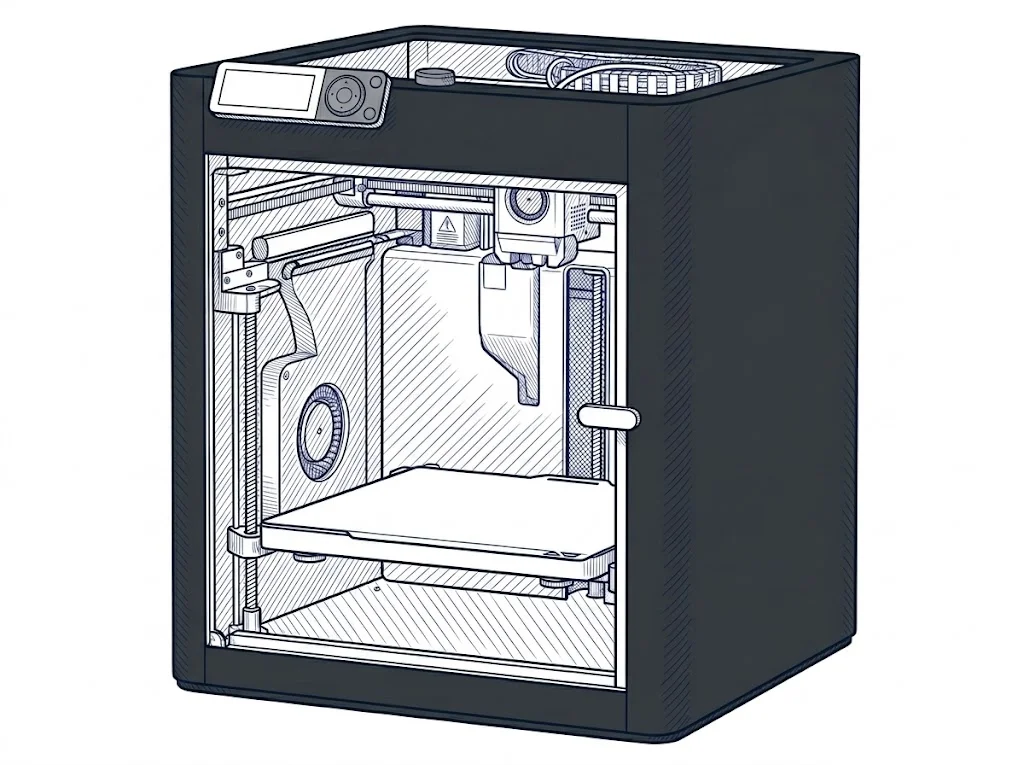
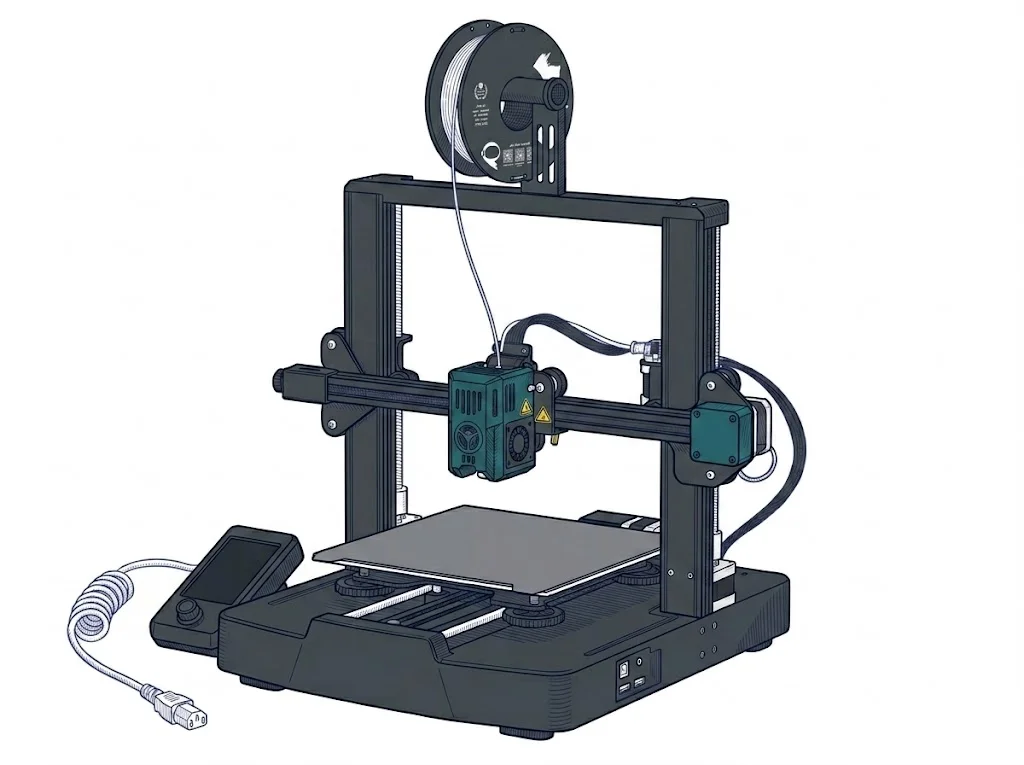
The differences that matter
- Kinematics and Structure: The Bambu Lab P1S features CoreXY kinematics with an enclosed chamber, while the Creality Ender-3 V3 KE utilizes an open-chamber Cartesian configuration.
- Build Volume: The P1S offers a build area of 256 × 256 mm with a Z-height of 256 mm, which is larger than the 220 × 220 mm area with a Z-height of 240 mm on the Ender-3 V3 KE.
- Color Management: The P1S supports multicolor printing up to a maximum of 16 colors by purchasing a dedicated accessory, whereas the Ender-3 V3 KE is limited to 1 color.
- Firmware and Ecosystem: The Ender-3 V3 KE integrates native Klipper via Creality OS, while the P1S does not feature native Klipper and relies on the Bambu Studio / OrcaSlicer ecosystem with optional cloud features.
- Power Consumption: The P1S specifies a maximum power consumption of 1000 W compared to the 350 W of the Ender-3 V3 KE.
Which one to choose
Choose P1S if…
The Bambu Lab P1S is suitable for those who need an enclosed chamber structure and a larger build area (256x256x256 mm). It represents the ideal choice if you plan to upgrade to multicolor printing up to 16 total colors and want an integrated software ecosystem via Bambu Studio or OrcaSlicer, relying on a maximum power of 1000 W.
Choose Ender-3 V3 KE if…
The Creality Ender-3 V3 KE is suitable for those looking for native Klipper integration via Creality OS for printer control and who prefer a lighter Cartesian machine (7.8 kg). It is the optimal choice for tighter budgets, open compatibility with third-party slicers like Cura and PrusaSlicer, and acceptance of a 220x220x240 mm build volume and single-color printing.
Where to buy
Paid link: the price for you does not change. Methodology
As an Amazon Associate I earn from qualifying purchases.
Filaments for these printers
The most chosen spools among the materials both printers can print according to their specifications.
- ELEGOO PLA PLA1.75 mm1 kg Check the price on Amazon →
- Bambu Lab PLA PLA1.75 mm1 kg Check the price on Amazon →
- SUNLU PETG (Polyethylene Terephthalate Glycol) PETG (Polyethylene Terephthalate Glycol)1.75 mm1 kg Check the price on Amazon →
- SUNLU PLA PLA1.75 mm1 kg Check the price on Amazon →
- OVERTURE PETG (Polyethylene Terephthalate Glycol) PETG (Polyethylene Terephthalate Glycol)High speed1.75 mm1 kg Check the price on Amazon →
Paid link: the price for you does not change. Methodology
As an Amazon Associate I earn from qualifying purchases.
MakerSpecs is an independent atlas. We don't sell products: the purchase links are the same as on the two product sheets and don't influence the verdict. The sheets have the complete data.