Bambu Lab H2S vs Qidi Tech Plus4
Technical comparison · Fused filament fabrication (FFF/FDM)
Anyone printing bulky parts and wanting the fastest machine in the pair looks at the top speed; anyone wanting to spend less and tinker with the firmware looks at the Plus4. The difference that matters most is price: the Plus4 costs about €400 less, in exchange for a smaller print bed.
| Parameter | ||
|---|---|---|
| Identity | ||
| Launch year | 2025 | 2024 |
| Use tier | F2 — Intermediate | F2 — Intermediate |
| Price | ||
| Price (€) | ~1150–1250 € | 799 € |
| Universal specs | ||
| Dimensions (W×D×H) (cm) | 49.2 × 51.4 × 62.6 cm | 50.5 × 48.7 × 55 cm |
| Weight (kg) | 30 kg | 27 kg |
| Work area (mm) | 340 × 320 mm | 305 × 305 mm |
| Z-axis height (mm) | 340 mm | 280 mm |
| Power (W) | 1800 W | 850 W |
| Voltage (V) | 220 V | 240 V |
| Maximum speed | 1000 mm/s | 600 mm/s |
| Declared precision | 50 μm | — |
| Category specs | ||
| Footprint X×Y (short side) (mm) | 320 mm | 305 mm |
| Build height Z (mm) | 340 mm | 280 mm |
| Kinematics | CoreXY | CoreXY |
| Max nozzle temperature (°C) | 350 °C | 370 °C |
| Max bed temperature (°C) | 120 °C | 120 °C |
| Max print speed (mm/s) | 1000 mm/s | 600 mm/s |
| Enclosed chamber | Yes | Yes |
| Filament sensor | Yes | Yes |
| Auto bed leveling | Mesh | Mesh |
| Standard nozzle diameter (mm) | 0.4 mm | 0.4 mm |
| Multi-extruder | No | No |
| Native Klipper | No | Yes |
| Input shaper | Yes | Yes |
| Multicolor printing | Yes | Yes |
| Multicolor requires accessory | Yes | Yes |
| Max colors | — | 16 |
| Ecosystem | ||
| Cloud dependency | No | No |
| Software notes | The H2S uses Bambu Studio as its primary slicer, with full support for proprietary features including automatic calibration, AI monitoring, and AMS management. It also accepts G-code exported from OrcaSlicer, PrusaSlicer, and Cura, though some advanced functions may not be available with third-party slicers. Laser and cutting functions are managed exclusively through Bambu Suite. Developer Mode is available, exposing MQTT access for custom integrations. | The machine relies on an architecture based on Klipper firmware, which provides advanced computational performance and native features like input shaping to reduce vibrations during high-speed movements. Users can interface via the integrated 5-inch touchscreen or through the standard Klipper web interface. The recommended official slicing software is QIDI Studio, a program derived from PrusaSlicer and Orca Slicer, optimized to leverage the machine's profiles and proprietary print parameters. However, the system maintains an open approach and is fully compatible with third-party slicers such as Orca Slicer, PrusaSlicer, and Cura, ensuring maximum flexibility in the daily workflow. |
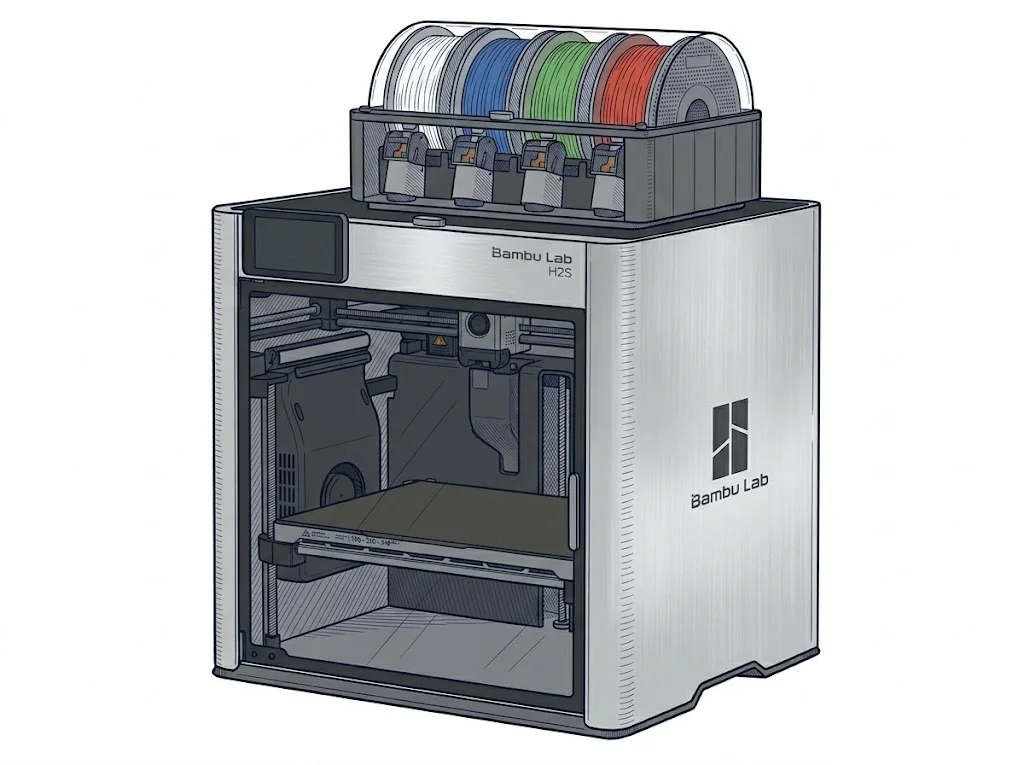
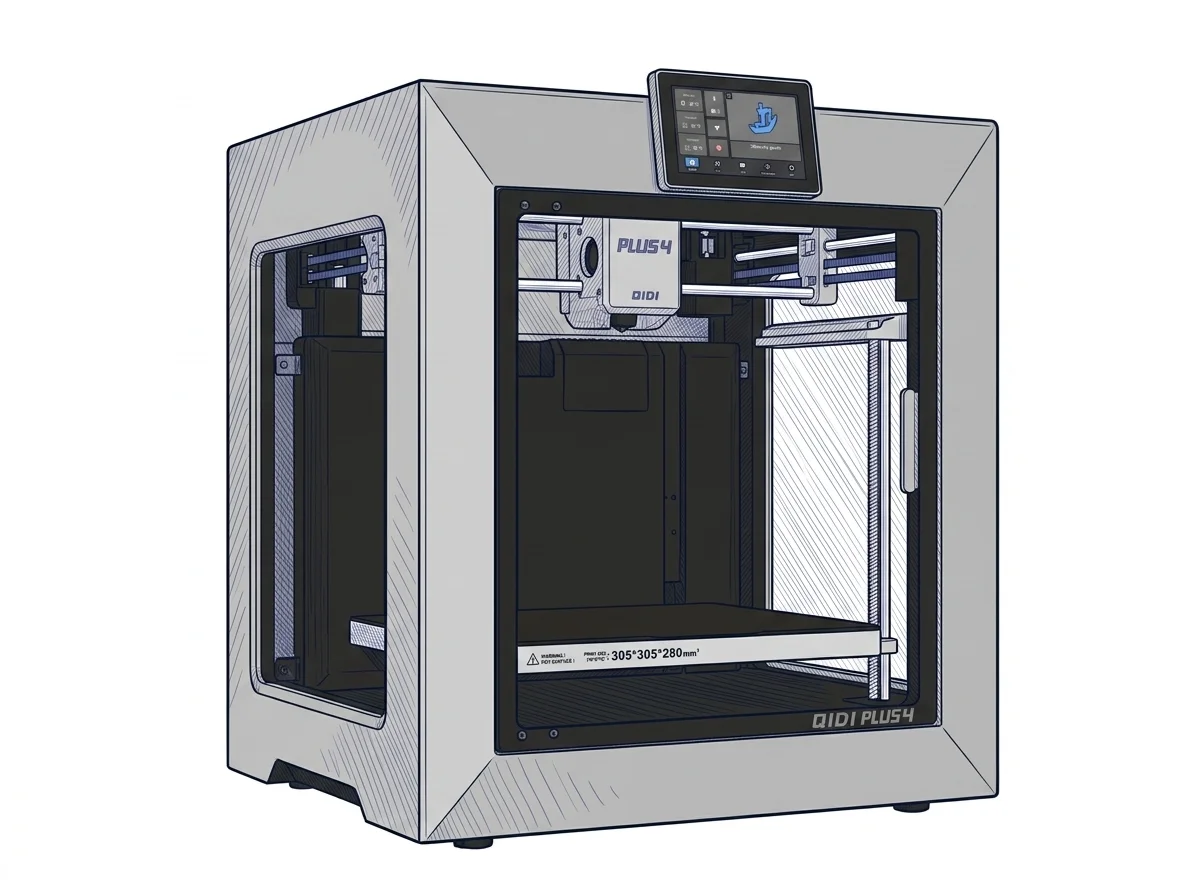
The differences that matter
- Price: the Plus4 costs about €400 less → more room in the budget for filament or accessories.
- Stated top speed: the H2S reaches 1000 mm/s against the Plus4's 600 mm/s → the H2S finishes bulky parts sooner.
- Firmware: only the Plus4 has native Klipper → direct access to profiles and calibration without going through Bambu Studio.
- Print bed: 340×320 mm on the H2S against 305×305 mm on the Plus4 → the H2S prints larger single parts in one go.
Which one to choose
Choose H2S if…
You print large parts in PLA or PETG and want the bigger bed of the two: 340×320 mm of surface and 340 mm of height, with a stated top speed of up to 1000 mm/s. You stay inside the Bambu Studio ecosystem, without direct firmware access.
Choose Plus4 if…
Budget matters more than size and you want to tweak the firmware directly: the Plus4 costs about €400 less and runs native Klipper, with direct access to profiles and calibration. The print bed is smaller (305×305 mm) and the stated top speed tops out at 600 mm/s.
Where to buy
Paid link: the price for you does not change. Methodology
As an Amazon Associate I earn from qualifying purchases.
Filaments for these printers
The most chosen spools among the materials both printers can print according to their specifications.
- ELEGOO PLA PLA1.75 mm1 kg Check the price on Amazon →
- Bambu Lab PLA PLA1.75 mm1 kg Check the price on Amazon →
- SUNLU PETG (Polyethylene Terephthalate Glycol) PETG (Polyethylene Terephthalate Glycol)1.75 mm1 kg Check the price on Amazon →
- SUNLU PLA PLA1.75 mm1 kg Check the price on Amazon →
- OVERTURE PETG (Polyethylene Terephthalate Glycol) PETG (Polyethylene Terephthalate Glycol)High speed1.75 mm1 kg Check the price on Amazon →
Paid link: the price for you does not change. Methodology
As an Amazon Associate I earn from qualifying purchases.
MakerSpecs is an independent atlas. We don't sell products: the purchase links are the same as on the two product sheets and don't influence the verdict. The sheets have the complete data.