Bambu Lab H2S vs Creality Ender-5 Max
Technical comparison · Fused filament fabrication (FFF/FDM)
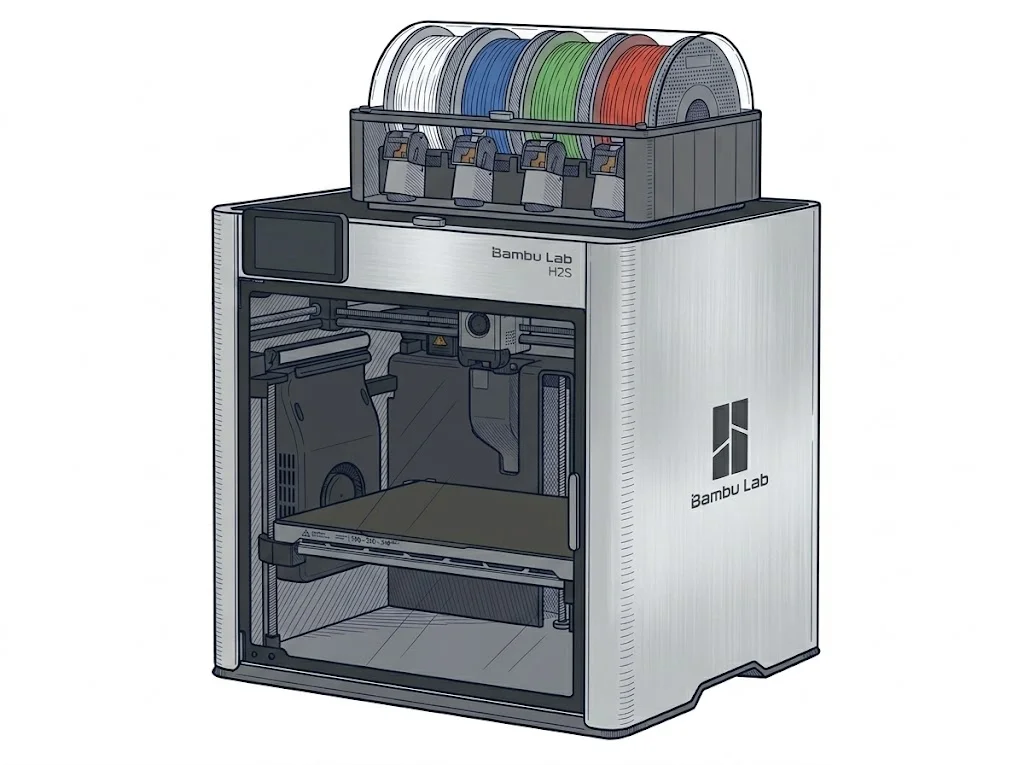
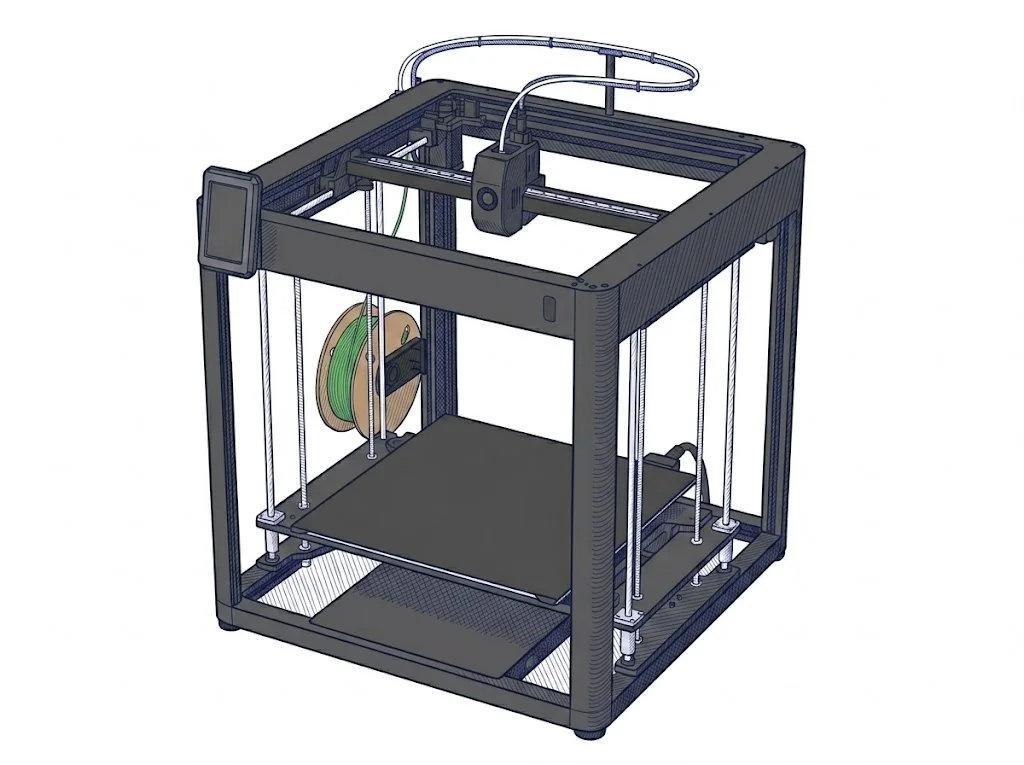
Bambu Lab H2S and Creality Ender-5 Max sit in the same mid-range price bracket for FDM, but they start from different assumptions: one seals everything inside a heated chamber, the other bets on a huge bed at a fraction of the cost. What you print most often should decide this one, not the spec sheet.
| Parameter | ||
|---|---|---|
| Identity | ||
| Launch year | 2025 | 2024 |
| Use tier | F2 — Intermediate | F2 — Intermediate |
| Price | ||
| Price (€) | ~1150–1250 € | ~400–500 € |
| Universal specs | ||
| Dimensions (W×D×H) (cm) | 49.2 × 51.4 × 62.6 cm | 46.18 × 43.48 × 52.58 cm |
| Weight (kg) | 30 kg | 18 kg |
| Work area (mm) | 340 × 320 mm | 400 × 400 mm |
| Z-axis height (mm) | 340 mm | 400 mm |
| Power (W) | 1800 W | 350 W |
| Voltage (V) | 220 V | 240 V |
| Maximum speed | 1000 mm/s | 700 mm/s |
| Declared precision | 50 μm | 0.1 ±mm |
| Category specs | ||
| Footprint X×Y (short side) (mm) | 320 mm | 400 mm |
| Build height Z (mm) | 340 mm | 400 mm |
| Kinematics | CoreXY | CoreXY |
| Max nozzle temperature (°C) | 350 °C | 300 °C |
| Max bed temperature (°C) | 120 °C | 110 °C |
| Max print speed (mm/s) | 1000 mm/s | 700 mm/s |
| Enclosed chamber | Yes | No |
| Filament sensor | Yes | Yes |
| Auto bed leveling | Mesh | Mesh |
| Standard nozzle diameter (mm) | 0.4 mm | 0.4 mm |
| Multi-extruder | No | No |
| Native Klipper | No | Yes |
| Input shaper | Yes | Yes |
| Multicolor printing | Yes | No |
| Multicolor requires accessory | Yes | — |
| Max colors | — | 1 |
| Ecosystem | ||
| Cloud dependency | No | No |
| Software notes | The H2S uses Bambu Studio as its primary slicer, with full support for proprietary features including automatic calibration, AI monitoring, and AMS management. It also accepts G-code exported from OrcaSlicer, PrusaSlicer, and Cura, though some advanced functions may not be available with third-party slicers. Laser and cutting functions are managed exclusively through Bambu Suite. Developer Mode is available, exposing MQTT access for custom integrations. | Klipper-based firmware with a 4.3" colour touchscreen. Compatible with Creality Print, Orca Slicer and PrusaSlicer; remote monitoring via the Creality Cloud app is optional. |
The differences that matter
- Enclosed chamber only on the H2S: it decides whether ABS and ASA come out flat or warped.
- Bed size: 400×400 mm on the Ender-5 Max against 340×320 mm on the H2S, useful for batching small parts.
- Native Klipper only on the Ender-5 Max, versus the H2S's Bambu Studio/Suite ecosystem.
- Price: around €450 for the Ender-5 Max against €1200 for the H2S.
- Higher rated speed on the H2S (1000 mm/s vs 700), though it only shows on simple geometry with matching acceleration.
Which one to choose
Choose H2S if…
The enclosed chamber and 350°C hotend keep ABS and ASA from warping — the material of choice for brackets, motor covers or anything that sits near heat. The AMS, with its accessory unit, adds multicolor printing for prototypes that need to read at a glance.
Choose Ender-5 Max if…
A 400×400 mm bed fits frames, jigs or several parts in one run, where the H2S (340×320 mm) would need two passes. Native Klipper puts tuning and macros directly in your hands instead of Bambu's closed ecosystem, and the price — roughly a third of the H2S — leaves room in the budget for the technical filament the open frame can't print well anyway.
Where to buy
Paid link: the price for you does not change. Methodology
As an Amazon Associate I earn from qualifying purchases.
Filaments for these printers
The most chosen spools among the materials both printers can print according to their specifications.
- ELEGOO PLA PLA1.75 mm1 kg Check the price on Amazon →
- Bambu Lab PLA PLA1.75 mm1 kg Check the price on Amazon →
- SUNLU PETG (Polyethylene Terephthalate Glycol) PETG (Polyethylene Terephthalate Glycol)1.75 mm1 kg Check the price on Amazon →
- SUNLU PLA PLA1.75 mm1 kg Check the price on Amazon →
- OVERTURE PETG (Polyethylene Terephthalate Glycol) PETG (Polyethylene Terephthalate Glycol)High speed1.75 mm1 kg Check the price on Amazon →
Paid link: the price for you does not change. Methodology
As an Amazon Associate I earn from qualifying purchases.
MakerSpecs is an independent atlas. We don't sell products: the purchase links are the same as on the two product sheets and don't influence the verdict. The sheets have the complete data.