Bambu Lab H2C vs Qidi Tech Q2
Technical comparison · Fused filament fabrication (FFF/FDM)
The H2C and the Q2 target very different budgets: one costs more than four times the other, so the choice comes down to how much you want to spend before technical specs even enter the picture. Anyone who has already set a budget looks at just one of the two.
| Parameter | ||
|---|---|---|
| Identity | ||
| Launch year | 2025 | 2025 |
| Use tier | F3 — Advanced | F2 — Intermediate |
| Price | ||
| Price (€) | 2249 € | 499 € |
| Universal specs | ||
| Dimensions (W×D×H) (cm) | 49.2 × 51.4 × 62.6 cm | 40.2 × 43.8 × 49.4 cm |
| Weight (kg) | 32.5 kg | 18.1 kg |
| Work area (mm) | 330 × 320 mm | 270 × 270 mm |
| Z-axis height (mm) | 325 mm | 256 mm |
| Power (W) | 1800 W | 630 W |
| Maximum speed | 1000 mm/s | 600 mm/s |
| Declared precision | 50 μm | — |
| Category specs | ||
| Footprint X×Y (short side) (mm) | 320 mm | 270 mm |
| Build height Z (mm) | 325 mm | 256 mm |
| Kinematics | CoreXY | CoreXY |
| Max nozzle temperature (°C) | 350 °C | 370 °C |
| Max bed temperature (°C) | 120 °C | 120 °C |
| Max print speed (mm/s) | 1000 mm/s | 600 mm/s |
| Enclosed chamber | Yes | Yes |
| Filament sensor | Yes | Yes |
| Auto bed leveling | Mesh | Mesh |
| Standard nozzle diameter (mm) | 0.4 mm | 0.4 mm |
| Multi-extruder | Yes | No |
| Native Klipper | No | Yes |
| Input shaper | Yes | Yes |
| Multicolor printing | Yes | Yes |
| Multicolor requires accessory | Yes | Yes |
| Max colors | 24 | 16 |
| Ecosystem | ||
| Cloud dependency | No | No |
| Software notes | The printer is operated through Bambu Studio, Bambu Lab's open-source slicer based on PrusaSlicer, available for Windows, macOS, and Linux. Remote control is available via the Bambu Handy app or Bambu Suite. The machine includes a 5" color touchscreen for local operation and connects over dual-band Wi-Fi. The firmware is proprietary; Klipper is not natively supported. | The system is natively supported by QIDI Studio, a slicing software derived from PrusaSlicer and Orca Slicer, providing a modern interface and advanced features. The open architecture still allows the use of third-party slicing solutions. Network connectivity, via Wi-Fi or Ethernet, facilitates direct remote printing and monitoring, aided by the built-in camera. |
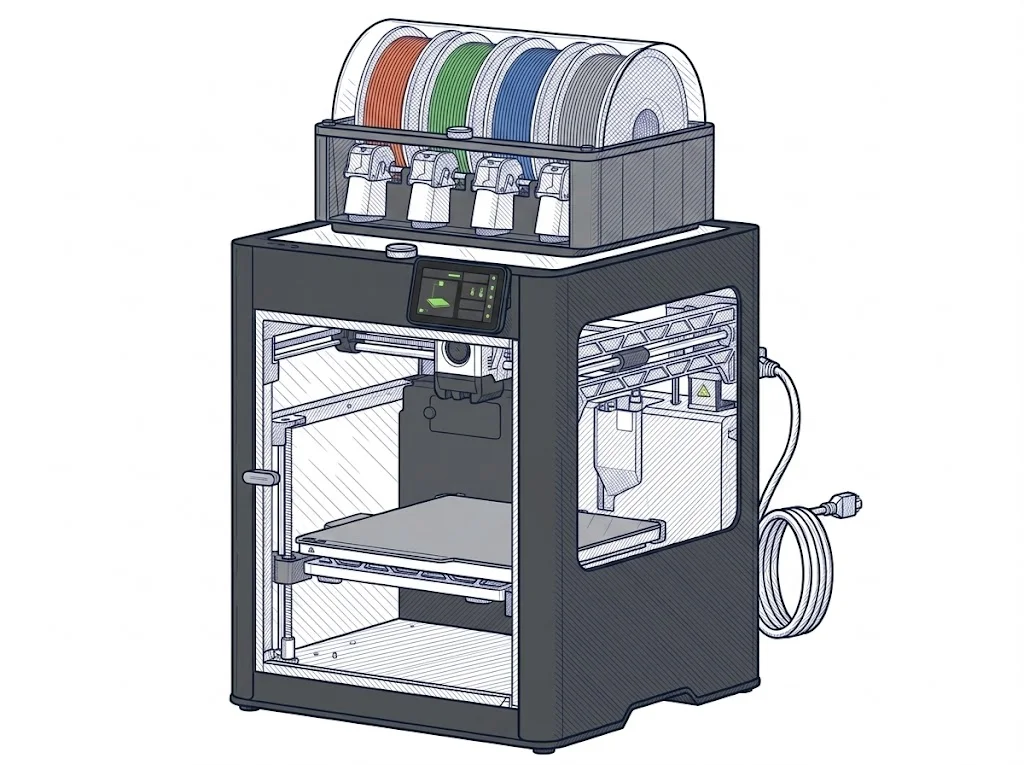
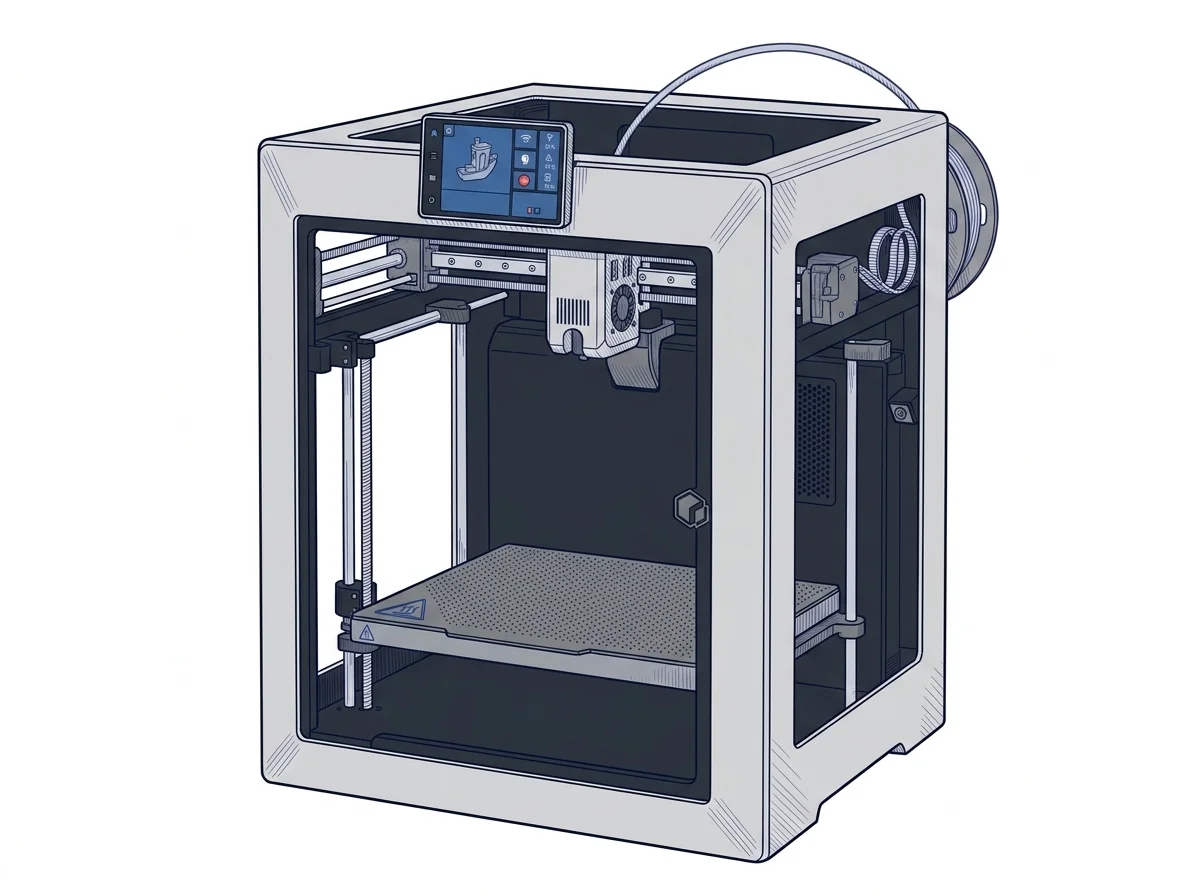
The differences that matter
- Price: H2C €2249 vs Q2 €499 → the Q2 costs €1750 less, suited to starting out without investing in the advanced tier.
- Extrusion: the H2C has physical dual extrusion up to 24 colors, the Q2 reaches 16 colors only with an accessory → the H2C handles color changes and supports without manual intervention.
- Build plate: 330×320 mm vs 270×270 mm → the H2C fits larger single parts.
- Firmware: the Q2 runs natively on Klipper, the H2C has proprietary firmware → more room for tuning and macros on the Q2.
Which one to choose
Choose H2C if…
The H2C has two independent physical extruders, useful for dual-color prints or soluble support material without manual swaps, on a 330×320 mm bed that fits larger parts in a single job. It's a cost that pays off when batch production or complex parts call for that space and flexibility.
Choose Q2 if…
The Q2 costs a quarter of the H2C and runs natively on Klipper, useful for anyone who wants to customize the firmware without a closed ecosystem. The smaller 270×270 mm bed covers most single parts, but larger or batch prints need to be split into multiple jobs.
Where to buy
Paid link: the price for you does not change. Methodology
As an Amazon Associate I earn from qualifying purchases.
Filaments for these printers
The most chosen spools among the materials both printers can print according to their specifications.
- ELEGOO PLA PLA1.75 mm1 kg Check the price on Amazon →
- Bambu Lab PLA PLA1.75 mm1 kg Check the price on Amazon →
- SUNLU PETG (Polyethylene Terephthalate Glycol) PETG (Polyethylene Terephthalate Glycol)1.75 mm1 kg Check the price on Amazon →
- SUNLU PLA PLA1.75 mm1 kg Check the price on Amazon →
- OVERTURE PETG (Polyethylene Terephthalate Glycol) PETG (Polyethylene Terephthalate Glycol)High speed1.75 mm1 kg Check the price on Amazon →
Paid link: the price for you does not change. Methodology
As an Amazon Associate I earn from qualifying purchases.
MakerSpecs is an independent atlas. We don't sell products: the purchase links are the same as on the two product sheets and don't influence the verdict. The sheets have the complete data.