Atomstack A20 Pro V2 vs Sculpfun S30 Ultra 11W
Technical comparison · Diode laser (405–460 nm)
Two diode lasers set apart by two linked numbers: the A20 Pro V2 declares 20 W on a 400 × 365 mm bed, the S30 Ultra 11W declares 11 W on a 600 × 600 mm bed. The choice is between power and part size, and the S30 costs about €250 more.
| Parameter | ||
|---|---|---|
| Identity | ||
| Launch year | 2024 | 2023 |
| Use tier | F2 — Intermediate | F2 — Intermediate |
| Price | ||
| Price (€) | ~300–600 € | 699 € |
| Universal specs | ||
| Dimensions (W×D×H) (cm) | — | 80 × 84 × 22 cm |
| Weight (kg) | 6 kg | — |
| Work area (mm) | 400 × 365 mm | 600 × 600 mm |
| Power (W) | 120 W | 84 W |
| Voltage (V) | — | 24 V |
| Maximum speed | 400 mm/s | — |
| Declared precision | 0.02 mm | 0.005 mm |
| Category specs | ||
| Work area (short side) (mm) | 365 mm | 600 mm |
| Rated power (W) | 20 W | 11 W |
| Source technology | Diode | Diode |
| Max travel speed (mm/s) | 400 mm/s | — |
| Max processing speed (mm/s) | 400 mm/s | — |
| Wavelength (nm) | 455 nm | 455 nm |
| Autofocus | No | No |
| Rotary included/compatible | No | No |
| Passthrough | No | No |
| Supported software | Proprietary, LightBurn, Other | LightBurn, Other |
| Frame | Open, optional enclosure | — |
| Air assist | Optional | Included |
| Fume extraction | Optional filter | — |
| Ecosystem | ||
| Cloud dependency | No | No |
| Software notes | The software compatibility of the device is extensive and aligns with the industrial standards of the maker sector. It natively supports both LaserGRBL, a free and open-source option suitable for basic engraving operations, and LightBurn, the most popular paid professional platform for advanced management of layers, cutting parameters, and complex vector formats. Control can be managed directly via a wired USB connection from a computer or in offline mode, using memory cards to load processing files. The machine responds to standard G-code commands, allowing experienced users fine customization of acceleration and speed parameters through the configuration of the internal firmware, without constraints linked to proprietary and closed-source cloud ecosystems. | Fully compatible with industry-standard software such as LightBurn and LaserGRBL. The 32-bit motherboard supports Bluetooth connectivity for wireless control and future expansions. |
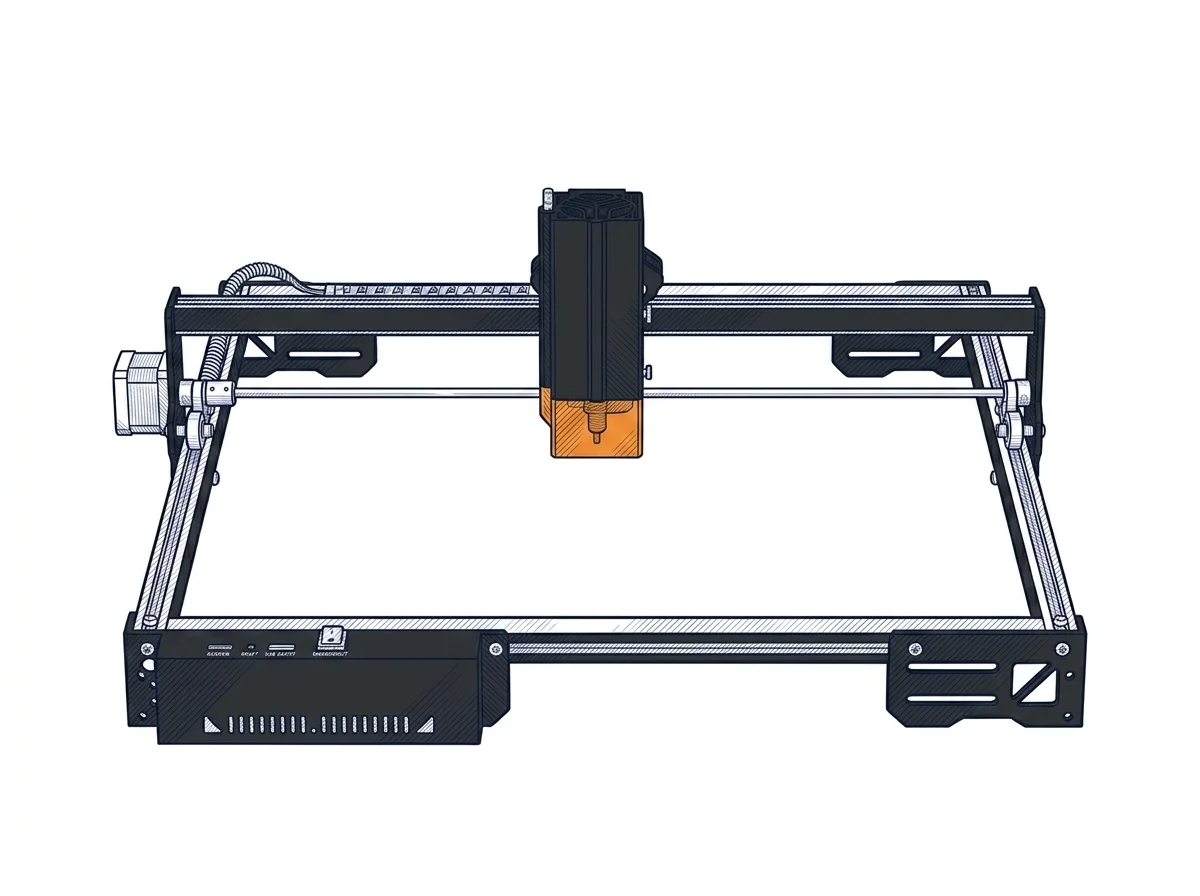

The differences that matter
- Work area: 600 × 600 mm against 400 × 365 mm → a 50 cm panel is engraved whole only on the S30 Ultra.
- Declared power: 20 W against 11 W → the A20 Pro V2 is the machine with more power on hand to cut and engrave faster.
- Price: about €450 against €699 → the A20 Pro V2 leaves about €250 for materials.
- Connection: the A20 Pro V2 also works offline from a memory card; the S30 Ultra has Bluetooth on its 32-bit board.
Which one to choose
Choose A20 Pro V2 if…
You engrave and cut parts that fit in 400 × 365 mm and want the higher power, a declared 20 W, at about €450. You can work from a computer over USB or offline from a memory card, and the firmware answers standard G-code commands, so acceleration and speed can be tuned by hand. The trade-off: a panel wider than 365 mm on one side does not fit.
Choose S30 Ultra 11W if…
You work large panels, up to 600 × 600 mm, such as signs or whole boards, without splitting the job into two placements. Control goes through LightBurn or LaserGRBL and the 32-bit board has Bluetooth. The trade-off: a declared 11 W against 20 and about €250 more; the declared 0.005 mm precision is a rated value.
Where to buy
Paid link: the price for you does not change. Methodology
MakerSpecs is an independent atlas. We don't sell products: the purchase links are the same as on the two product sheets and don't influence the verdict. The sheets have the complete data.