Anycubic Kobra S1 Max vs Creality K1 Max
Technical comparison · Fused filament fabrication (FFF/FDM)
Choose Anycubic Kobra S1 Max if you require a larger build volume of 350x350x350 mm, a maximum nozzle temperature of 350 °C, and support for multi-color printing via an optional accessory. Choose Creality K1 Max if you prefer native Klipper integrated into the operating system and official compatibility with third-party slicers like Cura and PrusaSlicer.
| Parameter | ||
|---|---|---|
| Identity | ||
| Launch year | 2025 | 2023 |
| Use tier | F2 — Intermediate | F2 — Intermediate |
| Price | ||
| Price (€) | ~599–799 € | 899 € |
| Price updated on | 06/2026 | 06/2026 |
| Universal specs | ||
| Dimensions (W×D×H) (cm) | 50.27 × 48.3 × 58.4 cm | 43.5 × 46.2 × 52.6 cm |
| Weight (kg) | — | 18 kg |
| Work area (mm) | 350 × 350 mm | 300 × 300 mm |
| Z-axis height (mm) | 350 mm | 300 mm |
| Power (W) | 2200 W | 1000 W |
| Voltage (V) | 220 V | — |
| Maximum speed | 600 mm/s | 600 mm/s |
| Declared precision | 0.05 mm | 0.1 mm |
| Category specs | ||
| Footprint X×Y (short side) (mm) | 350 mm | 300 mm |
| Build height Z (mm) | 350 mm | 300 mm |
| Kinematics | CoreXY | CoreXY |
| Max nozzle temperature (°C) | 350 °C | 300 °C |
| Max bed temperature (°C) | 120 °C | 120 °C |
| Max print speed (mm/s) | 600 mm/s | 600 mm/s |
| Enclosed chamber | Yes | Yes |
| Filament sensor | Yes | Yes |
| Auto bed leveling | Mesh | Mesh |
| Standard nozzle diameter (mm) | 0.4 mm | 0.4 mm |
| Multi-extruder | No | No |
| Native Klipper | No | Yes |
| Input shaper | Yes | Yes |
| Multicolor printing | Yes | No |
| Multicolor requires accessory | Yes | Yes |
| Max colors | 4 | 4 |
| Ecosystem | ||
| Cloud dependency | No | No |
| Software notes | The firmware runs on a proprietary Kobra OS layer built on top of Klipper; the official slicer is Anycubic Slicer Next, derived from OrcaSlicer, available for Windows and macOS. Third-party OrcaSlicer is also supported. Remote monitoring and control are available via the Anycubic app (iOS/Android) over LAN, with no mandatory cloud connection required for ordinary printing operations. Unlike the Combo version, the ACE 2 Pro module is not included in the box. | It runs on the Klipper-based Creality OS. Compatible with Creality Print, Cura, and PrusaSlicer, featuring remote control support via Wi-Fi or LAN. |
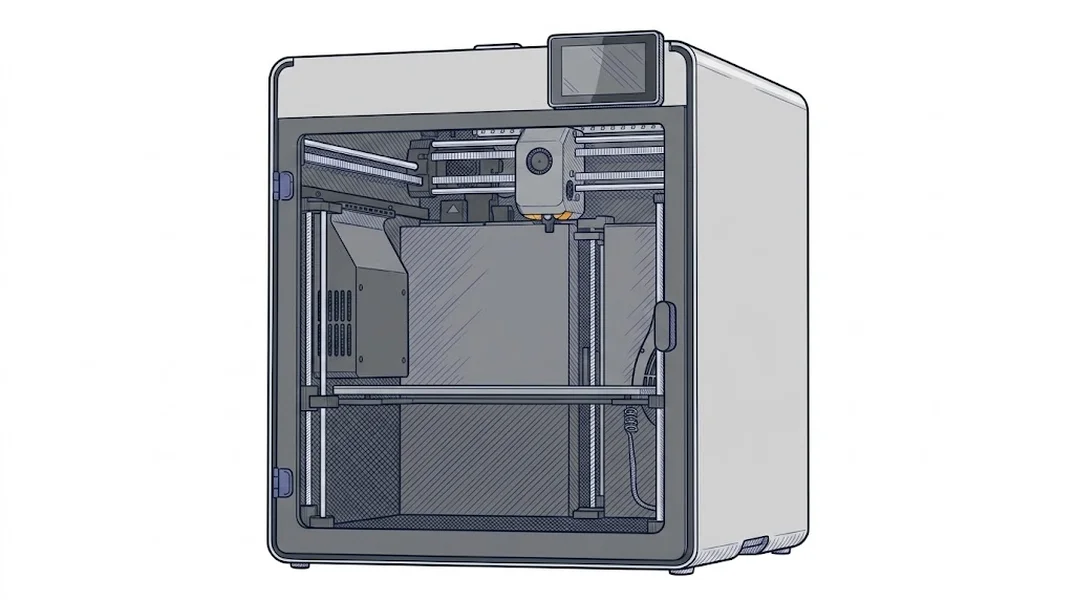
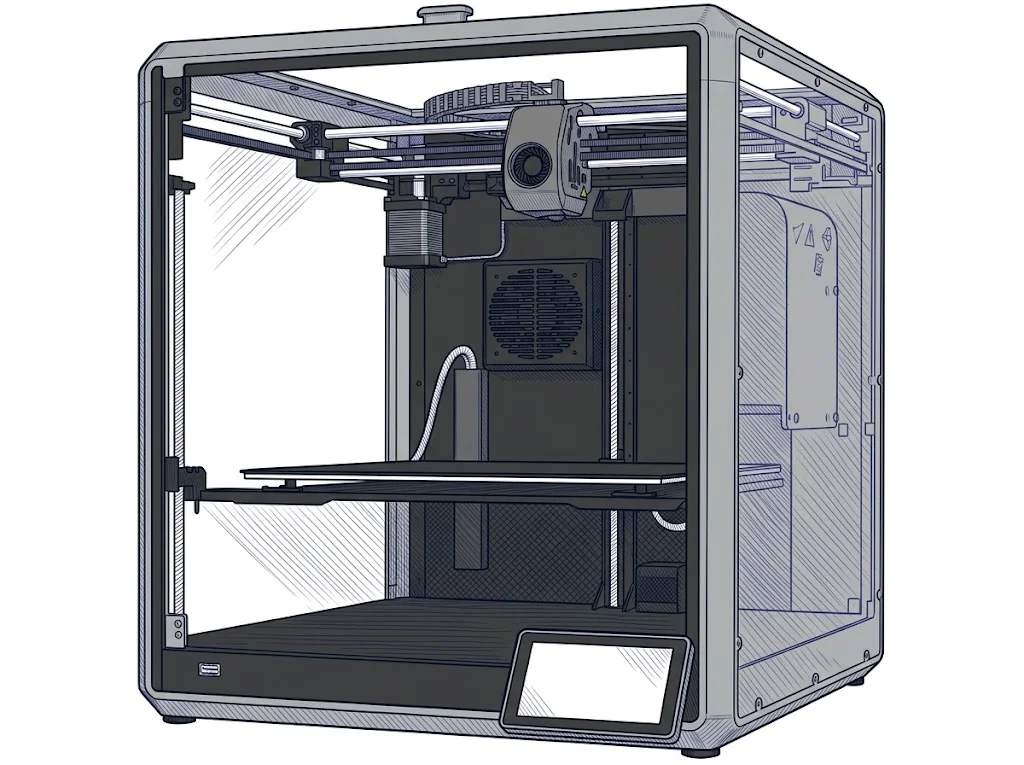
The differences that matter
- Build Volume and Footprint: Anycubic Kobra S1 Max offers a larger work area of 350×350×350 mm compared to 300×300×300 mm for Creality K1 Max, resulting in larger external dimensions.
- Maximum Nozzle Temperature: The Anycubic model reaches a nozzle temperature of 350 °C, exceeding the 300 °C of the Creality model.
- Color Management: Anycubic Kobra S1 Max supports multi-color printing up to 4 colors via an additional accessory, a feature absent on the Creality K1 Max.
- Firmware and Software Ecosystem: Creality K1 Max features native Klipper and is compatible with Creality Print, Cura, and PrusaSlicer, whereas Anycubic uses the proprietary Kobra OS interface (based on Klipper) paired mainly with Anycubic Slicer Next.
- Electrical Specs and Accuracy: Anycubic specifies a power consumption of 2200 W and a declared accuracy of 0.05 mm, compared to 1000 W and 0.1 mm specified by Creality.
Which one to choose
Choose Kobra S1 Max if…
Anycubic Kobra S1 Max is the ideal choice for users requiring the largest available build volume between the two models (350x350x350 mm) and a power rating of 2200 W. It is suitable for those planning to print high-temperature materials up to 350 °C or wishing to implement up to 4-color printing later, while also benefiting from a lower price point (~599–799 €) and a declared accuracy of 0.05 mm.
Choose K1 Max if…
Creality K1 Max is recommended for those seeking a solution with native Klipper integrated directly into Creality OS and software compatibility open to Cura and PrusaSlicer. While offering a smaller build volume (300x300x300 mm) and a power rating of 1000 W, it features more compact external dimensions and a weight of 18 kg, making it suitable for environments with space constraints.
Where to buy
Paid link: the price for you does not change. Methodology
Filaments for these printers
The most chosen spools among the materials both printers can print according to their specifications.
- ELEGOO PLA PLA1.75 mm1 kg Check the price on Amazon →
- Bambu Lab PLA PLA1.75 mm1 kg Check the price on Amazon →
- SUNLU PETG (Polyethylene Terephthalate Glycol) PETG (Polyethylene Terephthalate Glycol)1.75 mm1 kg Check the price on Amazon →
- SUNLU PLA PLA1.75 mm1 kg Check the price on Amazon →
- OVERTURE PETG (Polyethylene Terephthalate Glycol) PETG (Polyethylene Terephthalate Glycol)High speed1.75 mm1 kg Check the price on Amazon →
Paid link: the price for you does not change. Methodology
As an Amazon Associate I earn from qualifying purchases.
MakerSpecs is an independent atlas. We don't sell products: the purchase links are the same as on the two product sheets and don't influence the verdict. The sheets have the complete data.