Anycubic Kobra S1 Combo vs Bambu Lab H2S
Technical comparison · Fused filament fabrication (FFF/FDM)
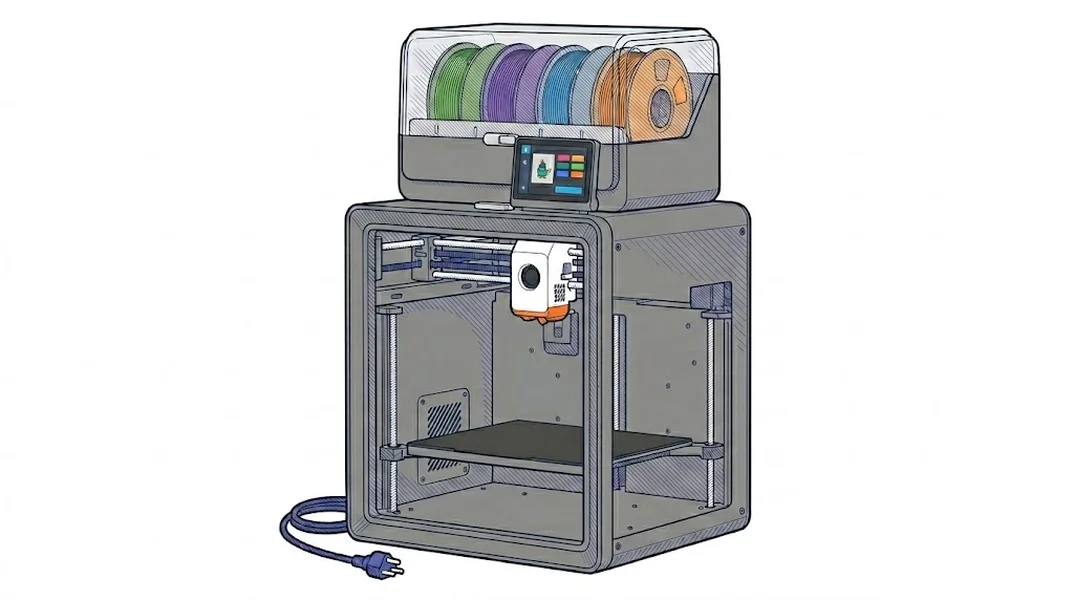
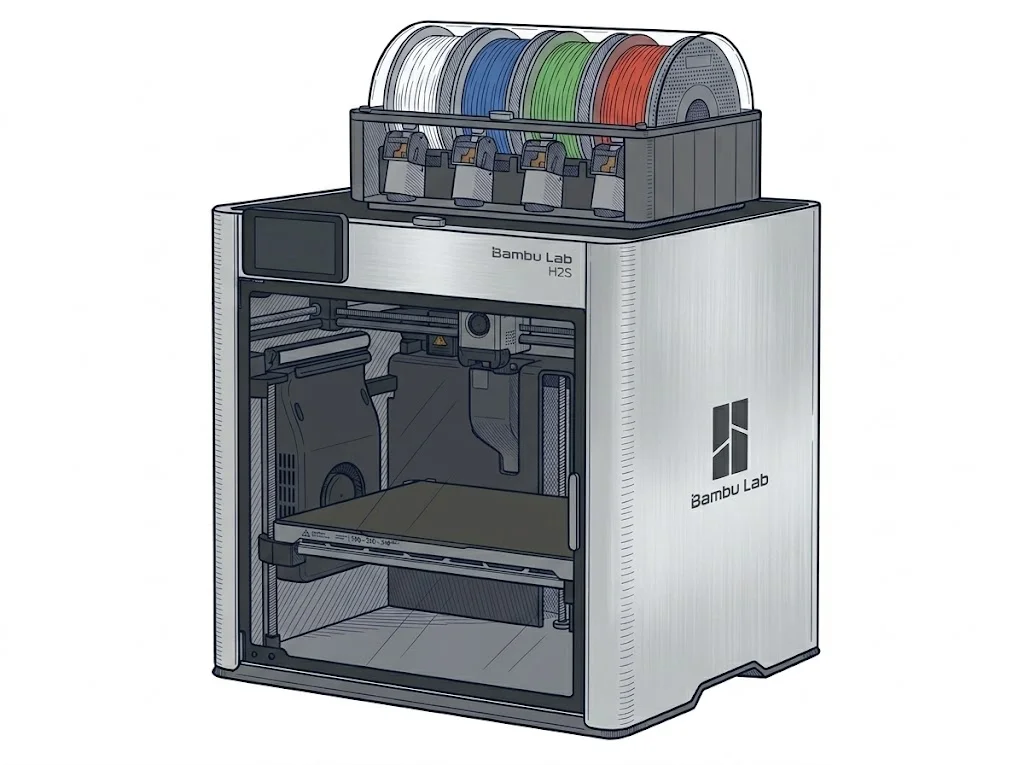
Two enclosed CoreXY printers that part ways on space and price: the H2S has more than double the build volume and costs about 450 € more than the Kobra S1 Combo.
| Parameter | ||
|---|---|---|
| Identity | ||
| Launch year | 2025 | 2025 |
| Use tier | F2 — Intermediate | F2 — Intermediate |
| Price | ||
| Price (€) | 749 € | ~1150–1250 € |
| Price updated on | 06/2026 | — |
| Universal specs | ||
| Dimensions (W×D×H) (cm) | 48.4 × 48.4 × 59.3 cm | 49.2 × 51.4 × 62.6 cm |
| Weight (kg) | 18 kg | 30 kg |
| Work area (mm) | 250 × 250 mm | 340 × 320 mm |
| Z-axis height (mm) | 250 mm | 340 mm |
| Power (W) | — | 1800 W |
| Voltage (V) | — | 220 V |
| Maximum speed | 600 mm/s | 1000 mm/s |
| Declared precision | 0.05 mm | 50 μm |
| Category specs | ||
| Footprint X×Y (short side) (mm) | 250 mm | 320 mm |
| Build height Z (mm) | 250 mm | 340 mm |
| Kinematics | CoreXY | CoreXY |
| Max nozzle temperature (°C) | 320 °C | 350 °C |
| Max bed temperature (°C) | 120 °C | 120 °C |
| Max print speed (mm/s) | 600 mm/s | 1000 mm/s |
| Enclosed chamber | Yes | Yes |
| Filament sensor | Yes | Yes |
| Auto bed leveling | Mesh | Mesh |
| Standard nozzle diameter (mm) | 0.4 mm | 0.4 mm |
| Multi-extruder | No | No |
| Native Klipper | No | No |
| Input shaper | Yes | Yes |
| Multicolor printing | Yes | Yes |
| Multicolor requires accessory | No | Yes |
| Ecosystem | ||
| Cloud dependency | No | No |
| Software notes | The printer works with Anycubic Slicer Next, derived from OrcaSlicer and optimized for the Anycubic ecosystem; it supports multi-plate management and object skipping during printing. Remote control and real-time monitoring are available through the Anycubic app (iOS and Android), connecting via LAN or cloud. The proprietary firmware is not currently open source; native Klipper compatibility is not supported. | The H2S uses Bambu Studio as its primary slicer, with full support for proprietary features including automatic calibration, AI monitoring, and AMS management. It also accepts G-code exported from OrcaSlicer, PrusaSlicer, and Cura, though some advanced functions may not be available with third-party slicers. Laser and cutting functions are managed exclusively through Bambu Suite. Developer Mode is available, exposing MQTT access for custom integrations. |
The differences that matter
- Price, 749 € vs about 1200 € → the H2S costs 400 to 500 € more.
- Build volume, 250×250×250 mm vs 340×320×340 mm → the H2S takes parts with more than twice the volume.
- Multicolor → the Kobra S1 Combo needs no extra accessory, the H2S does (AMS).
- Software → Anycubic Slicer Next, derived from OrcaSlicer, with closed firmware; Bambu Studio with Developer Mode and MQTT access for custom integrations.
Which one to choose
Choose Kobra S1 Combo if…
Medium-sized parts and multicolor ready to use, with no accessory to add, using Anycubic Slicer Next and multi-plate management. The firmware is proprietary, not open source, and a part larger than the bed has to be split into several prints.
Choose H2S if…
A single part larger than the Kobra can hold, which would otherwise be split into two prints. Multicolor needs the accessory added, and the full feature set stays tied to Bambu Studio: with third-party slicers some functions are not available.
Where to buy
Paid link: the price for you does not change. Methodology
As an Amazon Associate I earn from qualifying purchases.
Filaments for these printers
The most chosen spools among the materials both printers can print according to their specifications.
- ELEGOO PLA PLA1.75 mm1 kg Check the price on Amazon →
- Bambu Lab PLA PLA1.75 mm1 kg Check the price on Amazon →
- SUNLU PETG (Polyethylene Terephthalate Glycol) PETG (Polyethylene Terephthalate Glycol)1.75 mm1 kg Check the price on Amazon →
- SUNLU PLA PLA1.75 mm1 kg Check the price on Amazon →
- OVERTURE PETG (Polyethylene Terephthalate Glycol) PETG (Polyethylene Terephthalate Glycol)High speed1.75 mm1 kg Check the price on Amazon →
Paid link: the price for you does not change. Methodology
As an Amazon Associate I earn from qualifying purchases.
MakerSpecs is an independent atlas. We don't sell products: the purchase links are the same as on the two product sheets and don't influence the verdict. The sheets have the complete data.