Anycubic Kobra 2 Max vs Bambu Lab A1 mini
Technical comparison · Fused filament fabrication (FFF/FDM)
Choose the Anycubic Kobra 2 Max if you need to print large-scale components and have ample workshop space. Choose the Bambu Lab A1 mini if you are looking for a compact printer optimized for multi-color printing up to 4 colors and with a nozzle that reaches higher temperatures.
| Parameter | ||
|---|---|---|
| Identity | ||
| Launch year | 2023 | 2023 |
| Use tier | F2 — Intermediate | F2 — Intermediate |
| Price | ||
| Price (€) | ~500–600 € | 299 € |
| Price updated on | 06/2026 | — |
| Universal specs | ||
| Dimensions (W×D×H) (cm) | 73.5 × 64 × 74 cm | 34.7 × 31.5 × 36.5 cm |
| Weight (kg) | 21 kg | 5.7 kg |
| Work area (mm) | 420 × 420 mm | 180 × 180 mm |
| Z-axis height (mm) | 500 mm | 180 mm |
| Power (W) | 500 W | 150 W |
| Maximum speed | 500 mm/s | 500 mm/s |
| Declared precision | — | 50 μm |
| Category specs | ||
| Footprint X×Y (short side) (mm) | 420 mm | 180 mm |
| Build height Z (mm) | 500 mm | 180 mm |
| Kinematics | Cartesian | Cartesian |
| Max nozzle temperature (°C) | 260 °C | 300 °C |
| Max bed temperature (°C) | 90 °C | 80 °C |
| Max print speed (mm/s) | 500 mm/s | 500 mm/s |
| Enclosed chamber | No | No |
| Filament sensor | Yes | Yes |
| Auto bed leveling | Mesh | Mesh |
| Standard nozzle diameter (mm) | 0.4 mm | 0.4 mm |
| Multi-extruder | No | No |
| Native Klipper | No | No |
| Input shaper | Yes | Yes |
| Multicolor printing | No | Yes |
| Multicolor requires accessory | — | Yes |
| Max colors | 1 | 4 |
| Ecosystem | ||
| Cloud dependency | No | No |
| Software notes | Compatible with major third-party slicers such as PrusaSlicer and Cura. It features Wi-Fi connectivity managed through the Anycubic app, while still allowing offline use via USB. | Compatible with Bambu Studio (OrcaSlicer-derived) and OrcaSlicer. Supports LAN mode for cloud-free printing. Does not run native Klipper. |
The differences that matter
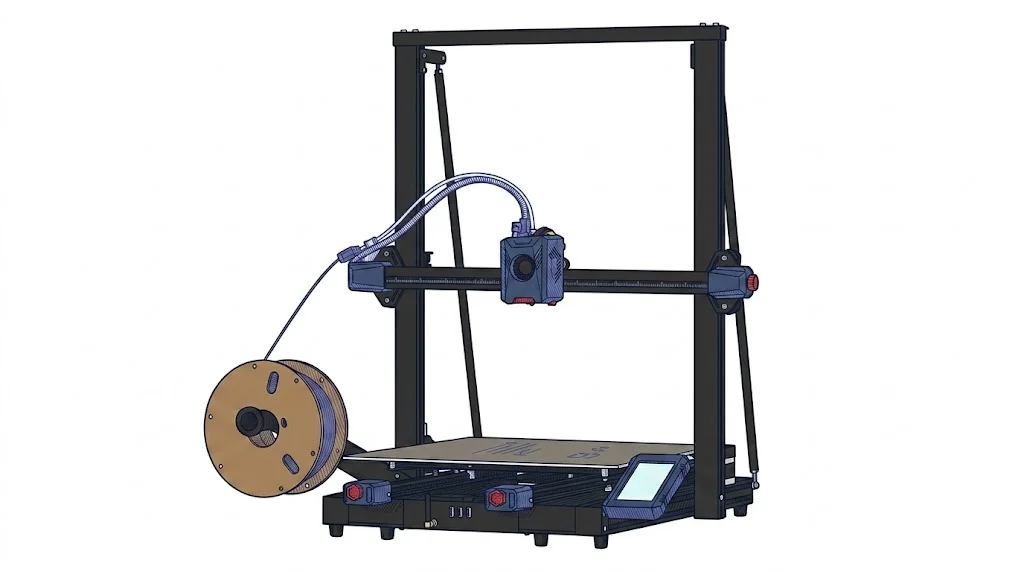
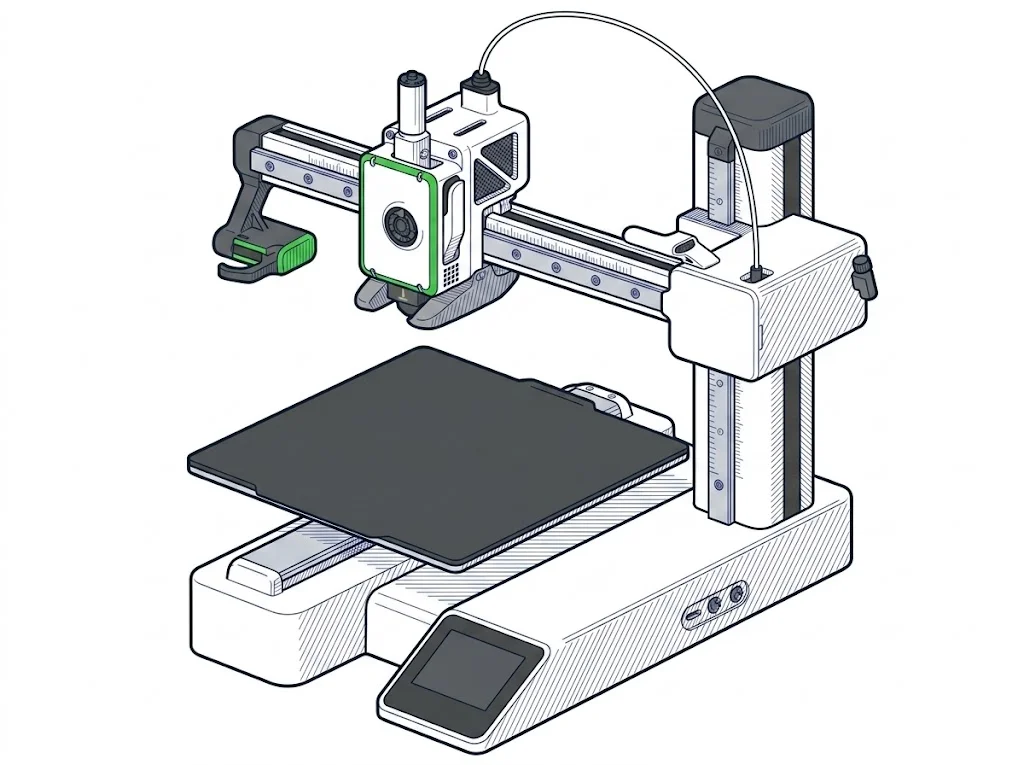
- Print Volume and Footprint: The Anycubic offers a significantly larger build volume of 420x420x500 mm compared to the 180x180x180 mm of the Bambu Lab. This impacts the external dimensions (73.5x64x74 cm and 21 kg for the Anycubic versus 34.7x31.5x36.5 cm and 5.7 kg for the Bambu Lab).
- Multi-color Capability: The Bambu Lab A1 mini supports printing up to 4 colors using a dedicated accessory, whereas the Anycubic Kobra 2 Max is limited to a single color.
- Maximum Temperatures: The Bambu Lab A1 mini reaches a higher nozzle temperature (300°C versus 260°C for the Anycubic), while the Anycubic Kobra 2 Max offers a slightly higher bed temperature (90°C versus 80°C).
- Power Consumption: The required power differs substantially between the two models, with 500W for the Anycubic Kobra 2 Max and 150W for the Bambu Lab A1 mini.
Which one to choose
Choose Kobra 2 Max if…
The Anycubic Kobra 2 Max is the right choice if print volume is your top priority. With a build volume of 420x420x500 mm, it allows for the production of large single-piece parts, managing a power consumption of 500W and a heated bed up to 90°C, though it requires significant installation space due to its 21 kg weight.
Choose A1 mini if…
The Bambu Lab A1 mini is ideal for those who need a compact and efficient machine for multi-color printing (up to 4 colors via an accessory). Despite its reduced build volume of 180x180x180 mm, it features a nozzle that reaches 300°C for greater filament thermal versatility and a declared precision of 50 μm, with a power consumption of just 150W.
Where to buy
Paid link: the price for you does not change. Methodology
As an Amazon Associate I earn from qualifying purchases.
Filaments for these printers
The most chosen spools among the materials both printers can print according to their specifications.
- ELEGOO PLA PLA1.75 mm1 kg Check the price on Amazon →
- Bambu Lab PLA PLA1.75 mm1 kg Check the price on Amazon →
- SUNLU PETG (Polyethylene Terephthalate Glycol) PETG (Polyethylene Terephthalate Glycol)1.75 mm1 kg Check the price on Amazon →
- SUNLU PLA PLA1.75 mm1 kg Check the price on Amazon →
- OVERTURE PETG (Polyethylene Terephthalate Glycol) PETG (Polyethylene Terephthalate Glycol)High speed1.75 mm1 kg Check the price on Amazon →
Paid link: the price for you does not change. Methodology
As an Amazon Associate I earn from qualifying purchases.
MakerSpecs is an independent atlas. We don't sell products: the purchase links are the same as on the two product sheets and don't influence the verdict. The sheets have the complete data.