Prusa Research CORE One+ vs Prusa Research XL Single-toolhead
Technical comparison · Fused filament fabrication (FFF/FDM)
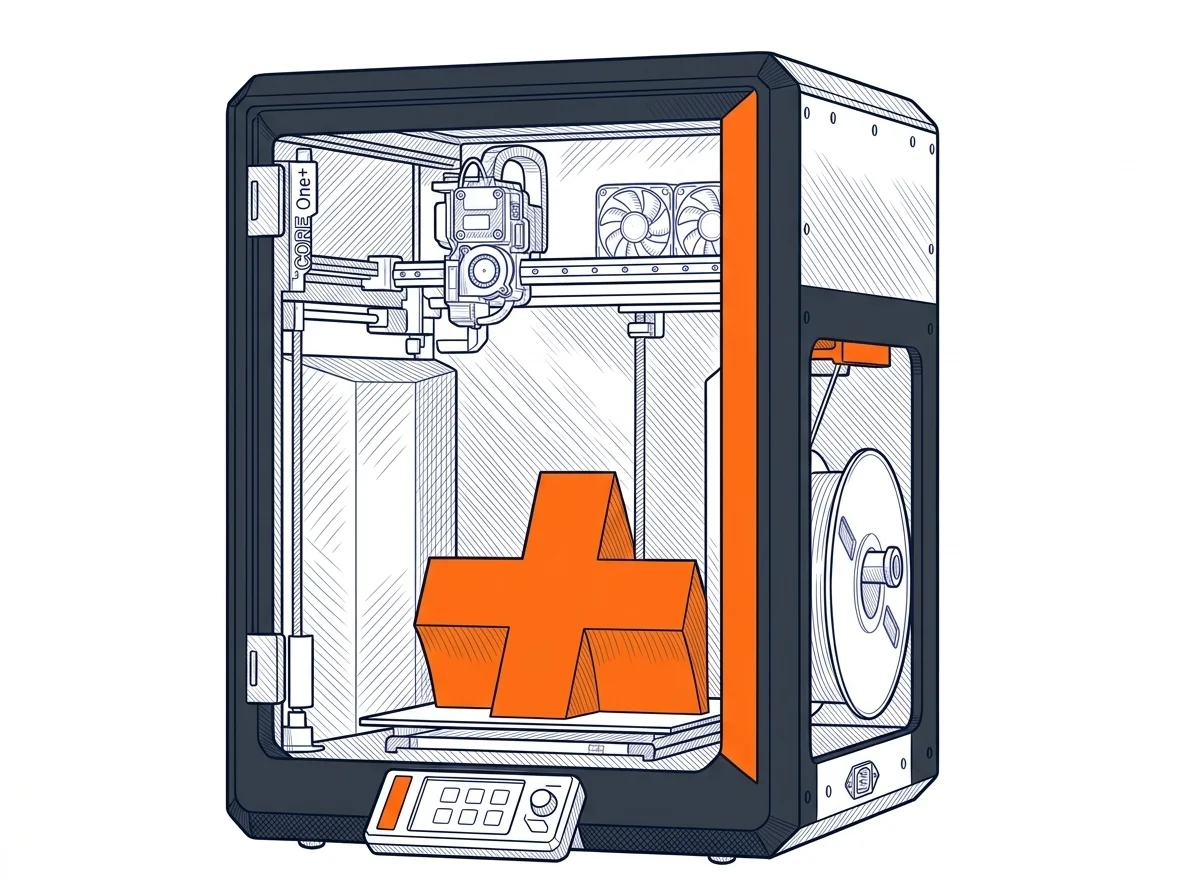
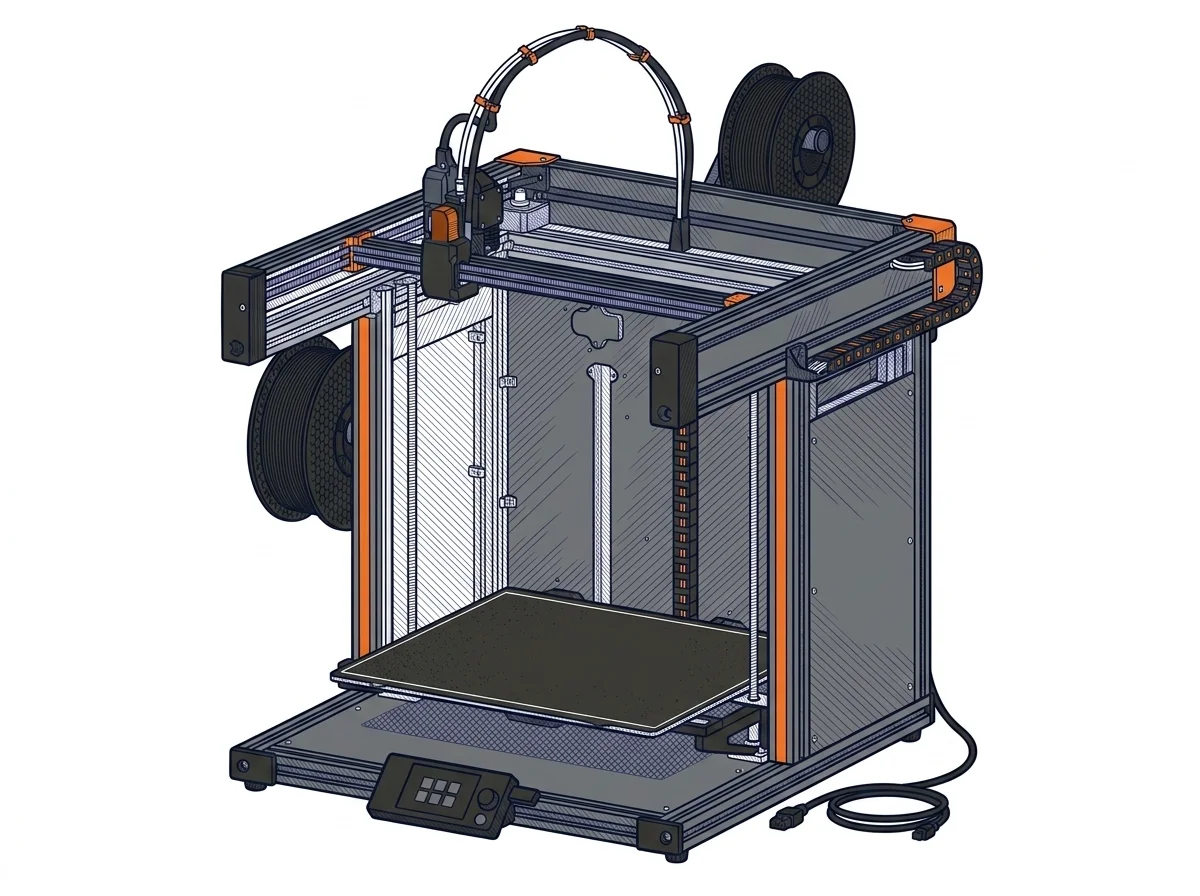
Two CoreXY Prusas with open firmware and PrusaSlicer, on the same level but with very different volumes. The XL prints in a cube 360 mm on a side; the CORE One+ is enclosed and costs about 1,100 € less.
| Parameter | ||
|---|---|---|
| Identity | ||
| Launch year | 2026 | 2025 |
| Use tier | F2 — Intermediate | F2 — Intermediate |
| Price | ||
| Price (€) | ~1049–1349 € | 2299 € |
| Universal specs | ||
| Dimensions (W×D×H) (cm) | 41.5 × 44.4 × 55.5 cm | 70 × 90 × 72 cm |
| Weight (kg) | 22.5 kg | — |
| Work area (mm) | 250 × 220 mm | 360 × 360 mm |
| Z-axis height (mm) | 270 mm | 360 mm |
| Power (W) | 240 W | — |
| Voltage (V) | 230 V | 230 V |
| Maximum speed | — | 400 mm/s |
| Declared precision | — | 0.2 mm |
| Category specs | ||
| Footprint X×Y (short side) (mm) | 220 mm | 360.0 mm |
| Build height Z (mm) | 270 mm | 360.0 mm |
| Kinematics | CoreXY | CoreXY |
| Max nozzle temperature (°C) | 290 °C | 300 °C |
| Max bed temperature (°C) | 120 °C | 100 °C |
| Max print speed (mm/s) | — | 400 mm/s |
| Enclosed chamber | Yes | No |
| Filament sensor | Yes | Yes |
| Auto bed leveling | Mesh | Mesh |
| Standard nozzle diameter (mm) | 0.4 mm | 0.4 mm |
| Multi-extruder | No | Yes |
| Native Klipper | No | No |
| Input shaper | Yes | Yes |
| Multicolor printing | Yes | Yes |
| Multicolor requires accessory | Yes | Yes |
| Max colors | 5 | 5 |
| Ecosystem | ||
| Cloud dependency | No | No |
| Software notes | Natively compatible with PrusaSlicer (based on Slic3r, open-source), but it works with any slicer able to generate Marlin-flavored G-code, such as Cura, ideaMaker or Simplify3D. The firmware is a Prusa-modified Marlin 2, fully open: no lock-in to proprietary software or protocols. The user has full control over the machine, but PrusaSlicer is recommended for optimal performance, as it includes exclusive profiles and features like dynamic flow calibration. | The printer runs Marlin firmware customized by Prusa, heavily influenced by Klipper and natively compatible with PrusaSlicer for tool-change management, Input Shaper, and Pressure Advance. Other slicers such as Cura or Simplify3D produce standard G-code but don't support tool changing or the segmented bed. The G-code protocol is open, and control via OctoPrint or Pronterface is possible. PrusaConnect and Wi-Fi are built in for remote management, while the absence of a locked proprietary ecosystem allows the use of third-party filaments and spare parts. |
The differences that matter
- Price: 1,199 € against 2,299 € → the CORE One+ costs about 1,100 € less.
- Volume: 250×220×270 mm against 360×360×360 mm → a 30 cm part fits only in the XL.
- Chamber: enclosed on the CORE One+, open on the XL → the XL prints with no enclosure around the part.
Which one to choose
Choose CORE One+ if…
you print on a desk, 41.5 × 44.4 cm footprint and 22.5 kg, with an enclosed chamber and a bed up to 120 °C. The trade-off: a part larger than its volume has to be split into pieces.
Choose XL Single-toolhead if…
you print large parts in one go, or prototypes that will not fit the CORE One+. The trade-off: 70 × 90 × 72 cm of footprint needs a dedicated bench, there is no enclosed chamber, the bed stops at 100 °C and the price is higher.
Where to buy
Paid link: the price for you does not change. Methodology
As an Amazon Associate I earn from qualifying purchases.
Filaments for these printers
The most chosen spools among the materials both printers can print according to their specifications.
- ELEGOO PLA PLA1.75 mm1 kg Check the price on Amazon →
- Bambu Lab PLA PLA1.75 mm1 kg Check the price on Amazon →
- SUNLU PETG (Polyethylene Terephthalate Glycol) PETG (Polyethylene Terephthalate Glycol)1.75 mm1 kg Check the price on Amazon →
- SUNLU PLA PLA1.75 mm1 kg Check the price on Amazon →
- OVERTURE PETG (Polyethylene Terephthalate Glycol) PETG (Polyethylene Terephthalate Glycol)High speed1.75 mm1 kg Check the price on Amazon →
Paid link: the price for you does not change. Methodology
As an Amazon Associate I earn from qualifying purchases.
MakerSpecs is an independent atlas. We don't sell products: the purchase links are the same as on the two product sheets and don't influence the verdict. The sheets have the complete data.