Cebora SYNSTAR 400 TS vs Cebora SYNSTAR 330 TC
Technical comparison · MIG/MAG welding (wire feed)
Two three-phase Cebora inverter MIG/MAG welders, both synergic, released five years apart. What decides it is how long you can weld without stopping: at rated current the 400 TS runs the whole time, the 330 TC for 40% of it.
| Parameter | ||
|---|---|---|
| Identity | ||
| Launch year | 2021 | 2016 |
| Use tier | F4 — Semi-professional | F4 — Semi-professional |
| Price | ||
| Price (€) | ~6500–8500 € | ~4500–6000 € |
| Universal specs | ||
| Dimensions (W×D×H) (cm) | 52.7 × 107.8 × 139.8 cm | 51 × 102.2 × 96 cm |
| Weight (kg) | 111 kg | 72 kg |
| Power (W) | 17500 W | 12400 W |
| Voltage (V) | 400 V | 400 V |
| Category specs | ||
| Welding type | Multi-process | Multi-process |
| Max welding current (A) | 400 A | 330 A |
| Max wire diameter (mm) | 1.6 mm | 1.2 mm |
| Duty cycle (rated current) (%) | 100 % | 40 % |
| Synergic control | Yes | Yes |
| Gasless capable | Yes | — |
| Power source technology | Inverter | Inverter |
| Aluminium ready | Yes | Yes |
| Pulse capable | Yes | Yes |
| Input voltage | 400 V (three-phase) | 400 V (three-phase) |
| Supported spool | Ø300 mm (~15 kg) | Ø300 mm (~15 kg) |
| Ecosystem | ||
| Cloud dependency | No | No |
| Software notes | The machine's operating system features advanced synergic control, significantly streamlining the setup of operating parameters. The SYNSTAR 400 TS comes standard with over sixty pre-loaded synergic programs, carefully optimized for various alloys, thicknesses, and wire diameters (iron, aluminum, stainless steel, and flux-cored wire). Users can save their custom settings in the system's memory for quick retrieval during repetitive tasks. The color LCD interface provides a clear and intuitive real-time readout of all welding values. Furthermore, the welder's base software is highly expandable: sophisticated features such as pulsed and double-pulsed welding are available via dedicated software upgrade packages. This modular approach allows the operator to adapt the power source to new and more complex welding requirements over time. | The power source is managed through a 5-inch color LCD touchscreen interface, allowing intuitive control of all welding functions. The operator can easily select parameters, activate MIG Short, pulse, or double pulse functions, and access aluminum-specific features such as Automatic Hot Start and Automatic Crater Filler. System firmware updates are performed quickly and simply via the integrated USB port. It is also pre-arranged for wireless connectivity with personal protective equipment, such as a compatible auto-darkening welding helmet. |

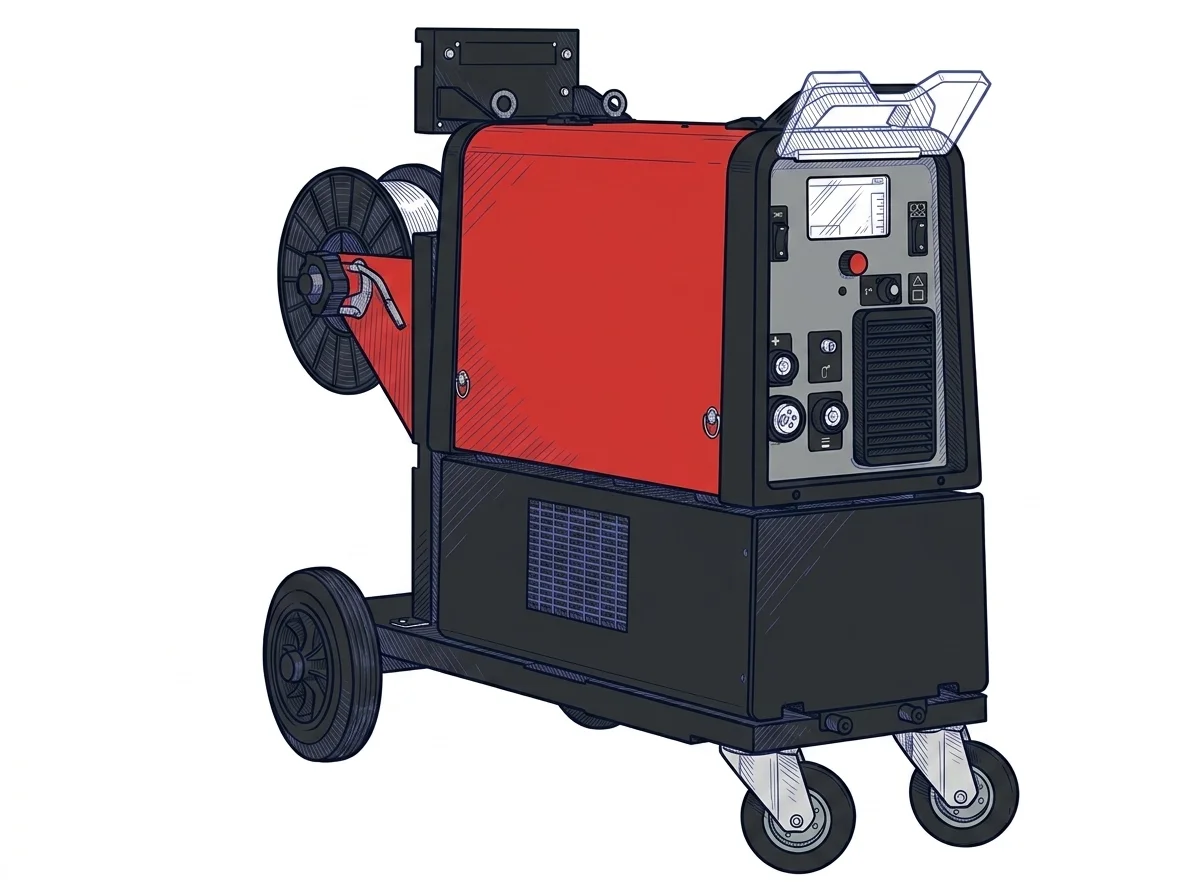
The differences that matter
- Price: about 7,500 € against 5,250 € → the 330 TC costs about 2,250 € less.
- Duty cycle at rated current: 100% against 40% → with the 330 TC a continuous bead means stopping to cool, with the 400 TS it does not.
- Maximum current: 400 A against 330 A (manufacturer's stated values) → the 400 TS leaves more margin for heavy jobs.
Which one to choose
Choose SYNSTAR 400 TS if…
you run long beads or continuous production at rated current with no pauses to let the machine cool, and wire up to 1.6 mm. The trade-off: 111 kg to move and 17.5 kW stated power.
Choose SYNSTAR 330 TC if…
you weld in stretches (single parts, repairs, work with pauses) and want 72 kg, a 5-inch touchscreen, aluminium functions such as automatic hot start and crater filler, and firmware updates over USB. The trade-off: wire up to 1.2 mm, and at rated current the machine has to rest for the rest of the time.
Where to buy
Paid link: the price for you does not change. Methodology
As an Amazon Associate I earn from qualifying purchases.
MakerSpecs is an independent atlas. We don't sell products: the purchase links are the same as on the two product sheets and don't influence the verdict. The sheets have the complete data.