Cebora Pocket Pulse vs Cebora SYNSTAR 270 T SRS
Technical comparison · MIG/MAG welding (wire feed)
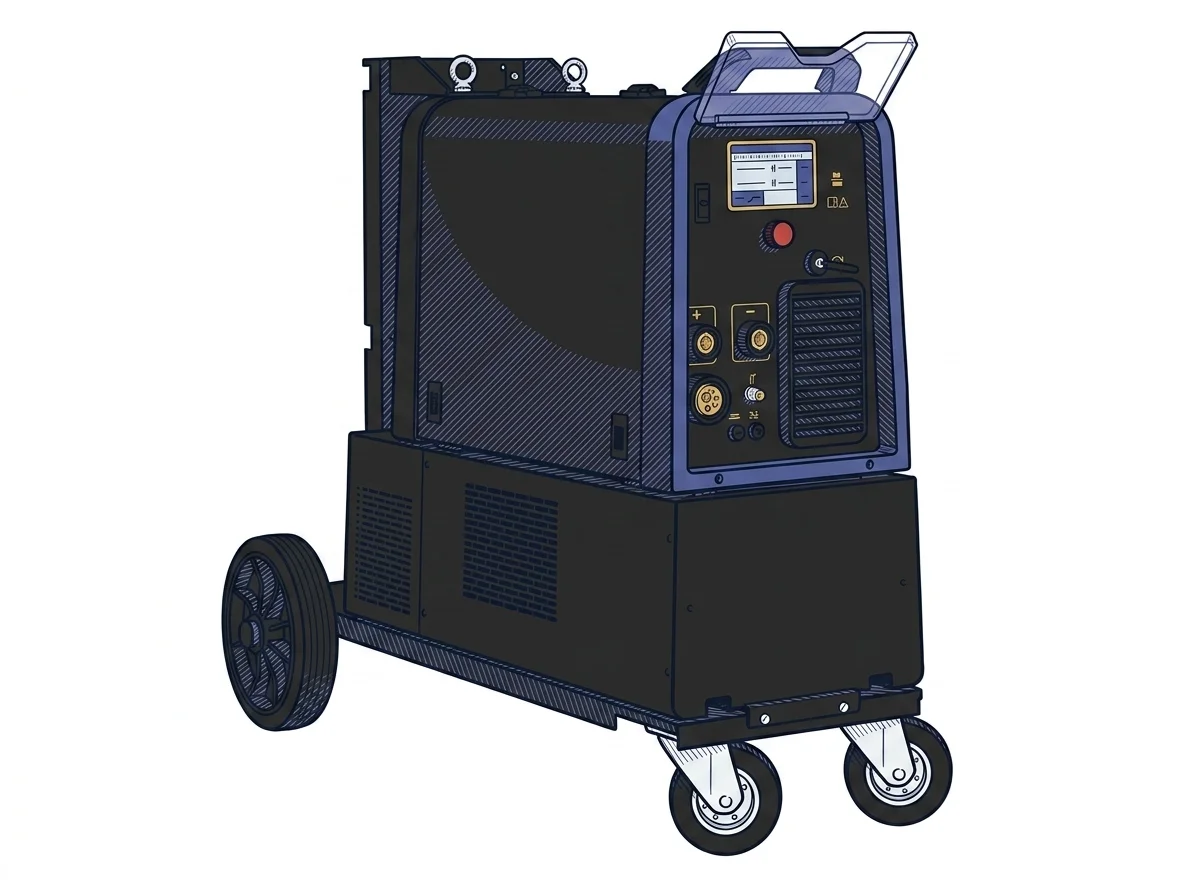
Two inverter MIG/MAG welders with synergic control, for steel and aluminium work. Power supply separates them: the Pocket Pulse runs on a single-phase 230 V socket, the SYNSTAR 270 T SRS needs three-phase 400 V.
| Parameter | ||
|---|---|---|
| Identity | ||
| Use tier | F3 — Advanced | F3 — Advanced |
| Price | ||
| Price (€) | ~1500–1800 € | ~3500–4500 € |
| Universal specs | ||
| Dimensions (W×D×H) (cm) | 19.6 × 45.8 × 38 cm | 51 × 102 × 86.5 cm |
| Weight (kg) | 13.5 kg | 68 kg |
| Power (W) | 5500 W | 9300 W |
| Voltage (V) | 230 V | 400 V |
| Category specs | ||
| Welding type | MIG/MAG | MIG/MAG |
| Max welding current (A) | 185 A | 270 A |
| Max wire diameter (mm) | 1 mm | 1.2 mm |
| Synergic control | Yes | Yes |
| Gasless capable | Yes | — |
| Power source technology | Inverter | Inverter |
| Aluminium ready | Yes | Yes |
| Pulse capable | Yes | — |
| Input voltage | 230 V (single-phase) | 400 V (three-phase) |
| Supported spool | Ø200 mm (~5 kg) | Ø300 mm (~15 kg) |
| Ecosystem | ||
| Cloud dependency | No | No |
| Software notes | The machine is controlled via an integrated LCD panel that displays three lines of simultaneous information: wire and gas type, current and material thickness, voltage, and wire feed speed. The system includes 37 pre-loaded synergic curves that optimize welding parameters based on the material, significantly streamlining the initial setup. It also features specific functions dedicated to aluminum welding, such as automatic Hot Start and Crater Filler for a perfect weld bead closure. | The power source features an advanced synergic control system that significantly simplifies initial setup, offering numerous pre-loaded curves for welding various alloys. The standout software feature is the integration of the exclusive Spatter Reduction System (SRS). This proprietary Cebora algorithm constantly monitors arc parameters in real-time, dynamically optimizing metal transfer to drastically reduce the formation of spatter. This advanced electronic control minimizes post-weld cleanup time and ensures cleaner weld beads, while interacting smoothly with the operator through an intuitive and comprehensive digital control panel. |

The differences that matter
- Power supply → single-phase 230 V against three-phase 400 V: the SYNSTAR needs a matching installation, the Pocket Pulse plugs into single-phase.
- Current → 185 A against 270 A (manufacturer's stated values): more current in hand for thicker work on the SYNSTAR.
- Price → about €1,650 against €4,000: the SYNSTAR costs about €2,350 more.
Which one to choose
Choose Pocket Pulse if…
you weld in a shop without three-phase, or carry the machine with you: 13.5 kg and a 20 × 46 cm footprint. With 37 pre-loaded synergic curves and aluminium functions (Hot Start and crater filler) you start with few adjustments, and it costs about €2,350 less. The trade-off: a 200 mm spool (about 5 kg), wire up to 1 mm and less current available.
Choose SYNSTAR 270 T SRS if…
you weld often and for long stretches: a 300 mm spool (about 15 kg) that needs changing less, wire up to 1.2 mm and more current in reserve. The SRS system cuts spatter and so the cleaning after welding. It costs about €2,350 more, weighs 68 kg and takes up 51 × 102 cm.
Where to buy
MakerSpecs is an independent atlas. We don't sell products: the purchase links are the same as on the two product sheets and don't influence the verdict. The sheets have the complete data.