Prusa Research CORE One+ vs Prusa Research XL 5-toolhead
Technical comparison · Fused filament fabrication (FFF/FDM)
Choose the Prusa CORE One+ if you are looking for a compact machine with a native enclosed chamber at a price below €1350. Choose the Prusa XL 5-toolhead if you need a larger build volume and a native multi-extruder system without external accessories.
| Parameter | ||
|---|---|---|
| Identity | ||
| Launch year | 2026 | 2023 |
| Use tier | F2 — Intermediate | F2 — Intermediate |
| Price | ||
| Price (€) | ~1049–1349 € | 3999 € |
| Universal specs | ||
| Dimensions (W×D×H) (cm) | 41.5 × 44.4 × 55.5 cm | 70 × 90 × 72 cm |
| Weight (kg) | 22.5 kg | 33.7 kg |
| Work area (mm) | 250 × 220 mm | 360 × 360 mm |
| Z-axis height (mm) | 270 mm | 360 mm |
| Power (W) | 240 W | 235 W |
| Voltage (V) | 230 V | 230 V |
| Maximum speed | — | 400 mm/s |
| Declared precision | — | 0.2 mm |
| Category specs | ||
| Footprint X×Y (short side) (mm) | 220 mm | 360 mm |
| Build height Z (mm) | 270 mm | 360 mm |
| Kinematics | CoreXY | CoreXY |
| Max nozzle temperature (°C) | 290 °C | 290 °C |
| Max bed temperature (°C) | 120 °C | 120 °C |
| Max print speed (mm/s) | — | 400 mm/s |
| Enclosed chamber | Yes | No |
| Filament sensor | Yes | Yes |
| Auto bed leveling | Mesh | Mesh |
| Standard nozzle diameter (mm) | 0.4 mm | 0.4 mm |
| Multi-extruder | No | Yes |
| Native Klipper | No | No |
| Input shaper | Yes | Yes |
| Multicolor printing | Yes | Yes |
| Multicolor requires accessory | Yes | No |
| Max colors | 5 | 5 |
| Ecosystem | ||
| Cloud dependency | No | No |
| Software notes | Natively compatible with PrusaSlicer (based on Slic3r, open-source), but it works with any slicer able to generate Marlin-flavored G-code, such as Cura, ideaMaker or Simplify3D. The firmware is a Prusa-modified Marlin 2, fully open: no lock-in to proprietary software or protocols. The user has full control over the machine, but PrusaSlicer is recommended for optimal performance, as it includes exclusive profiles and features like dynamic flow calibration. | The machine is managed through PrusaSlicer, with dedicated profiles for multi-toolhead configuration and automatic calculation of purge towers or wipe-to-infill strategies. The firmware includes Input Shaper and Pressure Advance for vibration compensation at high speeds. Network connectivity allows job submission and remote monitoring via Prusa Connect, though this is not a requirement for using the machine. |
The differences that matter
- Price and positioning: The CORE One+ is positioned in an estimated price range between €1049 and €1349, whereas the XL 5-toolhead requires an investment of €3999.
- Volume and footprint: The XL offers a build area of 360 × 360 × 360 mm with a weight of 33.7 kg, compared to 250 × 220 × 270 mm and 22.5 kg for the CORE One+.
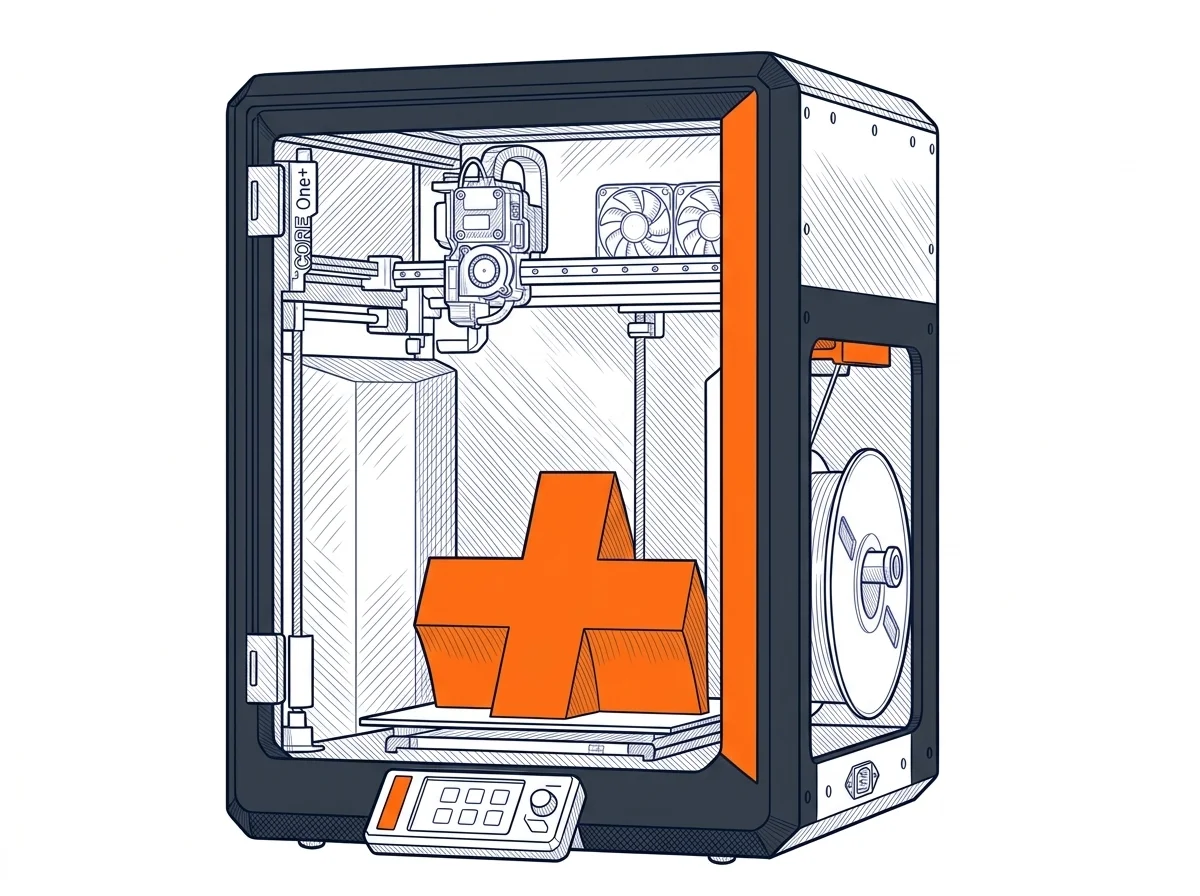
- Print chamber: The CORE One+ features a native enclosed chamber, which is absent on the XL model.
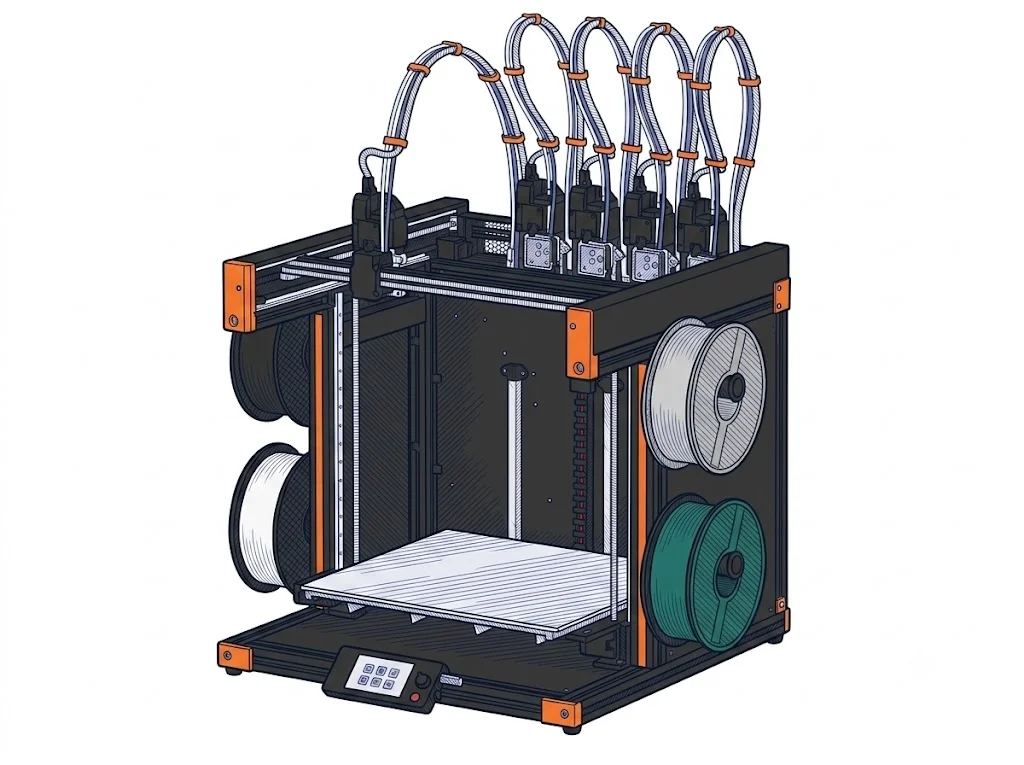
- Multicolor management: The XL integrates a native multi-extruder system for up to 5 colors, while the CORE One+ is a single-extruder machine that requires an external accessory to reach 5 colors.
Which one to choose
Choose CORE One+ if…
The Prusa CORE One+ is the right choice for users who need a 2026 3D printer with a small footprint (41.5 × 44.4 × 55.5 cm) and a standard enclosed chamber for print thermal management, while keeping a limited economic investment between €1049 and €1349.
Choose XL 5-toolhead if…
The Prusa XL 5-toolhead is suitable for those requiring an expanded build area (360 × 360 × 360 mm) and native multicolor management up to 5 colors through a true multi-extruder system, with a price of €3999 and dimensions of 70 × 90 × 72 cm.
Where to buy
Paid link: the price for you does not change. Methodology
As an Amazon Associate I earn from qualifying purchases.
Filaments for these printers
The most chosen spools among the materials both printers can print according to their specifications.
- ELEGOO PLA PLA1.75 mm1 kg Check the price on Amazon →
- Bambu Lab PLA PLA1.75 mm1 kg Check the price on Amazon →
- SUNLU PETG (Polyethylene Terephthalate Glycol) PETG (Polyethylene Terephthalate Glycol)1.75 mm1 kg Check the price on Amazon →
- SUNLU PLA PLA1.75 mm1 kg Check the price on Amazon →
- OVERTURE PETG (Polyethylene Terephthalate Glycol) PETG (Polyethylene Terephthalate Glycol)High speed1.75 mm1 kg Check the price on Amazon →
Paid link: the price for you does not change. Methodology
As an Amazon Associate I earn from qualifying purchases.
MakerSpecs is an independent atlas. We don't sell products: the purchase links are the same as on the two product sheets and don't influence the verdict. The sheets have the complete data.