Bambu Lab A1 mini vs Elegoo OrangeStorm Giga
Technical comparison · Fused filament fabrication (FFF/FDM)
A1 mini and OrangeStorm Giga are not direct competitors: very different prices (~10.5×). A1 mini costs less (~€299) and is the entry-level choice; OrangeStorm Giga offers more capability at a higher price (~€3150). Judge them by budget, not head-to-head.
| Parameter |
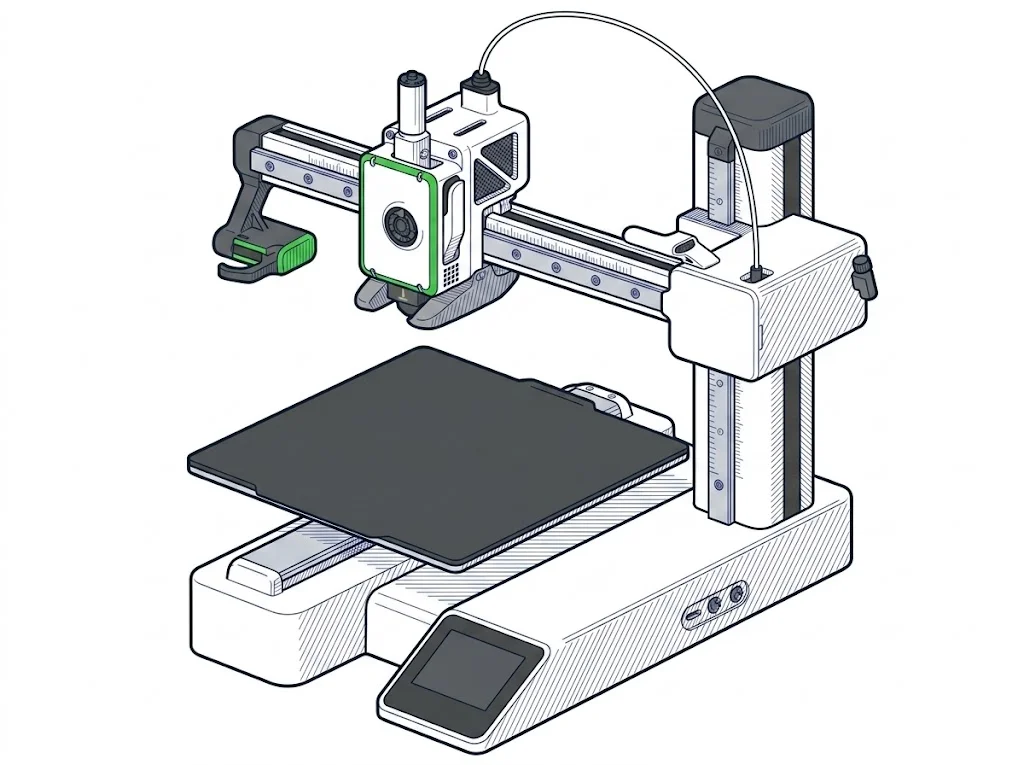 A1 mini
Bambu Lab
F2 · Intermediate
A1 mini
Bambu Lab
F2 · Intermediate
|
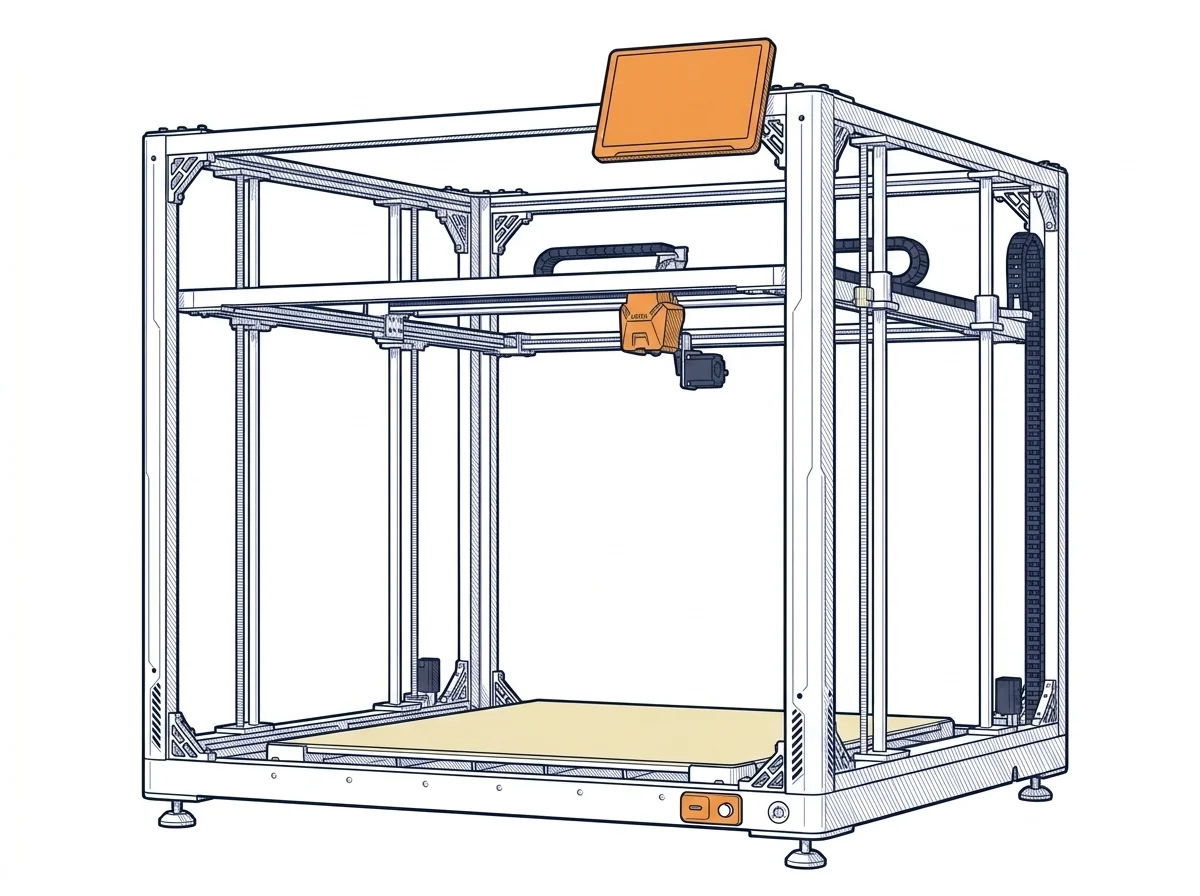 OrangeStorm Giga
Elegoo
F3 · Advanced
OrangeStorm Giga
Elegoo
F3 · Advanced
|
|---|---|---|
| Awards | — | |
| Identity | ||
| Launch year | 2023 | 2024 |
| Use tier | F2 — Intermediate | F3 — Advanced |
| Price | ||
| Price (€) | 299 € | ~2800–3500 € |
| Universal specs | ||
| Dimensions (W×D×H) (cm) | 34.7 × 31.5 × 36.5 cm | 122.4 × 120.4 × 142.5 cm |
| Weight (kg) | 5.7 kg | 104 kg |
| Work area (mm) | 180 × 180 mm | 800 × 800 mm |
| Z-axis height (mm) | 180 mm | 1000 mm |
| Power (W) | 150 W | 1530 W |
| Voltage (V) | — | 230 V |
| Maximum speed | 500 mm/s | 300 mm/s |
| Declared precision | 50 μm | 0.1 mm |
| Category specs | ||
| Footprint X×Y (short side) (mm) | 180 mm | 800 mm |
| Build height Z (mm) | 180 mm | 1000 mm |
| Kinematics | Cartesian | Cartesian |
| Max nozzle temperature (°C) | 300 °C | 300 °C |
| Max bed temperature (°C) | 80 °C | 100 °C |
| Max print speed (mm/s) | 500 mm/s | 300 mm/s |
| Enclosed chamber | false | False |
| Filament sensor | true | True |
| Auto bed leveling | Mesh | Mesh |
| Standard nozzle diameter (mm) | 0.4 mm | 0.6 mm |
| Multi-extruder | false | False |
| Native Klipper | false | True |
| Input shaper | true | True |
| Multicolor printing | true | False |
| Multicolor requires accessory | true | True |
| Max colors | 4 | 4 |
| Ecosystem | ||
| Cloud dependency | No | No |
| Software notes | Compatible with Bambu Studio (OrcaSlicer-derived) and OrcaSlicer. Supports LAN mode for cloud-free printing. Does not run native Klipper. | The system is powered by Klipper-based firmware, processed by a 64-bit quad-core SoC, enabling speeds up to 300 mm/s. Connectivity is comprehensive, offering USB, Ethernet, and Wi-Fi ports for the remote management of massive G-code files. The user interface is accessible via a generous 10.1-inch capacitive touchscreen, which is detachable from the chassis for comfortable positioning. The machine is best managed using the Elegoo Cura slicer but supports standard STL and OBJ formats, allowing broad workflow flexibility without any dependence on cloud platforms. |
MakerSpecs Awards
Nessun riconoscimento in questa fascia.
Largest work area Advanced
The largest work area among advanced Fused filament fabrication (FFF/FDM) machines: 6400 cm².
How we assign awards →The differences that matter
- Price: A1 mini 299 € vs OrangeStorm Giga 3150 € — A1 mini wins (+954%)
- Work area: A1 mini 180×180 mm vs OrangeStorm Giga 800×800 mm — OrangeStorm Giga wins (+1875%)
- Build height Z: A1 mini 180 mm vs OrangeStorm Giga 1000 mm — OrangeStorm Giga wins (+456%)
- Max print speed: A1 mini 500 mm/s vs OrangeStorm Giga 300 mm/s — A1 mini wins (+67%)
- Native Klipper: OrangeStorm Giga yes, A1 mini no
Which one to choose
Choose A1 mini if…
you value price, max print speed and multicolor printing.
Choose OrangeStorm Giga if…
you value work area, build height z and native klipper. It is the one with the largest build area in its class.
MakerSpecs is an independent atlas. We don't sell products: this comparison links to both sheets, where you'll find complete data and official links.