Creality K1C vs Snapmaker U1
Technical comparison · Fused filament fabrication (FFF/FDM)
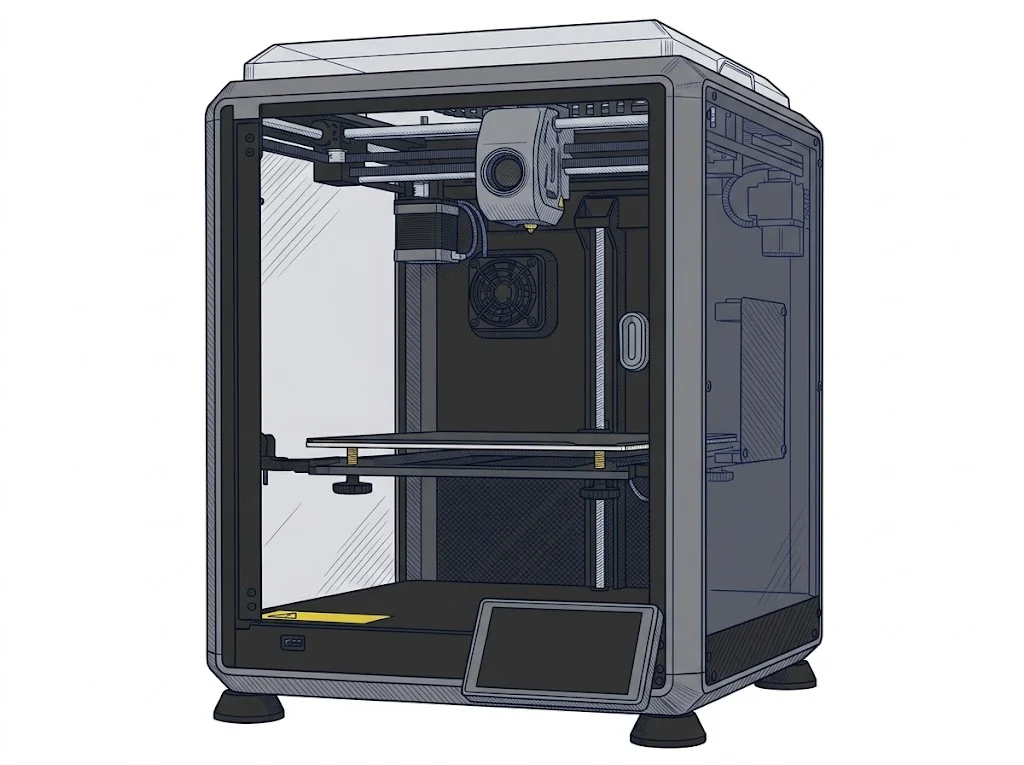
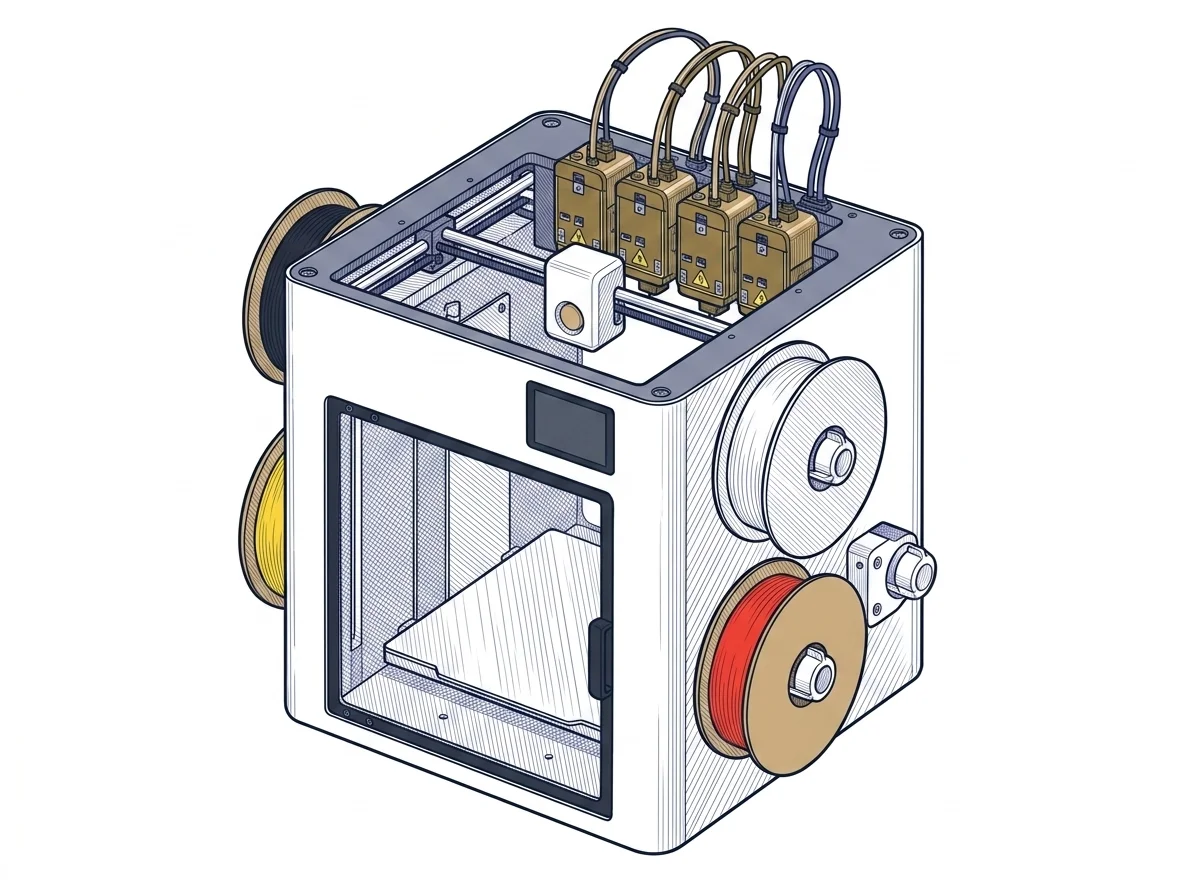
Creality K1C and Snapmaker U1 sit within €250 of each other and both run native Klipper, but the K1C closes its chamber while the U1 adds a bigger bed and native multicolor without extra hardware. The choice comes down to technical materials versus part size.
| Parameter | ||
|---|---|---|
| Identity | ||
| Launch year | 2024 | 2026 |
| Use tier | F2 — Intermediate | F2 — Intermediate |
| Price | ||
| Price (€) | 599 € | 849 € |
| Universal specs | ||
| Dimensions (W×D×H) (cm) | 35.5 × 35.5 × 48.2 cm | 58.4 × 49.9 × 73 cm |
| Weight (kg) | 12.4 kg | 18.2 kg |
| Work area (mm) | 220 × 220 mm | 270 × 270 mm |
| Z-axis height (mm) | 250 mm | 270 mm |
| Power (W) | 350 W | 1150 W |
| Maximum speed | 600 mm/s | 500 mm/s |
| Declared precision | 100 μm | 0.04 mm |
| Category specs | ||
| Footprint X×Y (short side) (mm) | 220 mm | 270 mm |
| Build height Z (mm) | 250 mm | 270 mm |
| Kinematics | CoreXY | CoreXY |
| Max nozzle temperature (°C) | 300 °C | 300 °C |
| Max bed temperature (°C) | 100 °C | 100 °C |
| Max print speed (mm/s) | 600 mm/s | 500 mm/s |
| Enclosed chamber | Yes | No |
| Filament sensor | Yes | Yes |
| Auto bed leveling | Mesh | Mesh |
| Standard nozzle diameter (mm) | 0.4 mm | 0.4 mm |
| Multi-extruder | No | Yes |
| Native Klipper | Yes | Yes |
| Input shaper | Yes | Yes |
| Multicolor printing | No | Yes |
| Multicolor requires accessory | Yes | No |
| Max colors | 4 | 4 |
| Ecosystem | ||
| Cloud dependency | No | No |
| Software notes | Uses Creality Print, an optimized proprietary slicer. Fully compatible with third-party software such as Orca Slicer and PrusaSlicer. | The primary software is Snapmaker Orca, an optimized version of the popular OrcaSlicer, which provides native management of the four toolheads and factory-calibrated material profiles. The printer can also be seamlessly managed via the Snapmaker mobile app for remote monitoring, taking advantage of the built-in 1080p camera. The internal firmware is built on Klipper, Moonraker, and Fluidd, which Snapmaker has made open-source, allowing experienced users to customize the machine and integrate it into complex workflows. |
The differences that matter
- Enclosed chamber only on the K1C: decides how well ABS and draft-sensitive materials hold up.
- Bed size: 270×270 mm on the U1 against 220×220 mm on the K1C.
- Native multicolor only on the U1, no extra hardware; the K1C would need an accessory that isn't included.
- Price: €599 for the K1C against €849 for the U1.
- Higher rated speed on the K1C (600 mm/s vs 500), a difference that only shows on simple geometry.
Which one to choose
Choose K1C if…
The enclosed chamber keeps ABS away from drafts, and the rated 600 mm/s — higher than the U1's — helps on repeat runs of simple parts. The price, roughly €250 below the U1, leaves room for accessories or technical filament.
Choose U1 if…
A 270×270 mm bed beats the K1C's 220×220 mm, useful for bulkier single parts. The U1's four toolheads add native multicolor, something the K1C would need external hardware for that isn't included: anyone printing multicolor often skips a step here.
Where to buy
Paid link: the price for you does not change. Methodology
Filaments for these printers
The most chosen spools among the materials both printers can print according to their specifications.
- ELEGOO PLA PLA1.75 mm1 kg Check the price on Amazon →
- Bambu Lab PLA PLA1.75 mm1 kg Check the price on Amazon →
- SUNLU PETG (Polyethylene Terephthalate Glycol) PETG (Polyethylene Terephthalate Glycol)1.75 mm1 kg Check the price on Amazon →
- SUNLU PLA PLA1.75 mm1 kg Check the price on Amazon →
- OVERTURE PETG (Polyethylene Terephthalate Glycol) PETG (Polyethylene Terephthalate Glycol)High speed1.75 mm1 kg Check the price on Amazon →
Paid link: the price for you does not change. Methodology
As an Amazon Associate I earn from qualifying purchases.
MakerSpecs is an independent atlas. We don't sell products: the purchase links are the same as on the two product sheets and don't influence the verdict. The sheets have the complete data.