Creality K1C vs Qidi Tech X-Max 3
Technical comparison · Fused filament fabrication (FFF/FDM)
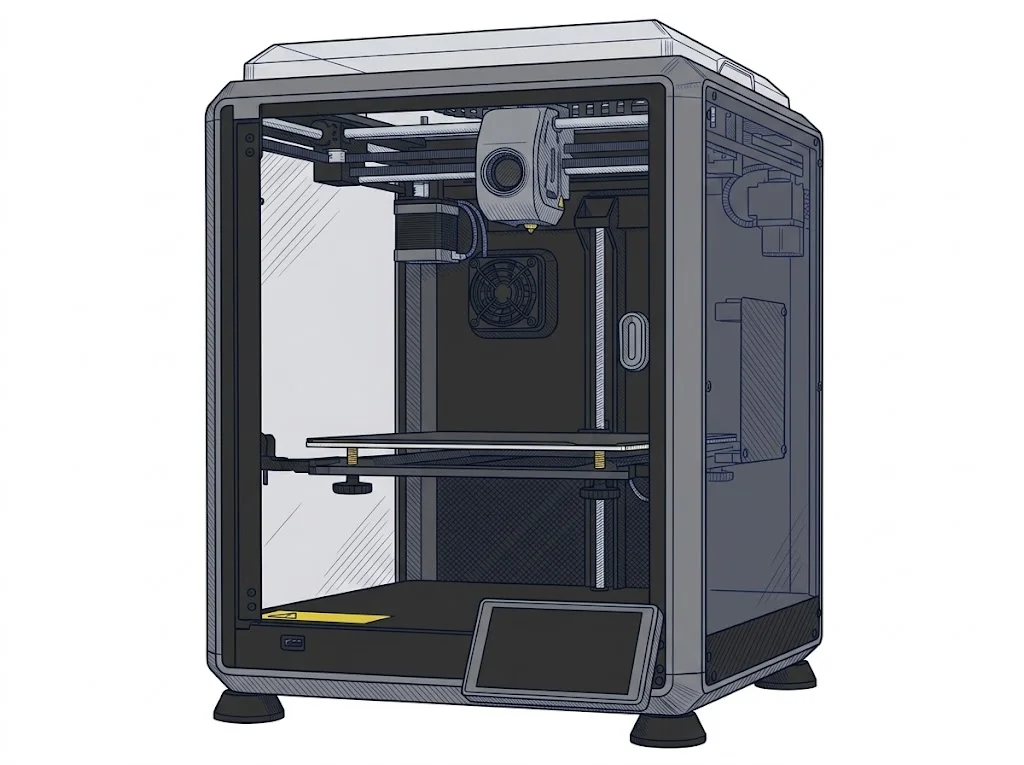
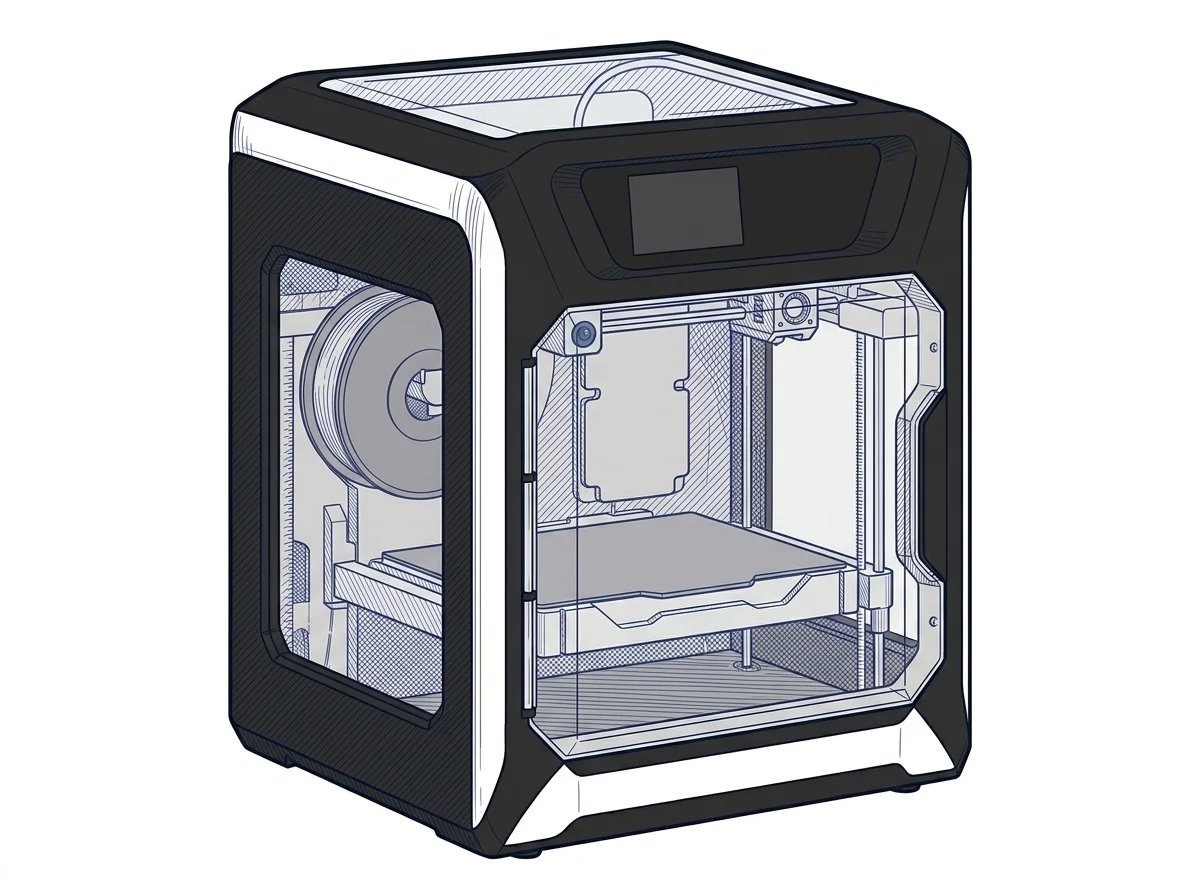
K1C and X-Max 3 3D Printer share a price tier but not a footprint: the K1C leans on compactness and multicolor, the X-Max 3 3D Printer on a build volume nearly triple the size and higher temperatures for technical materials. The pick depends on the size of the parts you print more than on price.
| Parameter | ||
|---|---|---|
| Identity | ||
| Launch year | 2024 | 2023 |
| Use tier | F2 — Intermediate | F2 — Intermediate |
| Price | ||
| Price (€) | 599 € | ~799–999 € |
| Universal specs | ||
| Dimensions (W×D×H) (cm) | 35.5 × 35.5 × 48.2 cm | 55.3 × 55.3 × 60.1 cm |
| Weight (kg) | 12.4 kg | 30.2 kg |
| Work area (mm) | 220 × 220 mm | 325 × 325 mm |
| Z-axis height (mm) | 250 mm | 315 mm |
| Power (W) | 350 W | — |
| Maximum speed | 600 mm/s | 600 mm/s |
| Declared precision | 100 μm | — |
| Category specs | ||
| Footprint X×Y (short side) (mm) | 220 mm | 325 mm |
| Build height Z (mm) | 250 mm | 315 mm |
| Kinematics | CoreXY | CoreXY |
| Max nozzle temperature (°C) | 300 °C | 350 °C |
| Max bed temperature (°C) | 100 °C | 120 °C |
| Max print speed (mm/s) | 600 mm/s | 600 mm/s |
| Enclosed chamber | Yes | Yes |
| Filament sensor | Yes | Yes |
| Auto bed leveling | Mesh | Mesh |
| Standard nozzle diameter (mm) | 0.4 mm | 0.4 mm |
| Multi-extruder | No | No |
| Native Klipper | Yes | Yes |
| Input shaper | Yes | Yes |
| Multicolor printing | No | No |
| Multicolor requires accessory | Yes | — |
| Max colors | 4 | 1 |
| Ecosystem | ||
| Cloud dependency | No | No |
| Software notes | Uses Creality Print, an optimized proprietary slicer. Fully compatible with third-party software such as Orca Slicer and PrusaSlicer. | The system relies on an architecture based on native Klipper firmware, a configuration that guarantees advanced kinematics management and precise control of accelerations through input shaping algorithms. The local and remote user interface is managed fluidly, allowing full monitoring of print parameters without the need to depend on mandatory external cloud services. For file preparation, the machine supports the main slicing software available on the market, including Qidi Print, OrcaSlicer, and PrusaSlicer, offering optimized profiles to enhance production times and the surface quality of components. Connectivity options include wired network and Wi-Fi, facilitating the integration of the device into local networks of laboratories or digital workshops. |
The differences that matter
- Work area: 325×325 mm on the X-Max 3 3D Printer vs 220×220 mm on the K1C — nearly double per side.
- Price: €599 for the K1C vs €899 for the X-Max 3 3D Printer.
- Multicolor: up to 4 colors with an accessory on the K1C, single color on the X-Max 3 3D Printer.
- Z height: 315 mm on the X-Max 3 3D Printer vs 250 mm on the K1C.
- Nozzle temperature: 350°C on the X-Max 3 3D Printer vs 300°C on the K1C.
Which one to choose
Choose K1C if…
Pick the K1C if multicolor or workshop space matters: up to 4 colors with an accessory, a compact footprint (220×220 mm) and a lower price (€599 vs €899).
Choose X-Max 3 if…
Pick the X-Max 3 3D Printer if you print large parts in one piece: a 325×325 mm bed and 315 mm of Z height clearly beat the K1C's 220×220×250 mm. The nozzle also reaches 350°C, useful for technical filaments the K1C, capped at 300°C, doesn't handle the same way.
Where to buy
Paid link: the price for you does not change. Methodology
As an Amazon Associate I earn from qualifying purchases.
Filaments for these printers
The most chosen spools among the materials both printers can print according to their specifications.
- ELEGOO PLA PLA1.75 mm1 kg Check the price on Amazon →
- Bambu Lab PLA PLA1.75 mm1 kg Check the price on Amazon →
- SUNLU PETG (Polyethylene Terephthalate Glycol) PETG (Polyethylene Terephthalate Glycol)1.75 mm1 kg Check the price on Amazon →
- SUNLU PLA PLA1.75 mm1 kg Check the price on Amazon →
- OVERTURE PETG (Polyethylene Terephthalate Glycol) PETG (Polyethylene Terephthalate Glycol)High speed1.75 mm1 kg Check the price on Amazon →
Paid link: the price for you does not change. Methodology
As an Amazon Associate I earn from qualifying purchases.
MakerSpecs is an independent atlas. We don't sell products: the purchase links are the same as on the two product sheets and don't influence the verdict. The sheets have the complete data.