Creality K1 vs Elegoo Neptune 4 Max
Technical comparison · Fused filament fabrication (FFF/FDM)
K1 and Neptune 4 Max are two fused filament fabrication (fff/fdm) in a similar class. Choose K1 if price matters more; choose Neptune 4 Max if work area and build height z matters more.
| Parameter |
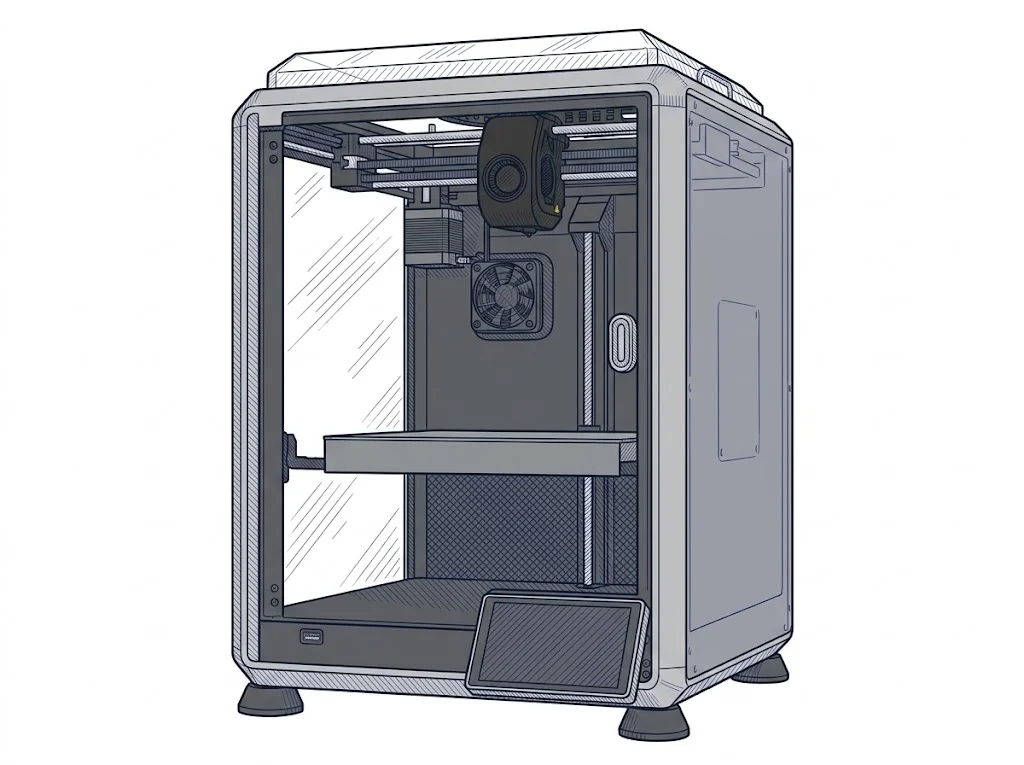 K1
Creality
F2 · Intermediate
K1
Creality
F2 · Intermediate
|
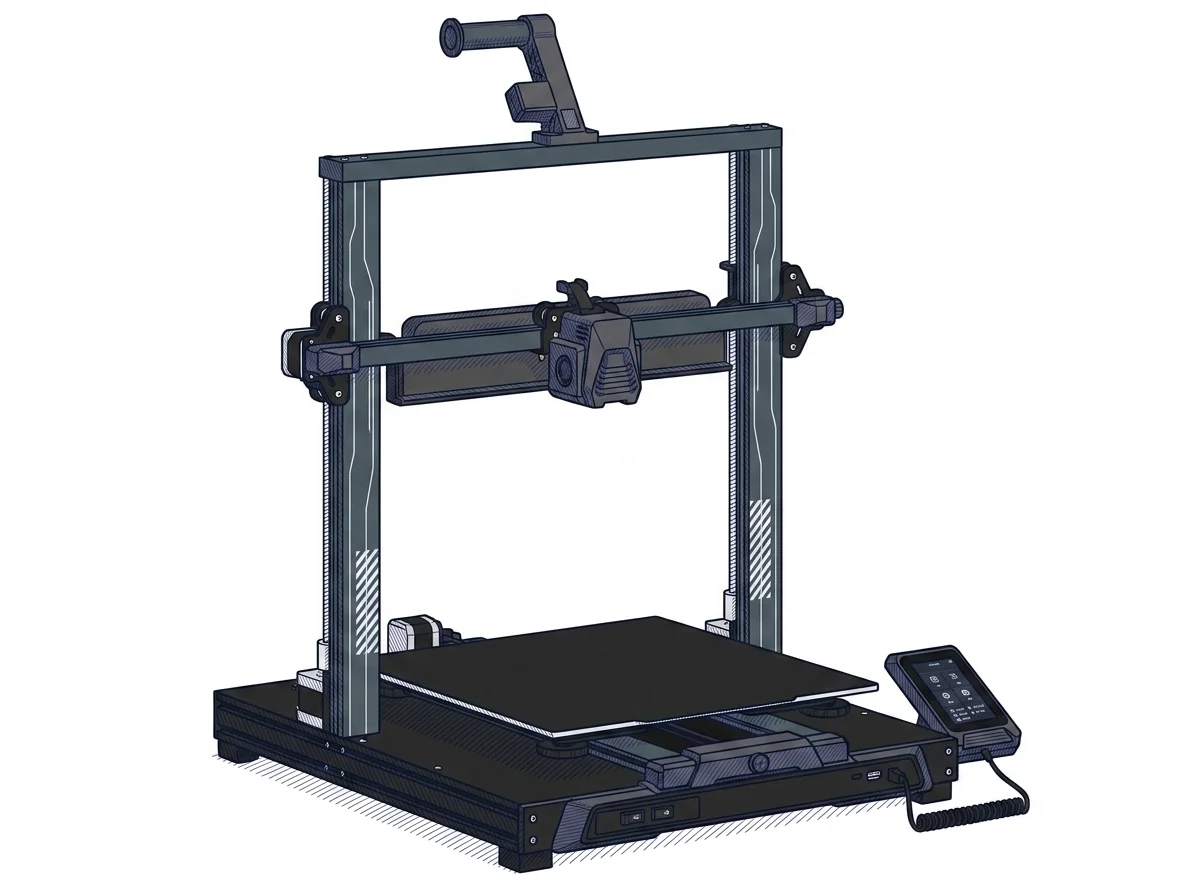 Neptune 4 Max
Elegoo
F2 · Intermediate
Neptune 4 Max
Elegoo
F2 · Intermediate
|
|---|---|---|
| Identity | ||
| Launch year | 2023 | 2023 |
| Use tier | F2 — Intermediate | F2 — Intermediate |
| Price | ||
| Price (€) | 329 € | 549 € |
| Price updated on | 06/2026 | — |
| Universal specs | ||
| Dimensions (W×D×H) (cm) | 35.5 × 35.5 × 48 cm | 65.8 × 63.2 × 74 cm |
| Weight (kg) | 9.6 kg | 18.1 kg |
| Work area (mm) | 220 × 220 mm | 420 × 420 mm |
| Z-axis height (mm) | 250 mm | 480 mm |
| Power (W) | 350 W | — |
| Maximum speed | 600 mm/s | 500 mm/s |
| Declared precision | 0.1 mm | 0.1 mm |
| Category specs | ||
| Footprint X×Y (short side) (mm) | 220 mm | 420 mm |
| Build height Z (mm) | 250 mm | 480 mm |
| Kinematics | CoreXY | Cartesian |
| Max nozzle temperature (°C) | 300 °C | 300 °C |
| Max bed temperature (°C) | 100 °C | 85 °C |
| Max print speed (mm/s) | 600 mm/s | 500 mm/s |
| Enclosed chamber | true | False |
| Filament sensor | true | True |
| Auto bed leveling | Mesh | Mesh |
| Standard nozzle diameter (mm) | 0.4 mm | 0.4 mm |
| Multi-extruder | false | False |
| Native Klipper | true | True |
| Input shaper | true | True |
| Multicolor printing | false | False |
| Multicolor requires accessory | — | False |
| Max colors | — | 1 |
| Ecosystem | ||
| Cloud dependency | No | No |
| Software notes | Pre-installed Klipper firmware with Creality OS interface. Wi-Fi connectivity and built-in 4.3" touch screen. | The system relies on an open ecosystem thanks to the motherboard with pre-installed Klipper. Users can manage the machine both through the 4.3-inch capacitive touchscreen interface and via local network using the integrated web interface (Fluidd). Elegoo provides its own customized version of the Cura slicer, but the printer remains fully compatible with most third-party slicers such as PrusaSlicer, OrcaSlicer, and Simplify3D. Native support for Wi-Fi and LAN connectivity facilitates sending and monitoring G-code files without the need for physical media. |
The differences that matter
- Work area: K1 220×220 mm vs Neptune 4 Max 420×420 mm — Neptune 4 Max wins (+264%)
- Price: K1 329 € vs Neptune 4 Max 549 € — K1 wins (+67%)
- Build height Z: K1 250 mm vs Neptune 4 Max 480 mm — Neptune 4 Max wins (+92%)
- Enclosed chamber: K1 yes, Neptune 4 Max no
- Max print speed: K1 600 mm/s vs Neptune 4 Max 500 mm/s — K1 wins (+20%)
Which one to choose
MakerSpecs is an independent atlas. We don't sell products: this comparison links to both sheets, where you'll find complete data and official links.