Creality Ender-3 V3 SE vs Elegoo Neptune 3 Pro
Technical comparison · Fused filament fabrication (FFF/FDM)
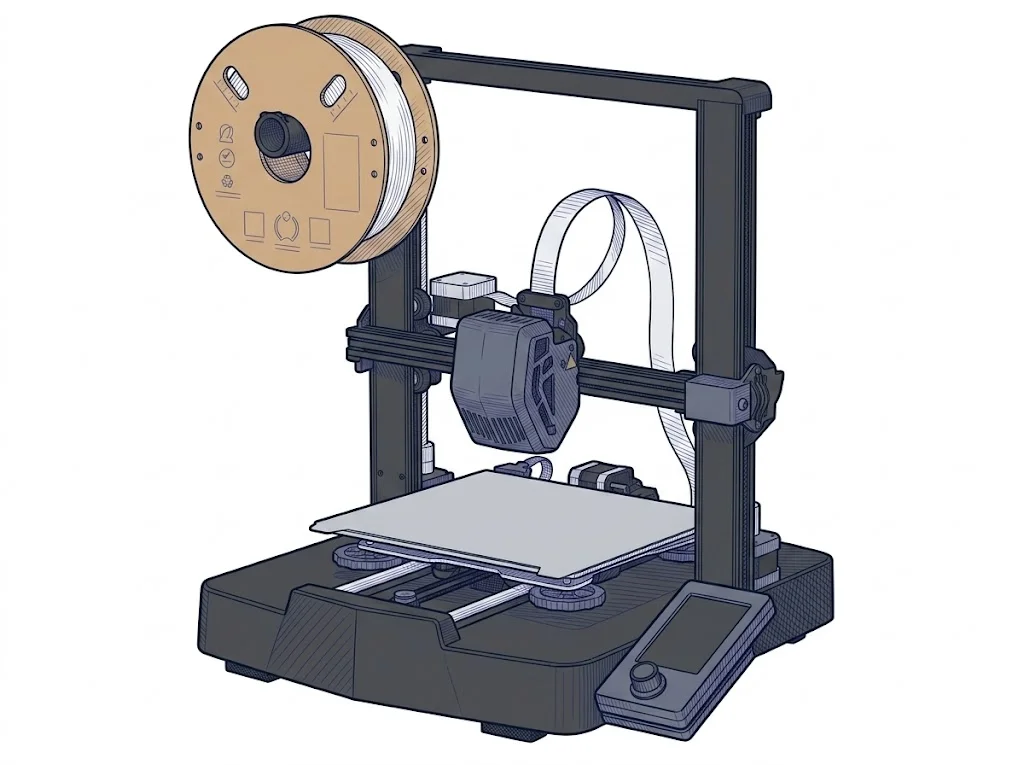
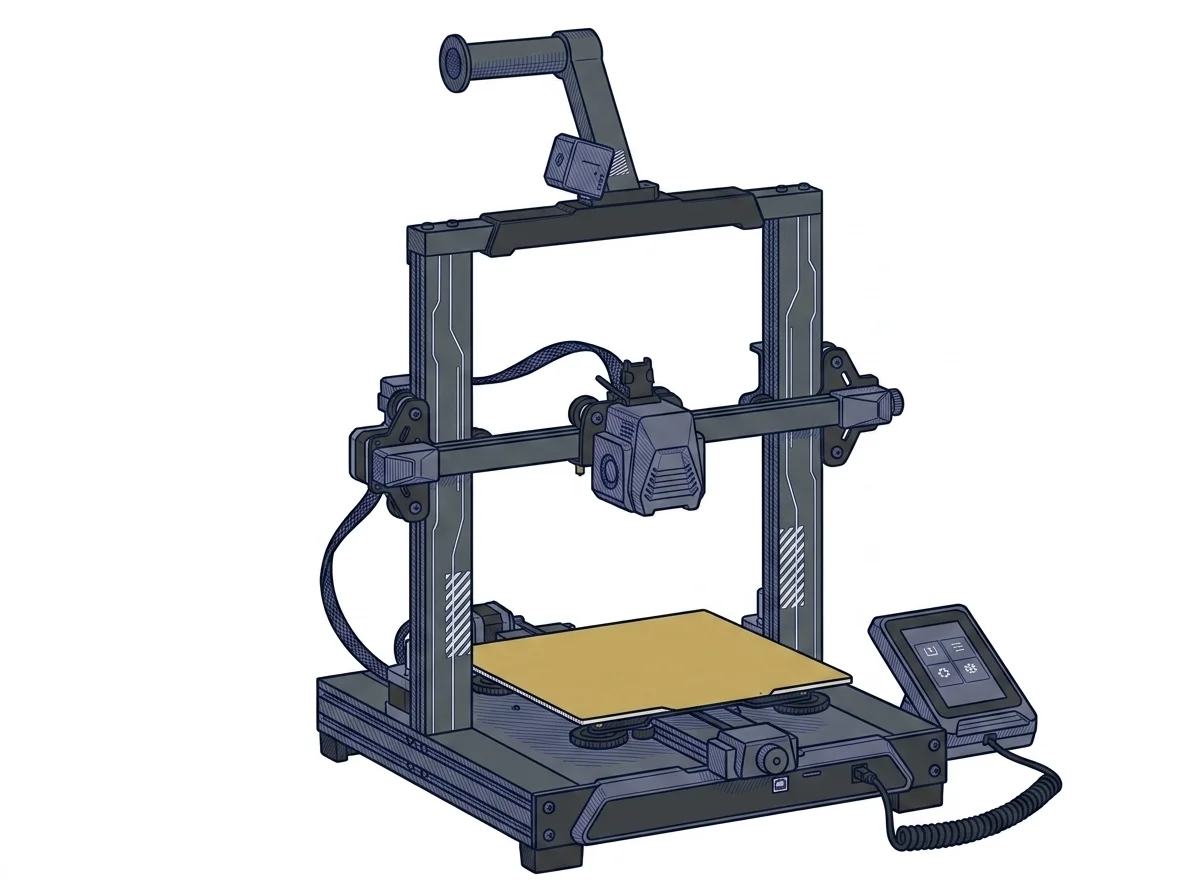
Two open Cartesian printers with Marlin firmware and a single colour. For about 50 € more, the Neptune 3 Pro adds a filament sensor and 3 cm of extra build height.
| Parameter | ||
|---|---|---|
| Awards | — | |
| Identity | ||
| Launch year | 2023 | 2022 |
| Use tier | F2 — Intermediate | F2 — Intermediate |
| Price | ||
| Price (€) | ~150–200 € | ~199–259 € |
| Price updated on | 06/2026 | — |
| Universal specs | ||
| Dimensions (W×D×H) (cm) | 42 × 36.6 × 49 cm | 47.5 × 44.5 × 51.5 cm |
| Weight (kg) | 7.34 kg | 8.1 kg |
| Work area (mm) | 220 × 220 mm | 225 × 225 mm |
| Z-axis height (mm) | 250 mm | 280 mm |
| Power (W) | 350 W | 350 W |
| Voltage (V) | 220 V | 230 V |
| Maximum speed | 250 mm/s | 180 mm/s |
| Declared precision | 0.1 ±mm | 0.1 mm |
| Category specs | ||
| Footprint X×Y (short side) (mm) | 220 mm | 225 mm |
| Build height Z (mm) | 250 mm | 280 mm |
| Kinematics | Cartesian | Cartesian |
| Max nozzle temperature (°C) | 260 °C | 260 °C |
| Max bed temperature (°C) | 100 °C | 100 °C |
| Max print speed (mm/s) | 250 mm/s | 180 mm/s |
| Enclosed chamber | No | No |
| Filament sensor | No | Yes |
| Auto bed leveling | Mesh | Mesh |
| Standard nozzle diameter (mm) | 0.4 mm | 0.4 mm |
| Multi-extruder | No | No |
| Native Klipper | No | No |
| Input shaper | No | No |
| Multicolor printing | No | No |
| Max colors | 1 | 1 |
| Ecosystem | ||
| Cloud dependency | No | No |
| Software notes | The printer runs Creality's proprietary Marlin-based firmware. It is compatible with Creality Print and Cura 5.0 or later; Simplify3D support is documented by third-party resellers. Print files are transferred via SD card. Community guides exist for converting to Klipper, but this is not an officially supported configuration and requires manual hardware and firmware intervention. | The operating system is based on the open-source Marlin firmware, ensuring broad compatibility and stability for the user. The printer is supported by major slicing software on the market, such as Ultimaker Cura and PrusaSlicer, for which official preset profiles or easily configurable community profiles exist. Operational management is handled via a practical removable capacitive touchscreen, featuring a simple interface for manual control and monitoring. The machine operates entirely offline, reading G-code files via a MicroSD card or direct USB cable connection, without any dependency on cloud services or wireless networks. |
MakerSpecs Awards
Best price Intermediate
The lowest list price among intermediate Fused filament fabrication (FFF/FDM) machines: €175. The second cheapest starts at €229. (Excluding manufacturer or retailer discounts.)
How we assign awards →Nessun riconoscimento in questa fascia.
The differences that matter
- Price, about 175 € vs about 229 € → the Neptune 3 Pro costs about 50 € more.
- Filament sensor, only on the Neptune 3 Pro → on the Ender-3 V3 SE a spool that runs out mid-print goes unnoticed by the machine.
- Build height, 250 mm vs 280 mm → the Neptune 3 Pro takes parts 3 cm taller.
- Maximum speed as declared by the manufacturer, 250 vs 180 mm/s → it is a peak: the Ender-3 V3 SE has more headroom on paper, but neither machine has input shaper.
Which one to choose
Choose Ender-3 V3 SE if…
You print single-colour parts that fit a 22×22 cm bed at the lowest cost, with files arriving from an SD card. A Klipper conversion exists as a community guide, but the manufacturer does not support it. You accept having no sensor: if the filament runs out mid-print, the machine does not detect it.
Choose Neptune 3 Pro if…
You also print taller parts and start long jobs with a sensor that detects the end of the filament; files come in by MicroSD or USB cable and the machine works entirely offline. You pay a little more, and the declared peak speed is lower.
Where to buy
Paid link: the price for you does not change. Methodology
As an Amazon Associate I earn from qualifying purchases.
Filaments for these printers
The most chosen spools among the materials both printers can print according to their specifications.
- ELEGOO PLA PLA1.75 mm1 kg Check the price on Amazon →
- Bambu Lab PLA PLA1.75 mm1 kg Check the price on Amazon →
- SUNLU PETG (Polyethylene Terephthalate Glycol) PETG (Polyethylene Terephthalate Glycol)1.75 mm1 kg Check the price on Amazon →
- SUNLU PLA PLA1.75 mm1 kg Check the price on Amazon →
- OVERTURE PETG (Polyethylene Terephthalate Glycol) PETG (Polyethylene Terephthalate Glycol)High speed1.75 mm1 kg Check the price on Amazon →
Paid link: the price for you does not change. Methodology
As an Amazon Associate I earn from qualifying purchases.
MakerSpecs is an independent atlas. We don't sell products: the purchase links are the same as on the two product sheets and don't influence the verdict. The sheets have the complete data.