Creality Ender-3 V3 SE vs Elegoo Centauri Carbon
Technical comparison · Fused filament fabrication (FFF/FDM)
Ender-3 V3 SE and Centauri Carbon are two fused filament fabrication (fff/fdm) in a similar class. Choose Ender-3 V3 SE if price matters more; choose Centauri Carbon if max print speed and max colors matters more. On the category's overall technical index, Centauri Carbon scores 49/100 against 10/100 for Ender-3 V3 SE.
| Parameter |
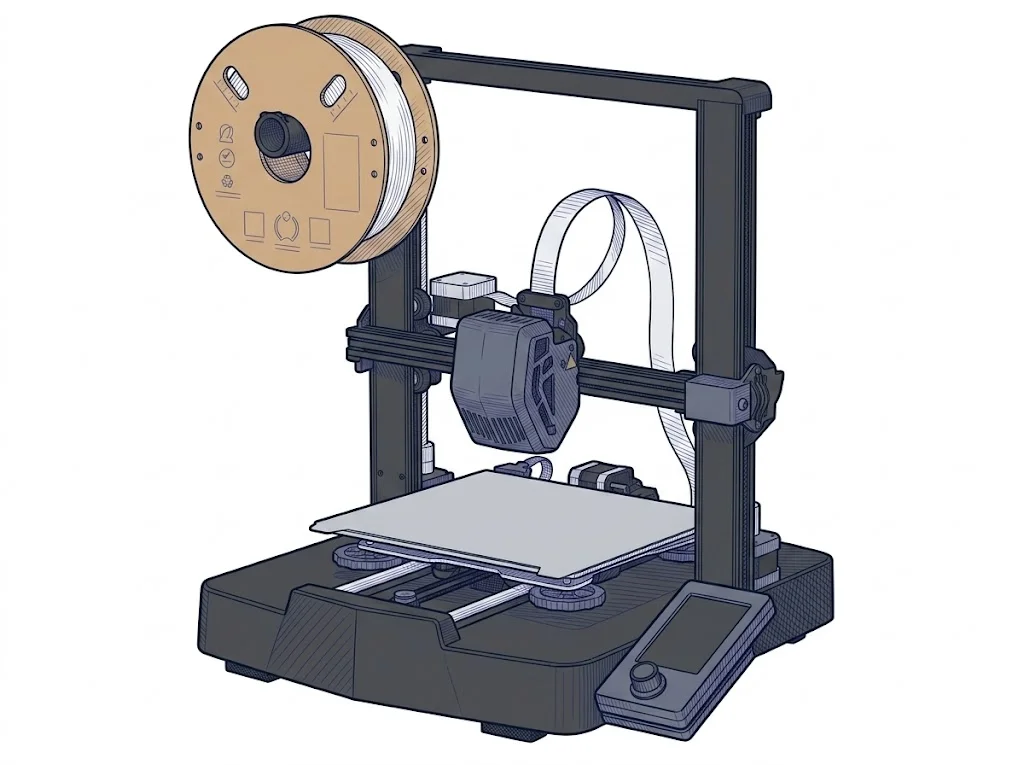 Ender-3 V3 SE
Creality
F2 · Intermediate
Ender-3 V3 SE
Creality
F2 · Intermediate
|
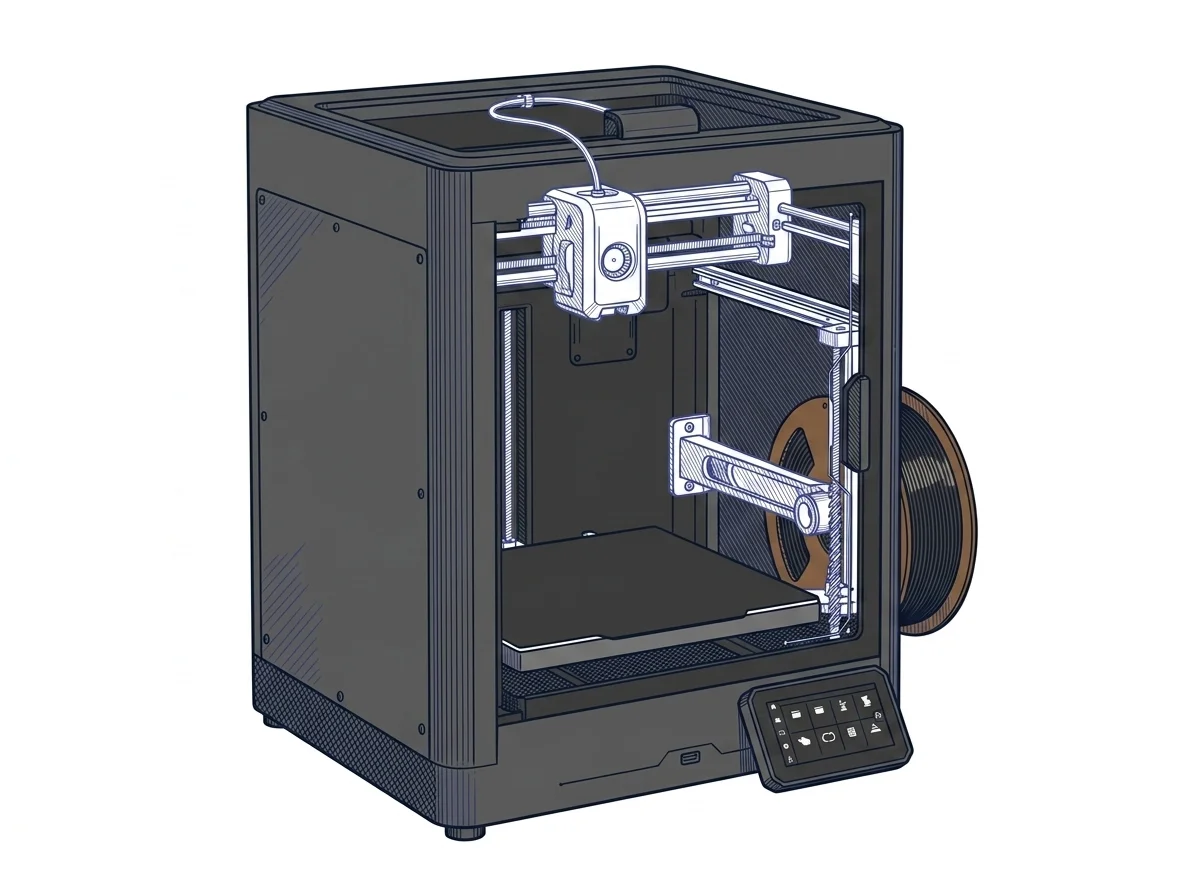 Centauri Carbon
Elegoo
F2 · Intermediate
Centauri Carbon
Elegoo
F2 · Intermediate
|
|---|---|---|
| Awards | — | |
| Identity | ||
| Launch year | 2023 | 2025 |
| Use tier | F2 — Intermediate | F2 — Intermediate |
| Price | ||
| Price (€) | ~150–200 € | ~300–450 € |
| Price updated on | 06/2026 | — |
| Universal specs | ||
| Dimensions (W×D×H) (cm) | 42 × 36.6 × 49 cm | 39.8 × 40.4 × 49 cm |
| Weight (kg) | 7.34 kg | 17.5 kg |
| Work area (mm) | 220 × 220 mm | 256 × 256 mm |
| Z-axis height (mm) | 250 mm | 256 mm |
| Power (W) | 350 W | 1100 W |
| Voltage (V) | 220 V | — |
| Maximum speed | 250 mm/s | 500 mm/s |
| Declared precision | 0.1 ±mm | 0.1 ±mm |
| Category specs | ||
| Footprint X×Y (short side) (mm) | 220 mm | 256 mm |
| Build height Z (mm) | 250 mm | 256 mm |
| Kinematics | Cartesian | CoreXY |
| Max nozzle temperature (°C) | 260 °C | 320 °C |
| Max bed temperature (°C) | 100 °C | 110 °C |
| Max print speed (mm/s) | 250 mm/s | 500 mm/s |
| Enclosed chamber | False | True |
| Filament sensor | False | True |
| Auto bed leveling | Mesh | Mesh |
| Standard nozzle diameter (mm) | 0.4 mm | 0.4 mm |
| Multi-extruder | False | False |
| Native Klipper | False | — |
| Input shaper | False | True |
| Multicolor printing | False | True |
| Multicolor requires accessory | — | True |
| Max colors | 1 | 4 |
| Ecosystem | ||
| Cloud dependency | No | No |
| Software notes | The printer runs Creality's proprietary Marlin-based firmware. It is compatible with Creality Print and Cura 5.0 or later; Simplify3D support is documented by third-party resellers. Print files are transferred via SD card. Community guides exist for converting to Klipper, but this is not an officially supported configuration and requires manual hardware and firmware intervention. | This printer is natively supported by Elegoo Slicer, a slicing software based on Orca Slicer that provides users with pre-configured, carefully optimized profiles designed to maximize both part detail and overall printing speed. Additionally, the machine's operating system is fully compatible with the most popular and community-endorsed third-party slicing software, such as Orca Slicer and Ultimaker Cura. The versatile onboard connectivity options include standard USB ports and a reliable dual-band Wi-Fi module (operating at 2.4 GHz and 5 GHz). This infrastructure enables effortless remote monitoring and comprehensive control of the printing process via its network interface and the built-in chamber camera, greatly streamlining daily workflow management. |
MakerSpecs Awards
Best price Intermediate
The lowest list price among intermediate Fused filament fabrication (FFF/FDM) machines: €175. The second cheapest starts at €229. (Excluding manufacturer or retailer discounts.)
How we assign awards →Nessun riconoscimento in questa fascia.
The differences that matter
- Price: Ender-3 V3 SE 175 € vs Centauri Carbon 375 € — Ender-3 V3 SE wins (+114%)
- Max print speed: Ender-3 V3 SE 250 mm/s vs Centauri Carbon 500 mm/s — Centauri Carbon wins (+100%)
- Max colors: Ender-3 V3 SE 1 vs Centauri Carbon 4 — Centauri Carbon wins (+300%)
- Enclosed chamber: Centauri Carbon yes, Ender-3 V3 SE no
- Work area: Ender-3 V3 SE 220×220 mm vs Centauri Carbon 256×256 mm — Centauri Carbon wins (+35%)
Which one to choose
Choose Centauri Carbon if…
you value max print speed, max colors and enclosed chamber.
MakerSpecs is an independent atlas. We don't sell products: this comparison links to both sheets, where you'll find complete data and official links.