Bambu Lab H2D vs Prusa Research XL 5-toolhead
Technical comparison · Fused filament fabrication (FFF/FDM)
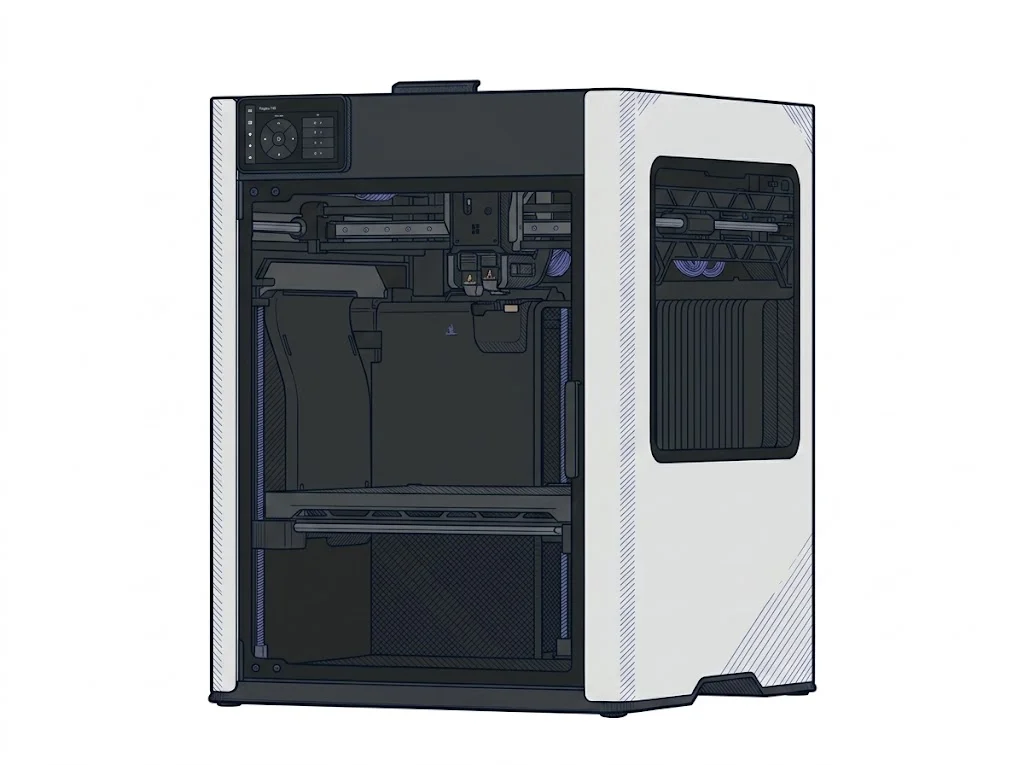
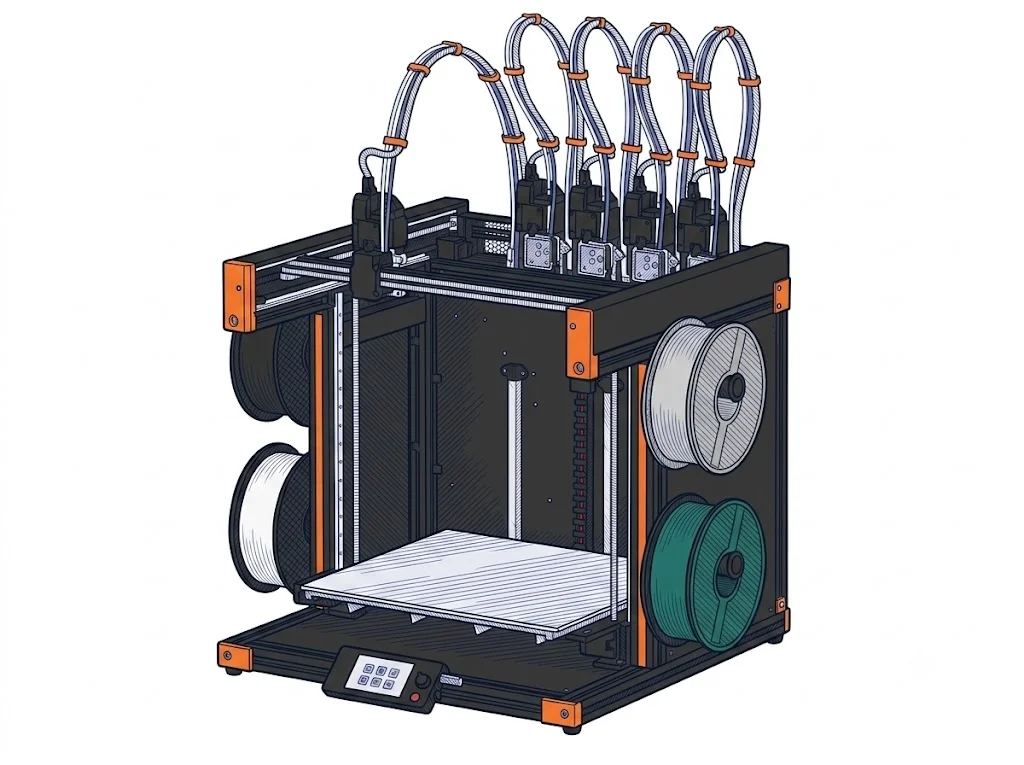
Two multi-material printers built in opposite ways: the H2D is an enclosed CoreXY with two nozzles, the XL has five toolheads on a 360 × 360 mm bed and is not enclosed. The XL costs €2,100 more.
| Parameter | ||
|---|---|---|
| Identity | ||
| Launch year | 2025 | 2023 |
| Use tier | F3 — Advanced | F2 — Intermediate |
| Price | ||
| Price (€) | 1899 € | 3999 € |
| Universal specs | ||
| Dimensions (W×D×H) (cm) | 49.2 × 51.4 × 62.6 cm | 70 × 90 × 72 cm |
| Weight (kg) | 31 kg | 33.7 kg |
| Work area (mm) | 350 × 320 mm | 360 × 360 mm |
| Z-axis height (mm) | 325 mm | 360 mm |
| Power (W) | 2200 W | 235 W |
| Voltage (V) | — | 230 V |
| Maximum speed | 1000 mm/s | 400 mm/s |
| Declared precision | 50 μm | 0.2 mm |
| Category specs | ||
| Footprint X×Y (short side) (mm) | 320 mm | 360 mm |
| Build height Z (mm) | 325 mm | 360 mm |
| Kinematics | CoreXY | CoreXY |
| Max nozzle temperature (°C) | 350 °C | 290 °C |
| Max bed temperature (°C) | 120 °C | 120 °C |
| Max print speed (mm/s) | 600 mm/s | 400 mm/s |
| Enclosed chamber | Yes | No |
| Filament sensor | Yes | Yes |
| Auto bed leveling | Mesh | Mesh |
| Standard nozzle diameter (mm) | 0.4 mm | 0.4 mm |
| Multi-extruder | Yes | Yes |
| Native Klipper | No | No |
| Input shaper | Yes | Yes |
| Multicolor printing | Yes | Yes |
| Multicolor requires accessory | Yes | No |
| Max colors | 4 | 5 |
| Ecosystem | ||
| Cloud dependency | No | No |
| Software notes | The H2D uses Bambu Studio as its official slicer, available for macOS and Windows. Third-party slicers that export standard G-code — including PrusaSlicer, SuperSlicer and Cura — are also compatible, though certain advanced proprietary features (such as automatic dual-nozzle offset calibration and Material CodeSync) are only accessible within the Bambu ecosystem. Remote monitoring and control are handled via Bambu Handy; Bambu Suite manages laser engraving and cutting workflows. | The machine is managed through PrusaSlicer, with dedicated profiles for multi-toolhead configuration and automatic calculation of purge towers or wipe-to-infill strategies. The firmware includes Input Shaper and Pressure Advance for vibration compensation at high speeds. Network connectivity allows job submission and remote monitoring via Prusa Connect, though this is not a requirement for using the machine. |
The differences that matter
- Enclosed chamber vs open frame → the H2D prints inside a chamber, the XL in the open.
- Multicolor: 4 colors with an accessory vs 5 colors with none.
- Volume 350 × 320 × 325 mm vs 360 × 360 × 360 mm → parts taller than 325 mm fit only on the XL.
- Price €1,899 vs €3,999 → €2,100 less with the H2D.
Which one to choose
Choose H2D if…
You print inside an enclosed chamber, with a nozzle up to 350 °C (declared), using Bambu Studio. Multicolor goes up to 4 colors and needs an accessory. You pay €1,899 instead of €3,999, but the bed is 350 × 320 mm and 325 mm tall, and features like automatic dual-nozzle calibration stay inside the Bambu ecosystem.
Choose XL 5-toolhead if…
You print up to 5 colors with no extra accessory, on a 360 × 360 mm bed 360 mm tall, with PrusaSlicer working out purge towers or wipe-to-infill. The trade-off: €2,100 more, no enclosed chamber and a nozzle up to 290 °C.
Where to buy
Paid link: the price for you does not change. Methodology
As an Amazon Associate I earn from qualifying purchases.
Filaments for these printers
The most chosen spools among the materials both printers can print according to their specifications.
- ELEGOO PLA PLA1.75 mm1 kg Check the price on Amazon →
- Bambu Lab PLA PLA1.75 mm1 kg Check the price on Amazon →
- SUNLU PETG (Polyethylene Terephthalate Glycol) PETG (Polyethylene Terephthalate Glycol)1.75 mm1 kg Check the price on Amazon →
- SUNLU PLA PLA1.75 mm1 kg Check the price on Amazon →
- OVERTURE PETG (Polyethylene Terephthalate Glycol) PETG (Polyethylene Terephthalate Glycol)High speed1.75 mm1 kg Check the price on Amazon →
Paid link: the price for you does not change. Methodology
As an Amazon Associate I earn from qualifying purchases.
MakerSpecs is an independent atlas. We don't sell products: the purchase links are the same as on the two product sheets and don't influence the verdict. The sheets have the complete data.