Bambu Lab H2D vs Elegoo Neptune 3 Pro
Technical comparison · Fused filament fabrication (FFF/FDM)
H2D and Neptune 3 Pro are not direct competitors: very different prices (~8.3×). Neptune 3 Pro costs less (~€229) and is the entry-level choice; H2D offers more capability at a higher price (~€1899). Judge them by budget, not head-to-head.
| Parameter |
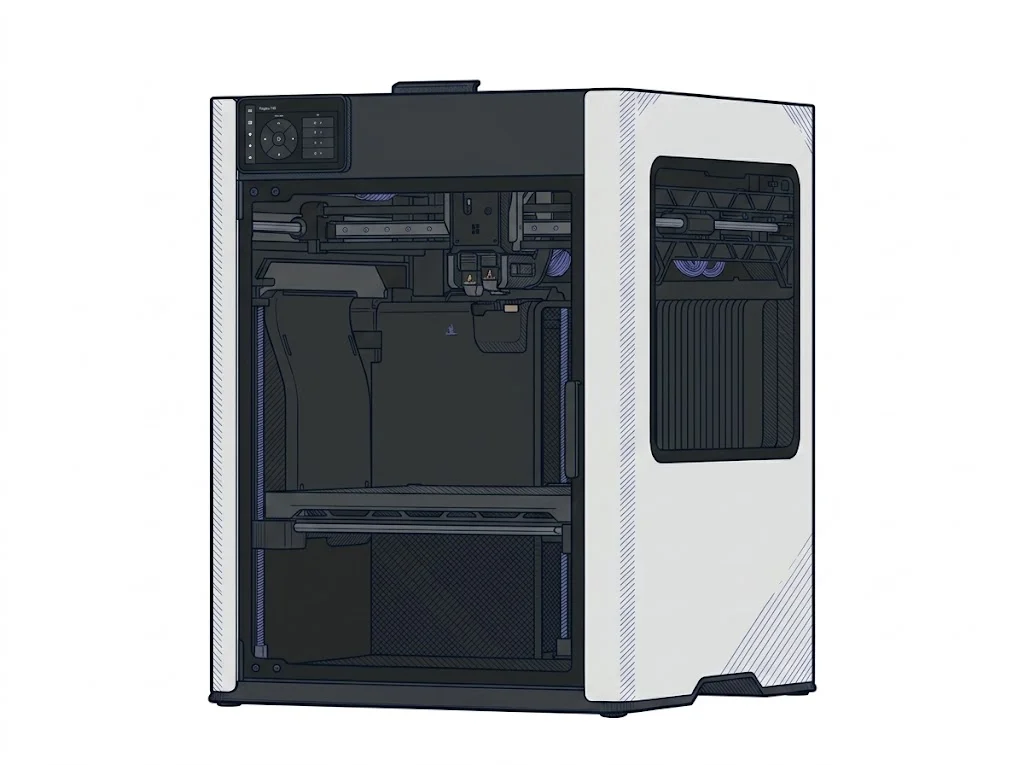 H2D
Bambu Lab
F3 · Advanced
H2D
Bambu Lab
F3 · Advanced
|
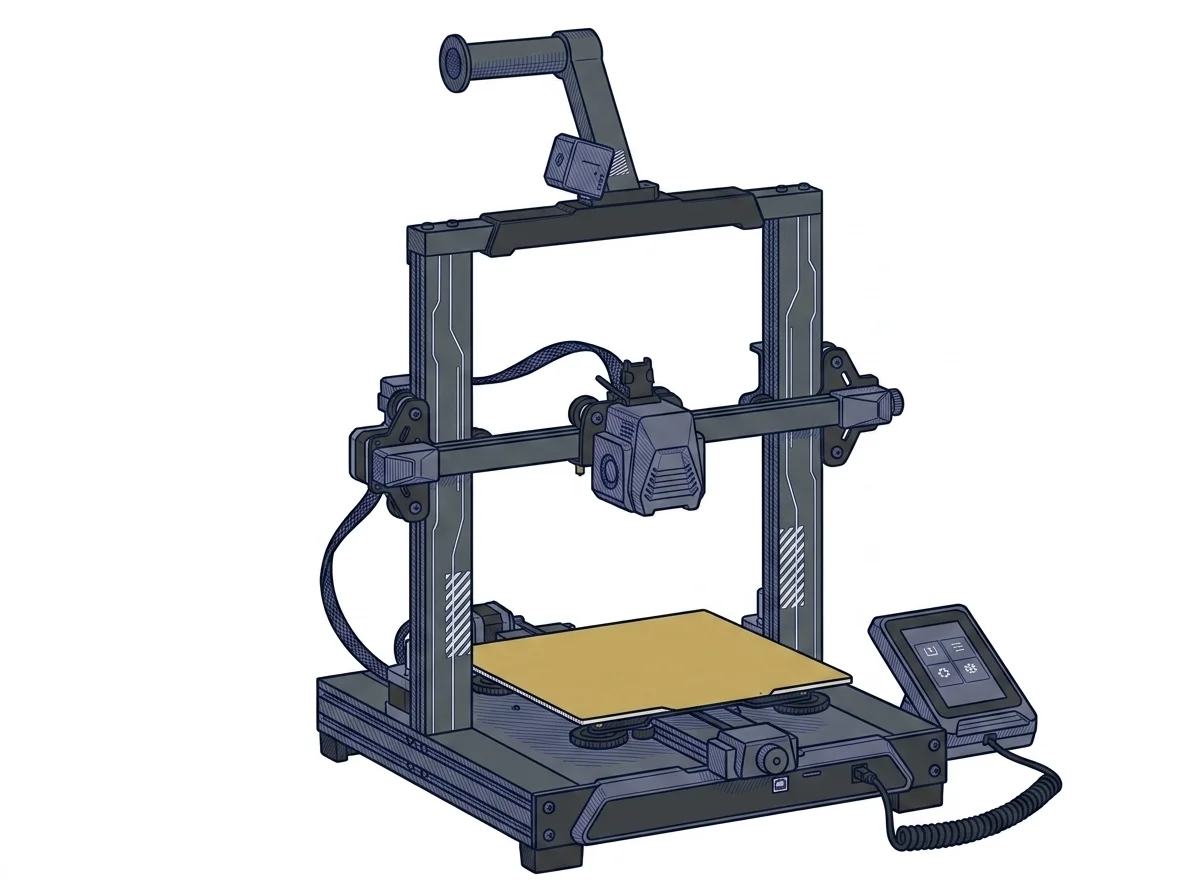 Neptune 3 Pro
Elegoo
F2 · Intermediate
Neptune 3 Pro
Elegoo
F2 · Intermediate
|
|---|---|---|
| Identity | ||
| Launch year | 2025 | 2022 |
| Use tier | F3 — Advanced | F2 — Intermediate |
| Price | ||
| Price (€) | 1899 € | ~199–259 € |
| Universal specs | ||
| Dimensions (W×D×H) (cm) | 49.2 × 51.4 × 62.6 cm | 47.5 × 44.5 × 51.5 cm |
| Weight (kg) | 31 kg | 8.1 kg |
| Work area (mm) | 350 × 320 mm | 225 × 225 mm |
| Z-axis height (mm) | 325 mm | 280 mm |
| Power (W) | 2200 W | 350 W |
| Voltage (V) | — | 230 V |
| Maximum speed | 1000 mm/s | 180 mm/s |
| Declared precision | 50 μm | 0.1 mm |
| Category specs | ||
| Footprint X×Y (short side) (mm) | 492 mm | 225 mm |
| Build height Z (mm) | 325 mm | 280 mm |
| Kinematics | CoreXY | Cartesian |
| Max nozzle temperature (°C) | 350 °C | 260 °C |
| Max bed temperature (°C) | 120 °C | 100 °C |
| Max print speed (mm/s) | 600 mm/s | 180 mm/s |
| Enclosed chamber | True | False |
| Filament sensor | True | True |
| Auto bed leveling | Mesh | Mesh |
| Standard nozzle diameter (mm) | 0.4 mm | 0.4 mm |
| Multi-extruder | True | False |
| Native Klipper | False | False |
| Input shaper | True | False |
| Multicolor printing | True | False |
| Multicolor requires accessory | True | — |
| Max colors | 4 | 1 |
| Ecosystem | ||
| Cloud dependency | No | No |
| Software notes | The H2D uses Bambu Studio as its official slicer, available for macOS and Windows. Third-party slicers that export standard G-code — including PrusaSlicer, SuperSlicer and Cura — are also compatible, though certain advanced proprietary features (such as automatic dual-nozzle offset calibration and Material CodeSync) are only accessible within the Bambu ecosystem. Remote monitoring and control are handled via Bambu Handy; Bambu Suite manages laser engraving and cutting workflows. | The operating system is based on the open-source Marlin firmware, ensuring broad compatibility and stability for the user. The printer is supported by major slicing software on the market, such as Ultimaker Cura and PrusaSlicer, for which official preset profiles or easily configurable community profiles exist. Operational management is handled via a practical removable capacitive touchscreen, featuring a simple interface for manual control and monitoring. The machine operates entirely offline, reading G-code files via a MicroSD card or direct USB cable connection, without any dependency on cloud services or wireless networks. |
The differences that matter
- Price: H2D 1899 € vs Neptune 3 Pro 229 € — Neptune 3 Pro wins (+729%)
- Max print speed: H2D 600 mm/s vs Neptune 3 Pro 180 mm/s — H2D wins (+233%)
- Work area: H2D 350×320 mm vs Neptune 3 Pro 225×225 mm — H2D wins (+121%)
- Max colors: H2D 4 vs Neptune 3 Pro 1 — H2D wins (+300%)
- Enclosed chamber: H2D yes, Neptune 3 Pro no
Which one to choose
MakerSpecs is an independent atlas. We don't sell products: this comparison links to both sheets, where you'll find complete data and official links.