Bambu Lab H2D vs Elegoo Centauri Carbon
Technical comparison · Fused filament fabrication (FFF/FDM)
H2D and Centauri Carbon don't sit in the same spending bracket: €1899 against €375, almost a 5x gap. This isn't a head-to-head — it's a question about available budget.
| Parameter | ||
|---|---|---|
| Identity | ||
| Launch year | 2025 | 2025 |
| Use tier | F3 — Advanced | F2 — Intermediate |
| Price | ||
| Price (€) | 1899 € | ~300–450 € |
| Universal specs | ||
| Dimensions (W×D×H) (cm) | 49.2 × 51.4 × 62.6 cm | 39.8 × 40.4 × 49 cm |
| Weight (kg) | 31 kg | 17.5 kg |
| Work area (mm) | 350 × 320 mm | 256 × 256 mm |
| Z-axis height (mm) | 325 mm | 256 mm |
| Power (W) | 2200 W | 1100 W |
| Maximum speed | 1000 mm/s | 500 mm/s |
| Declared precision | 50 μm | 0.1 ±mm |
| Category specs | ||
| Footprint X×Y (short side) (mm) | 320 mm | 256 mm |
| Build height Z (mm) | 325 mm | 256 mm |
| Kinematics | CoreXY | CoreXY |
| Max nozzle temperature (°C) | 350 °C | 320 °C |
| Max bed temperature (°C) | 120 °C | 110 °C |
| Max print speed (mm/s) | 600 mm/s | 500 mm/s |
| Enclosed chamber | Yes | Yes |
| Filament sensor | Yes | Yes |
| Auto bed leveling | Mesh | Mesh |
| Standard nozzle diameter (mm) | 0.4 mm | 0.4 mm |
| Multi-extruder | Yes | No |
| Native Klipper | No | — |
| Input shaper | Yes | Yes |
| Multicolor printing | Yes | Yes |
| Multicolor requires accessory | Yes | Yes |
| Max colors | 4 | 4 |
| Ecosystem | ||
| Cloud dependency | No | No |
| Software notes | The H2D uses Bambu Studio as its official slicer, available for macOS and Windows. Third-party slicers that export standard G-code — including PrusaSlicer, SuperSlicer and Cura — are also compatible, though certain advanced proprietary features (such as automatic dual-nozzle offset calibration and Material CodeSync) are only accessible within the Bambu ecosystem. Remote monitoring and control are handled via Bambu Handy; Bambu Suite manages laser engraving and cutting workflows. | This printer is natively supported by Elegoo Slicer, a slicing software based on Orca Slicer that provides users with pre-configured, carefully optimized profiles designed to maximize both part detail and overall printing speed. Additionally, the machine's operating system is fully compatible with the most popular and community-endorsed third-party slicing software, such as Orca Slicer and Ultimaker Cura. The versatile onboard connectivity options include standard USB ports and a reliable dual-band Wi-Fi module (operating at 2.4 GHz and 5 GHz). This infrastructure enables effortless remote monitoring and comprehensive control of the printing process via its network interface and the built-in chamber camera, greatly streamlining daily workflow management. |
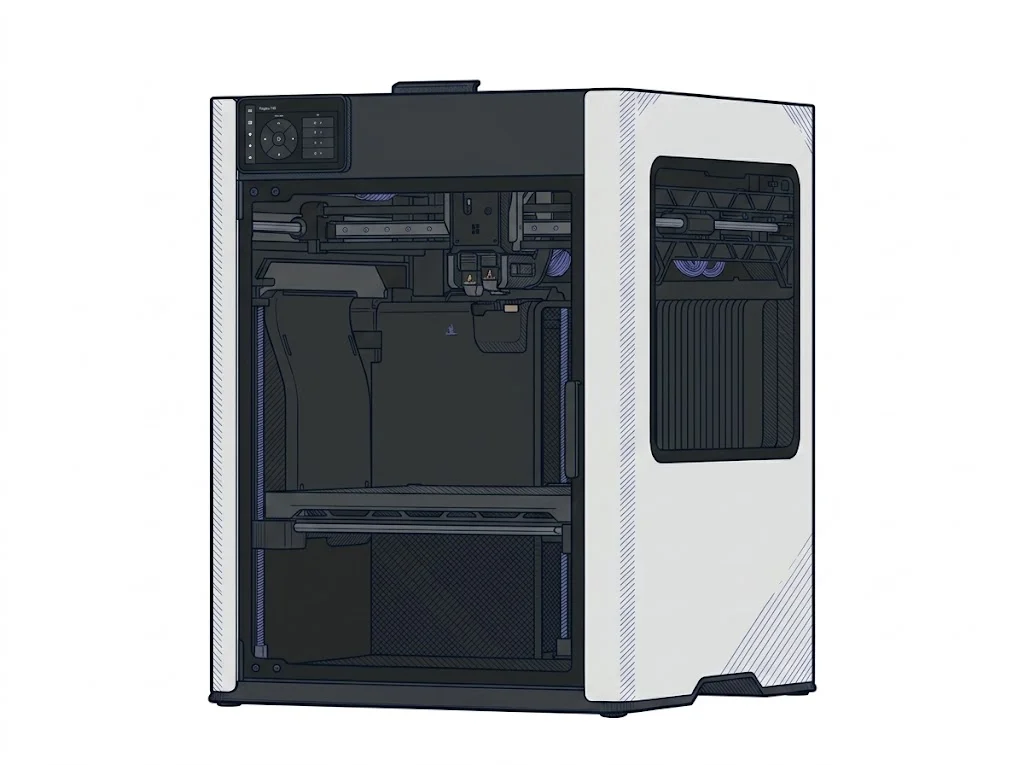
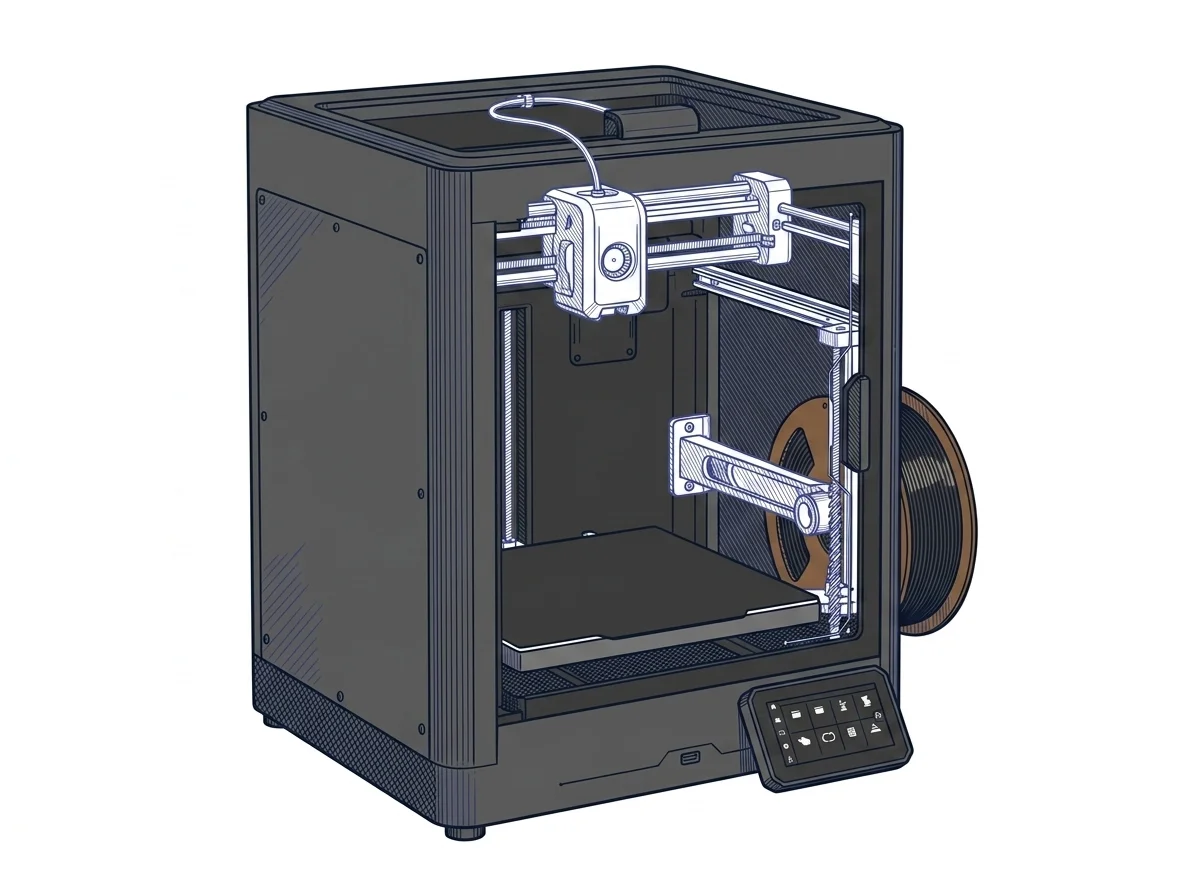
The differences that matter
- Price: H2D €1899 vs Centauri Carbon €375 → the Centauri Carbon costs €1524 less, suited to entering the enclosed-chamber tier without a big investment.
- Build plate: 350×320 mm vs 256×256 mm → the H2D fits larger single parts.
- Extrusion: H2D has a physical dual extruder, Centauri Carbon a single extruder → the H2D prints two materials in the same part without manual intervention.
- Max temperatures: nozzle 350°C vs 320°C, bed 120°C vs 110°C (manufacturer-declared values) → the H2D covers more technical filaments.
Which one to choose
Choose H2D if…
The H2D covers a 350×320 mm bed, fitting larger single parts than the Centauri Carbon's 256×256 mm, and carries an actual dual extruder for printing two materials together without manual swaps. The nozzle reaches 350°C (manufacturer-declared value), useful for technical filaments the Centauri Carbon isn't built to handle. The price only makes sense if these three points genuinely matter for your work.
Choose Centauri Carbon if…
The Centauri Carbon costs €1524 less and remains the pick for entering enclosed CoreXY printing without going past €400, at the cost of a smaller bed and slightly lower maximum nozzle and bed temperatures.
Where to buy
Paid link: the price for you does not change. Methodology
As an Amazon Associate I earn from qualifying purchases.
Filaments for these printers
The most chosen spools among the materials both printers can print according to their specifications.
- ELEGOO PLA PLA1.75 mm1 kg Check the price on Amazon →
- Bambu Lab PLA PLA1.75 mm1 kg Check the price on Amazon →
- SUNLU PETG (Polyethylene Terephthalate Glycol) PETG (Polyethylene Terephthalate Glycol)1.75 mm1 kg Check the price on Amazon →
- SUNLU PLA PLA1.75 mm1 kg Check the price on Amazon →
- OVERTURE PETG (Polyethylene Terephthalate Glycol) PETG (Polyethylene Terephthalate Glycol)High speed1.75 mm1 kg Check the price on Amazon →
Paid link: the price for you does not change. Methodology
As an Amazon Associate I earn from qualifying purchases.
MakerSpecs is an independent atlas. We don't sell products: the purchase links are the same as on the two product sheets and don't influence the verdict. The sheets have the complete data.