Bambu Lab H2D vs Elegoo Centauri Carbon 2 Combo 3D Printer
Technical comparison · Fused filament fabrication (FFF/FDM)
H2D and Centauri Carbon 2 Combo 3D Printer are not direct competitors: very different prices (~4.3×). Centauri Carbon 2 Combo 3D Printer costs less (~€439) and is the entry-level choice; H2D offers more capability at a higher price (~€1899). Judge them by budget, not head-to-head.
| Parameter |
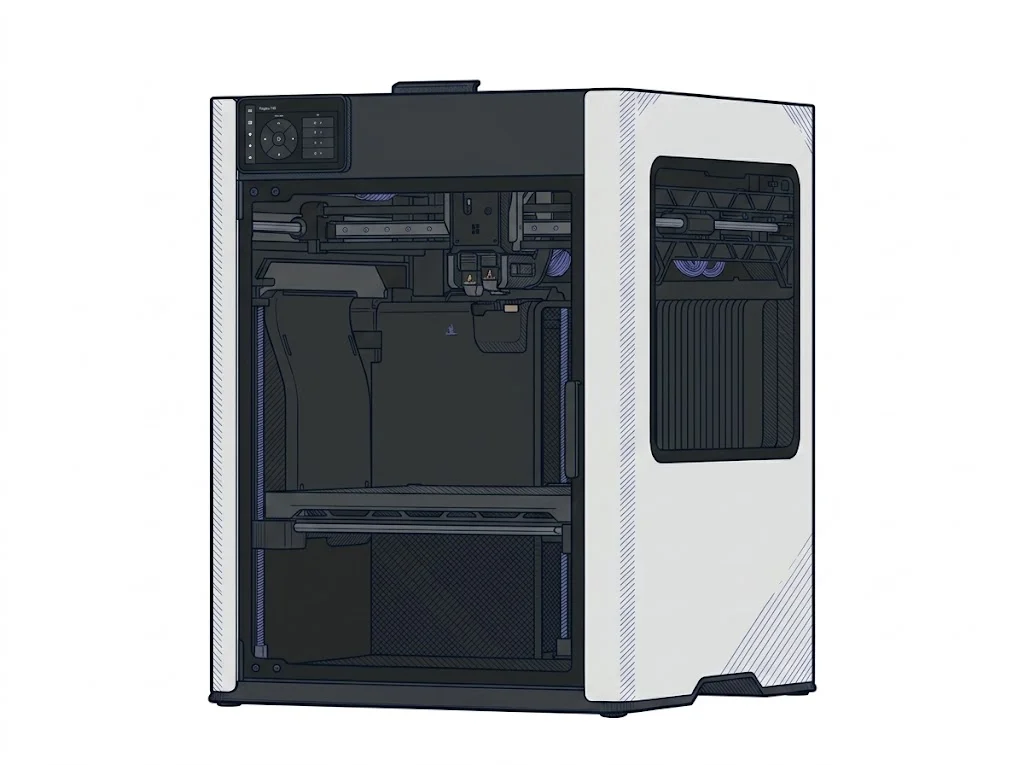 H2D
Bambu Lab
F3 · Advanced
H2D
Bambu Lab
F3 · Advanced
|
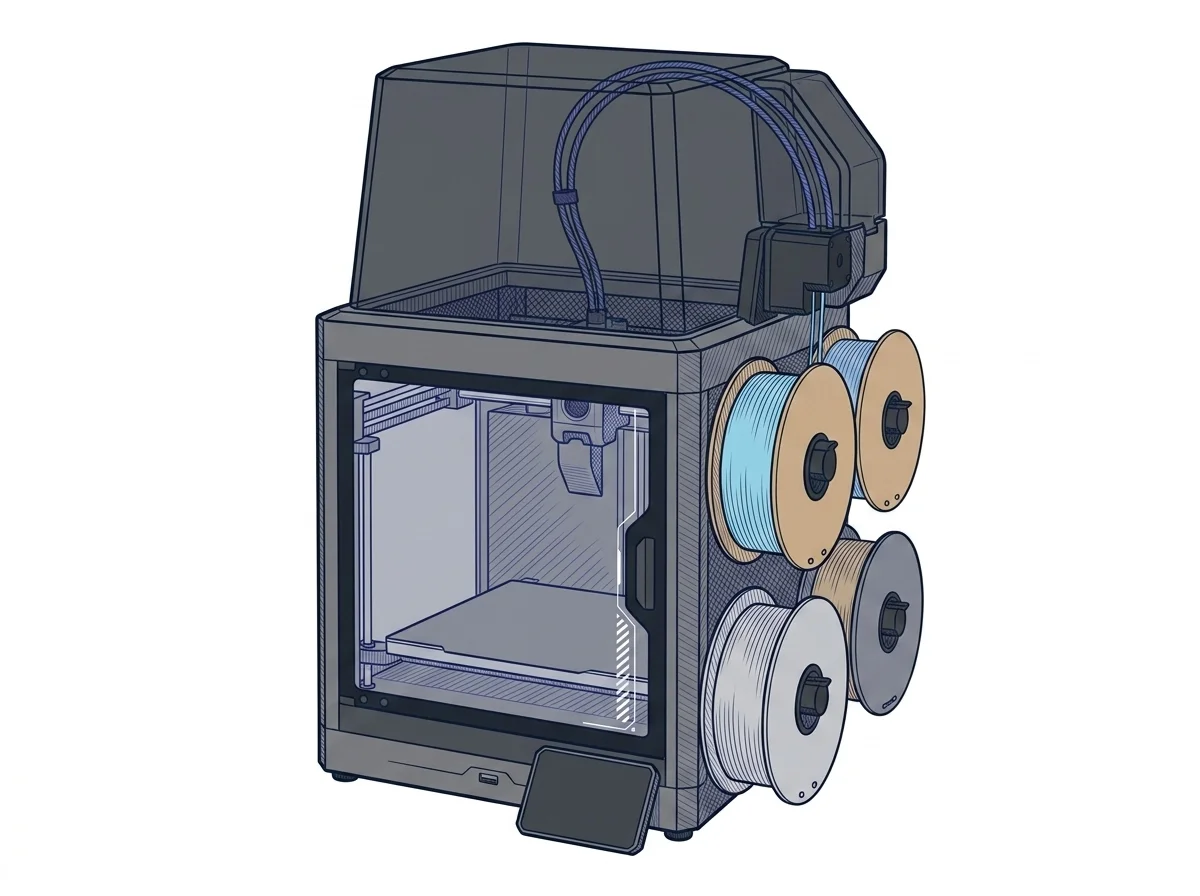 Centauri Carbon 2 Combo 3D Printer
Elegoo
F2 · Intermediate
Centauri Carbon 2 Combo 3D Printer
Elegoo
F2 · Intermediate
|
|---|---|---|
| Identity | ||
| Launch year | 2025 | 2026 |
| Use tier | F3 — Advanced | F2 — Intermediate |
| Price | ||
| Price (€) | 1899 € | 439 € |
| Universal specs | ||
| Dimensions (W×D×H) (cm) | 49.2 × 51.4 × 62.6 cm | 50 × 48 × 74.3 cm |
| Weight (kg) | 31 kg | 19.35 kg |
| Work area (mm) | 350 × 320 mm | 256 × 256 mm |
| Z-axis height (mm) | 325 mm | 256 mm |
| Power (W) | 2200 W | 1100 W |
| Voltage (V) | — | 240 V |
| Maximum speed | 1000 mm/s | 500 mm/s |
| Declared precision | 50 μm | 0.1 mm |
| Category specs | ||
| Footprint X×Y (short side) (mm) | 492 mm | 256 mm |
| Build height Z (mm) | 325 mm | 256 mm |
| Kinematics | CoreXY | CoreXY |
| Max nozzle temperature (°C) | 350 °C | 350 °C |
| Max bed temperature (°C) | 120 °C | 110 °C |
| Max print speed (mm/s) | 600 mm/s | 500 mm/s |
| Enclosed chamber | True | True |
| Filament sensor | True | True |
| Auto bed leveling | Mesh | Mesh |
| Standard nozzle diameter (mm) | 0.4 mm | 0.4 mm |
| Multi-extruder | True | False |
| Native Klipper | False | — |
| Input shaper | True | True |
| Multicolor printing | True | True |
| Multicolor requires accessory | True | False |
| Max colors | 4 | 4 |
| Ecosystem | ||
| Cloud dependency | No | No |
| Software notes | The H2D uses Bambu Studio as its official slicer, available for macOS and Windows. Third-party slicers that export standard G-code — including PrusaSlicer, SuperSlicer and Cura — are also compatible, though certain advanced proprietary features (such as automatic dual-nozzle offset calibration and Material CodeSync) are only accessible within the Bambu ecosystem. Remote monitoring and control are handled via Bambu Handy; Bambu Suite manages laser engraving and cutting workflows. | The machine is compatible with major slicing software on the market. The manufacturer recommends using Elegoo Slicer, specifically optimized to leverage the CoreXY kinematics, multi-color printing via the CANVAS system, and vibration compensation algorithms (Input Shaping). Alternatively, popular slicers like Orca Slicer and Cura can be used, offering broad flexibility to users who prefer established workflows. The integrated dual-band Wi-Fi connectivity allows direct transfer of G-code files to the 8 GB internal memory without physical cards, while the internal camera enables remote monitoring and time-lapse video recording, simplifying the management of the printing process even from a distance. |
The differences that matter
- Price: H2D 1899 € vs Centauri Carbon 2 Combo 3D Printer 439 € — Centauri Carbon 2 Combo 3D Printer wins (+333%)
- Work area: H2D 350×320 mm vs Centauri Carbon 2 Combo 3D Printer 256×256 mm — H2D wins (+71%)
- Build height Z: H2D 325 mm vs Centauri Carbon 2 Combo 3D Printer 256 mm — H2D wins (+27%)
- Multi-extruder: H2D yes, Centauri Carbon 2 Combo 3D Printer no
- Multicolor requires accessory: H2D yes, Centauri Carbon 2 Combo 3D Printer no
Which one to choose
Choose Centauri Carbon 2 Combo 3D Printer if…
you value price.
MakerSpecs is an independent atlas. We don't sell products: this comparison links to both sheets, where you'll find complete data and official links.