Bambu Lab A1 vs Snapmaker 2.0 A250 Modular 3-in-1
Technical comparison · Fused filament fabrication (FFF/FDM)
A1 leads on the available specs (starting with price); 2.0 A250 Modular 3-in-1 makes sense only for non-technical reasons (availability, support, ecosystem), or if the missing data matters in your case. On the category's overall technical index, A1 scores 33/100 against 16/100 for 2.0 A250 Modular 3-in-1.
| Parameter |
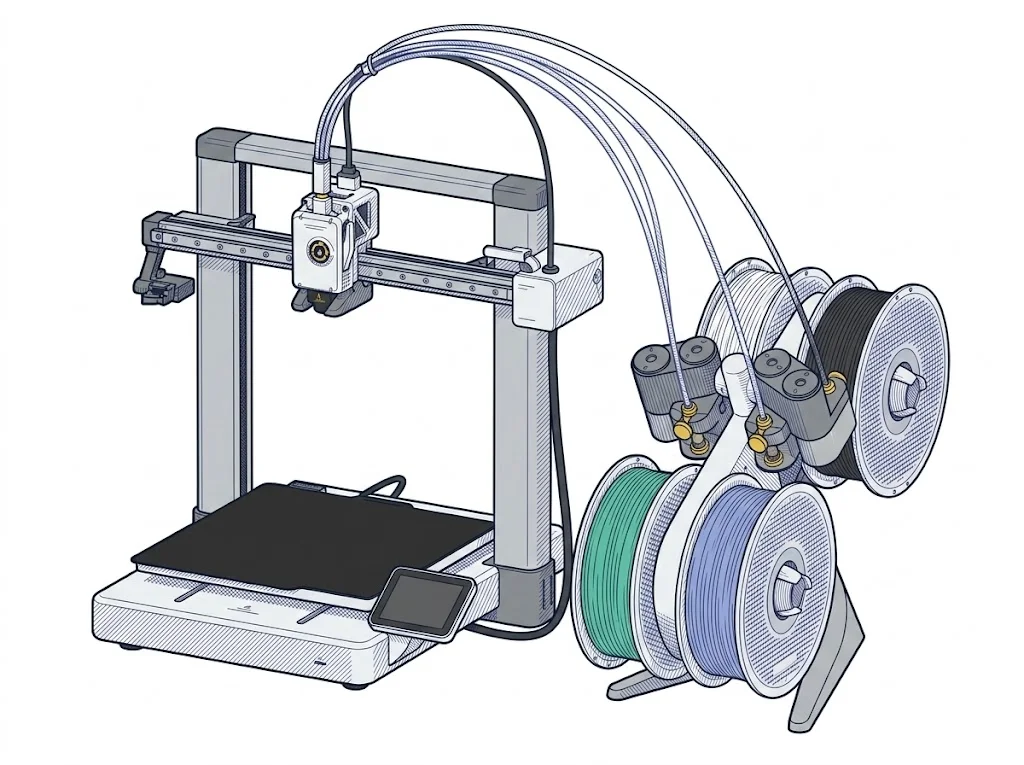 A1
Bambu Lab
F2 · Intermediate
A1
Bambu Lab
F2 · Intermediate
|
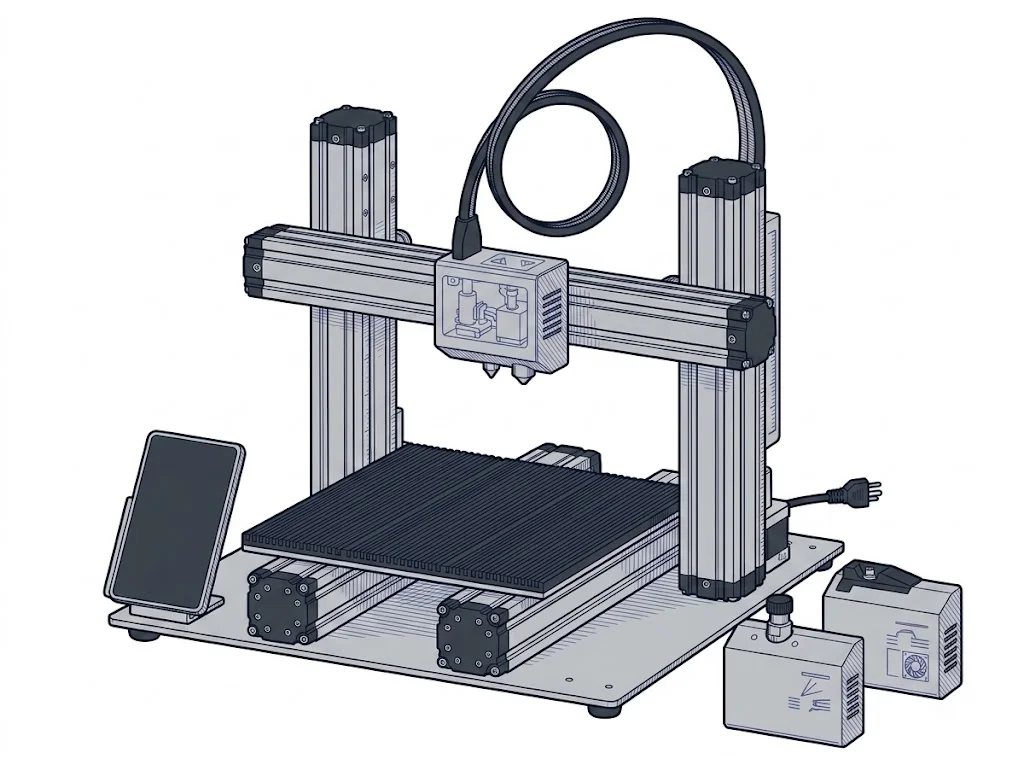 2.0 A250 Modular 3-in-1
Snapmaker
F2 · Intermediate
2.0 A250 Modular 3-in-1
Snapmaker
F2 · Intermediate
|
|---|---|---|
| Identity | ||
| Launch year | 2023 | 2020 |
| Use tier | F2 — Intermediate | F2 — Intermediate |
| Price | ||
| Price (€) | 429 € | ~1000–1500 € |
| Universal specs | ||
| Dimensions (W×D×H) (cm) | 38.5 × 41 × 43 cm | — |
| Weight (kg) | 8.3 kg | 14.2 kg |
| Work area (mm) | 256 × 256 mm | 230 × 250 mm |
| Z-axis height (mm) | 256 mm | 235 mm |
| Power (W) | 1300 W | 320 W |
| Voltage (V) | 220 V | — |
| Maximum speed | 500 mm/s | — |
| Declared precision | — | 0.005 mm |
| Category specs | ||
| Footprint X×Y (short side) (mm) | 256 mm | 230 mm |
| Build height Z (mm) | 256 mm | 235 mm |
| Kinematics | Cartesian | Cartesian |
| Max nozzle temperature (°C) | 300 °C | 275 °C |
| Max bed temperature (°C) | 100 °C | 100 °C |
| Max print speed (mm/s) | 500 mm/s | — |
| Enclosed chamber | False | False |
| Filament sensor | True | True |
| Auto bed leveling | Mesh | Mesh |
| Standard nozzle diameter (mm) | 0.4 mm | — |
| Multi-extruder | False | False |
| Native Klipper | False | False |
| Input shaper | True | False |
| Multicolor printing | True | False |
| Multicolor requires accessory | True | True |
| Max colors | 4 | 1 |
| Ecosystem | ||
| Cloud dependency | No | No |
| Software notes | The A1 works natively with Bambu Studio, Bambu Lab's proprietary slicer available for Windows and macOS, which handles slicing, automatic calibrations, and remote monitoring via the Bambu Handy app. Third-party slicers — including PrusaSlicer, SuperSlicer, and Ultimaker Cura — are supported via standard G-code export, but advanced features such as vibration compensation and active flow control are only available within the Bambu ecosystem. | The machine is natively managed via Snapmaker Luban, a free, cross-platform software (Windows, macOS, Linux) custom-built to handle the three workflows (3D printing, laser engraving, CNC carving) within a single interface. Luban simplifies the transition between tasks and is ideal for novice users. However, the controller, running on a custom firmware, supports the export and use of standard G-code files. Users can utilize third-party slicers like Cura or PrusaSlicer for 3D printing, LightBurn for laser module control, and Fusion 360 or Vectric Aspire for CNC operations, providing the necessary flexibility for more advanced workflows. |
The differences that matter
- Price: A1 429 € vs 2.0 A250 Modular 3-in-1 1250 € — A1 wins (+191%)
- Max colors: A1 4 vs 2.0 A250 Modular 3-in-1 1 — A1 wins (+300%)
- Input shaper: A1 yes, 2.0 A250 Modular 3-in-1 no
- Multicolor printing: A1 yes, 2.0 A250 Modular 3-in-1 no
- Work area: A1 256×256 mm vs 2.0 A250 Modular 3-in-1 230×250 mm — A1 wins (+14%)
Which one to choose
MakerSpecs is an independent atlas. We don't sell products: this comparison links to both sheets, where you'll find complete data and official links.