Bambu Lab A1 mini vs Creality K1 Max
Technical comparison · Fused filament fabrication (FFF/FDM)
The comparison between the Bambu Lab A1 mini and the Creality K1 Max analyzes two different approaches to 2023 FDM 3D printing. The choice depends mainly on the size of the required components and the need for a closed print chamber.
| Parameter |
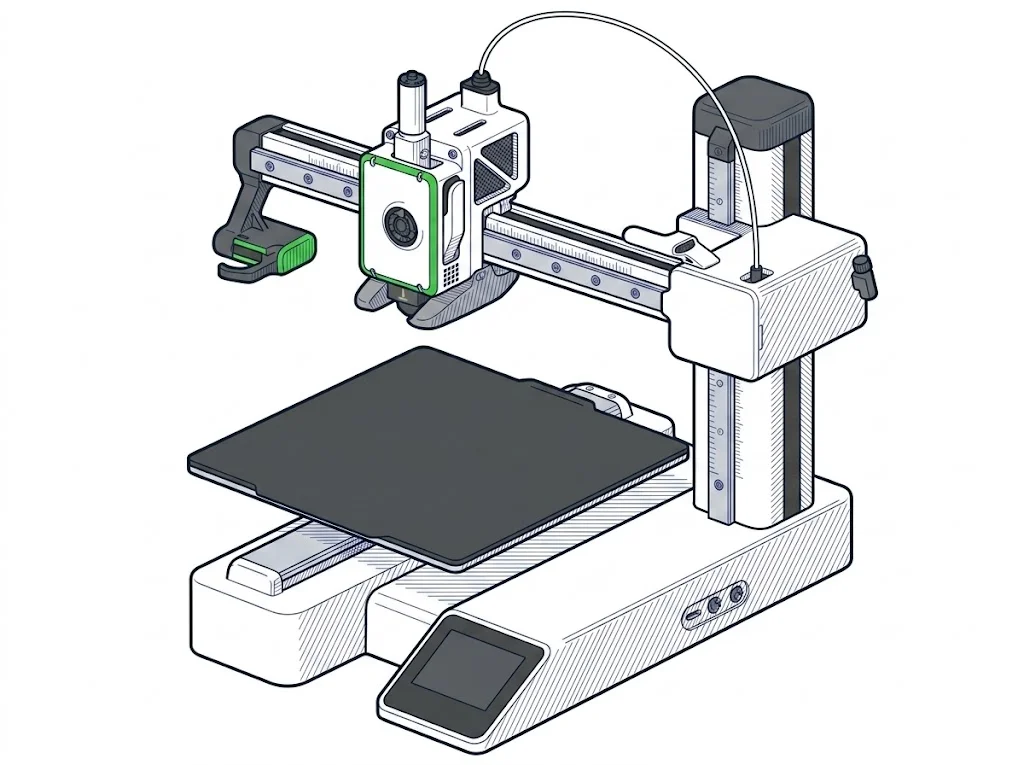 A1 mini
Bambu Lab
F2 · Intermediate
A1 mini
Bambu Lab
F2 · Intermediate
|
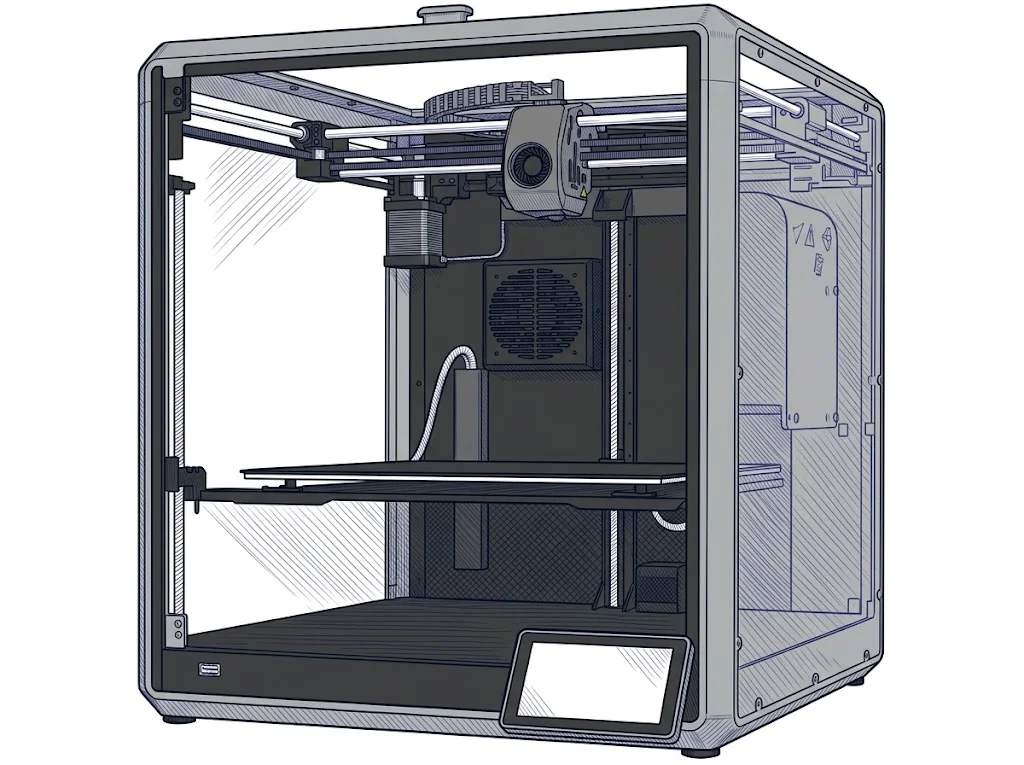 K1 Max
Creality
F2 · Intermediate
K1 Max
Creality
F2 · Intermediate
|
|---|---|---|
| Identity | ||
| Launch year | 2023 | 2023 |
| Use tier | F2 — Intermediate | F2 — Intermediate |
| Price | ||
| Price (€) | 299 € | 899 € |
| Price updated on | — | 06/2026 |
| Universal specs | ||
| Dimensions (W×D×H) (cm) | 34.7 × 31.5 × 36.5 cm | 43.5 × 46.2 × 52.6 cm |
| Weight (kg) | 5.7 kg | 18 kg |
| Work area (mm) | 180 × 180 mm | 300 × 300 mm |
| Z-axis height (mm) | 180 mm | 300 mm |
| Power (W) | 150 W | 1000 W |
| Maximum speed | 500 mm/s | 600 mm/s |
| Declared precision | 50 μm | 0.1 mm |
| Category specs | ||
| Footprint X×Y (short side) (mm) | 180 mm | 300 mm |
| Build height Z (mm) | 180 mm | 300 mm |
| Kinematics | Cartesian | CoreXY |
| Max nozzle temperature (°C) | 300 °C | 300 °C |
| Max bed temperature (°C) | 80 °C | 120 °C |
| Max print speed (mm/s) | 500 mm/s | 600 mm/s |
| Enclosed chamber | false | True |
| Filament sensor | true | True |
| Auto bed leveling | Mesh | Mesh |
| Standard nozzle diameter (mm) | 0.4 mm | 0.4 mm |
| Multi-extruder | false | False |
| Native Klipper | false | True |
| Input shaper | true | True |
| Multicolor printing | true | False |
| Multicolor requires accessory | true | True |
| Max colors | 4 | 4 |
| Ecosystem | ||
| Cloud dependency | No | No |
| Software notes | Compatible with Bambu Studio (OrcaSlicer-derived) and OrcaSlicer. Supports LAN mode for cloud-free printing. Does not run native Klipper. | It runs on the Klipper-based Creality OS. Compatible with Creality Print, Cura, and PrusaSlicer, featuring remote control support via Wi-Fi or LAN. |
The differences that matter
- Price: A1 mini 299 € vs K1 Max 899 € — A1 mini wins (+201%)
- Work area: A1 mini 180×180 mm vs K1 Max 300×300 mm — K1 Max wins (+178%)
- Build height Z: A1 mini 180 mm vs K1 Max 300 mm — K1 Max wins (+67%)
- Enclosed chamber: K1 Max yes, A1 mini no
- Max bed temperature: A1 mini 80 °C vs K1 Max 120 °C — K1 Max wins (+50%)
Which one to choose
Choose A1 mini if…
Choose the Bambu Lab A1 mini for small-scale projects, rapid desktop prototyping, and for those who need a compact system with native support for color changes via the AMS lite.
Choose K1 Max if…
Choose the Creality K1 Max for the production of large components, thanks to the 300x300x300 mm print volume and the closed chamber necessary for technical materials like ABS or ASA that require constant thermal control, and native Klipper for advanced management of high-speed printing parameters on extended volumes. The CoreXY kinematics ensure greater structural stability on large print volumes compared to the Cartesian configuration of the A1 mini. The price difference reflects the jump in category in terms of volumetric capacity and thermal management of the print environment. The 300x300x300 mm print volume of the K1 Max is four times larger than that of the A1 mini. The K1 Max offers a closed chamber and a heated bed up to 120°C, essential for advanced polymers, against the 80°C of the A1 mini. The A1 mini is optimized for a small footprint, weighing 5.7 kg against the 18 kg of the K1 Max. The K1 Max integrates native Klipper, offering greater software customization flexibility compared to the closed ecosystem of Bambu Lab. The A1 mini supports the AMS lite multicolor system, while the K1 Max is oriented towards larger-scale productivity without integrated multicolor options as standard.
MakerSpecs is an independent atlas. We don't sell products: this comparison links to both sheets, where you'll find complete data and official links.