Bambu Lab A1 mini vs Creality Ender-5 Max
Technical comparison · Fused filament fabrication (FFF/FDM)
The Bambu Lab A1 mini and Creality Ender-5 Max represent two distinct approaches to mid-range FDM 3D printing. The choice between the two models depends exclusively on the size of the components to be produced and the need to manage multi-color prints.
| Parameter |
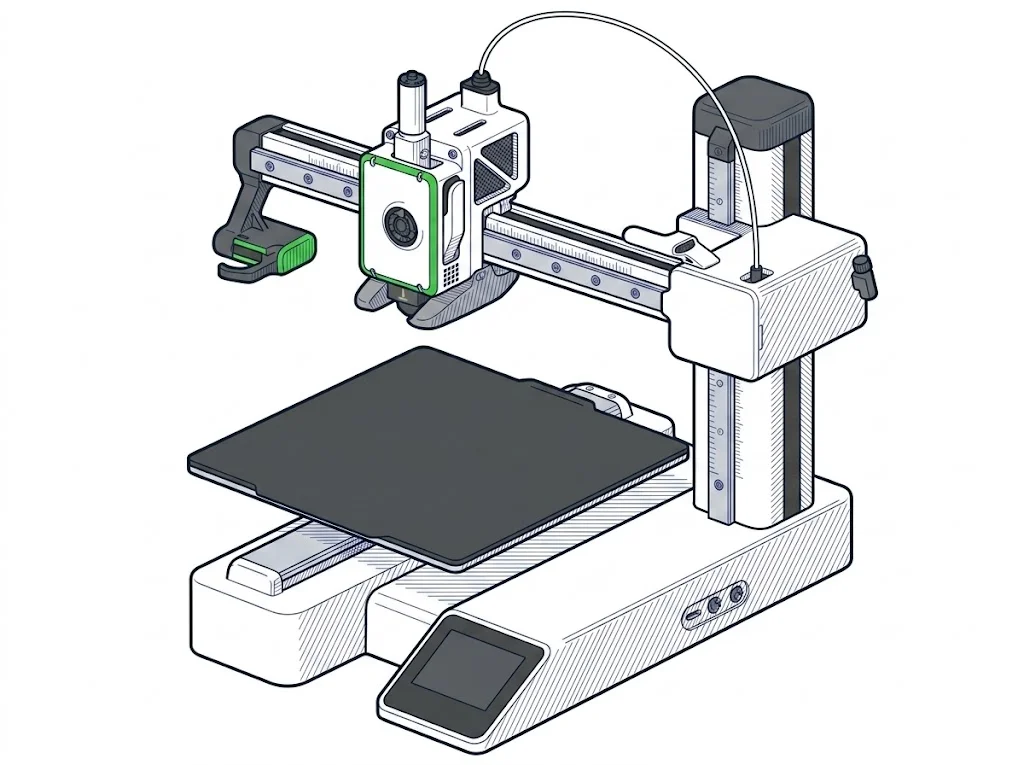 A1 mini
Bambu Lab
F2 · Intermediate
A1 mini
Bambu Lab
F2 · Intermediate
|
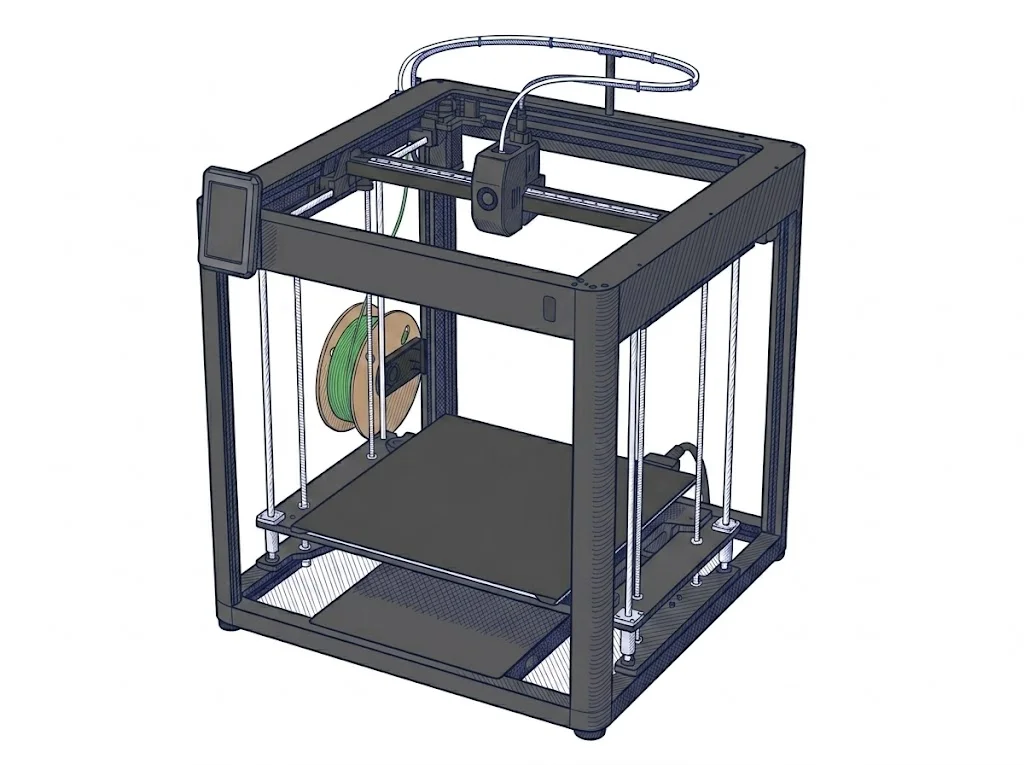 Ender-5 Max
Creality
F2 · Intermediate
Ender-5 Max
Creality
F2 · Intermediate
|
|---|---|---|
| Identity | ||
| Launch year | 2023 | 2024 |
| Use tier | F2 — Intermediate | F2 — Intermediate |
| Price | ||
| Price (€) | 299 € | ~400–500 € |
| Universal specs | ||
| Dimensions (W×D×H) (cm) | 34.7 × 31.5 × 36.5 cm | 46.18 × 43.48 × 52.58 cm |
| Weight (kg) | 5.7 kg | 18 kg |
| Work area (mm) | 180 × 180 mm | 400 × 400 mm |
| Z-axis height (mm) | 180 mm | 400 mm |
| Power (W) | 150 W | 350 W |
| Voltage (V) | — | 240 V |
| Maximum speed | 500 mm/s | 700 mm/s |
| Declared precision | 50 μm | 0.1 ±mm |
| Category specs | ||
| Footprint X×Y (short side) (mm) | 180 mm | 400 mm |
| Build height Z (mm) | 180 mm | 400 mm |
| Kinematics | Cartesian | CoreXY |
| Max nozzle temperature (°C) | 300 °C | 300 °C |
| Max bed temperature (°C) | 80 °C | 110 °C |
| Max print speed (mm/s) | 500 mm/s | 700 mm/s |
| Enclosed chamber | false | false |
| Filament sensor | true | true |
| Auto bed leveling | Mesh | Mesh |
| Standard nozzle diameter (mm) | 0.4 mm | 0.4 mm |
| Multi-extruder | false | false |
| Native Klipper | false | true |
| Input shaper | true | true |
| Multicolor printing | true | false |
| Multicolor requires accessory | true | — |
| Max colors | 4 | 1 |
| Ecosystem | ||
| Cloud dependency | No | No |
| Software notes | Compatible with Bambu Studio (OrcaSlicer-derived) and OrcaSlicer. Supports LAN mode for cloud-free printing. Does not run native Klipper. | Klipper-based firmware with a 4.3" colour touchscreen. Compatible with Creality Print, Orca Slicer and PrusaSlicer; remote monitoring via the Creality Cloud app is optional. |
The differences that matter
- Work area: A1 mini 180×180 mm vs Ender-5 Max 400×400 mm — Ender-5 Max wins (+394%)
- Build height Z: A1 mini 180 mm vs Ender-5 Max 400 mm — Ender-5 Max wins (+122%)
- Price: A1 mini 299 € vs Ender-5 Max 450 € — A1 mini wins (+51%)
- Max colors: A1 mini 4 vs Ender-5 Max 1 — A1 mini wins (+300%)
- Max print speed: A1 mini 500 mm/s vs Ender-5 Max 700 mm/s — Ender-5 Max wins (+40%)
Which one to choose
Choose A1 mini if…
The Bambu Lab A1 mini is the ideal choice for those who need a compact system capable of handling multi-color prints via the AMS lite module and who prioritize out-of-the-box ease of setup.
Choose Ender-5 Max if…
The Creality Ender-5 Max is suitable for users who require an extended print volume of 400x400x400 mm and the flexibility of native Klipper firmware for advanced customization of large-scale print parameters, at the cost of a significantly larger physical footprint and a weight of 18 kg compared to the 5.7 kg of its competitor. The CoreXY kinematics ensure more efficient motion management for large, high-speed prints compared to the Cartesian configuration of the A1 mini. The main differences lie in the print volume, with the Ender-5 Max offering over four times the workspace, and color management, which is exclusive to the A1 mini via the optional accessory. The A1 mini integrates a more automated calibration system for the entry-level user, while the Ender-5 Max focuses on a rigid structure and hardware performance oriented toward large projects and high execution speeds. Bambu Lab A1 mini vs Creality Ender-5 Max: a guide to choosing. Technical comparison between two mid-range FDM 3D printers for different volumes and functionalities.
MakerSpecs is an independent atlas. We don't sell products: this comparison links to both sheets, where you'll find complete data and official links.