Anycubic Photon Mono M7 vs Anycubic Photon P1 Max
Technical comparison · Resin 3D printing
The Photon P1 Max offers a larger build area and taller Z axis than the Photon Mono M7, which in turn declares a finer XY resolution (16.8 vs 24.8 µm). The P1 Max's price isn't yet listed in the official data, while the Mono M7 costs €499.
| Parameter | ||
|---|---|---|
| Identity | ||
| Launch year | 2024 | 2026 |
| Use tier | F2 — Intermediate | F3 — Advanced |
| Price | ||
| Price (€) | 499 € | ~450–1000 € |
| Universal specs | ||
| Dimensions (W×D×H) (cm) | 31.2 × 31.5 × 52 cm | — |
| Weight (kg) | 11.5 kg | — |
| Work area (mm) | 223 × 126 mm | 285.5 × 214 mm |
| Z-axis height (mm) | 230 mm | 300 mm |
| Power (W) | 120 W | — |
| Voltage (V) | 100 V | — |
| Maximum speed | 130 mm/s | — |
| Declared precision | 16.8 μm | 24.8 μm |
| Category specs | ||
| Build area XY (short side) (mm) | 126 mm | 214 mm |
| XY resolution (µm) | 16.8 µm | 24.8 µm |
| Light source | Mono LCD | Mono LCD |
| Print speed (mm/h) | 130 mm/h | — |
| Tilt / peel system | Film ACF | — |
| Ecosystem | ||
| Cloud dependency | No | No |
| Software notes | File management and print preparation rely primarily on Anycubic Photon Workshop, which integrates optimized profiles to take advantage of the machine's reduced exposure times. The ecosystem supports network connectivity via Wi-Fi and allows remote monitoring and control through the Anycubic Cloud mobile application. While offering advanced cloud features for print queue management and firmware updates, the printer maintains full local offline operational capability. Compatibility with major third-party slicers such as ChiTuBox and Lychee Slicer is guaranteed upon manual configuration of the parameters. | The system supports file formats generated by the most popular third-party print preparation software, such as ChiTuBox and LycheeSlicer, ensuring operational flexibility and a consolidated workflow. The manufacturer also provides Anycubic Photon Workshop, the proprietary application optimized to fine-tune exposure parameters, manage advanced supports, and fully exploit the screen's pixel density without slowing down layer calculation. |

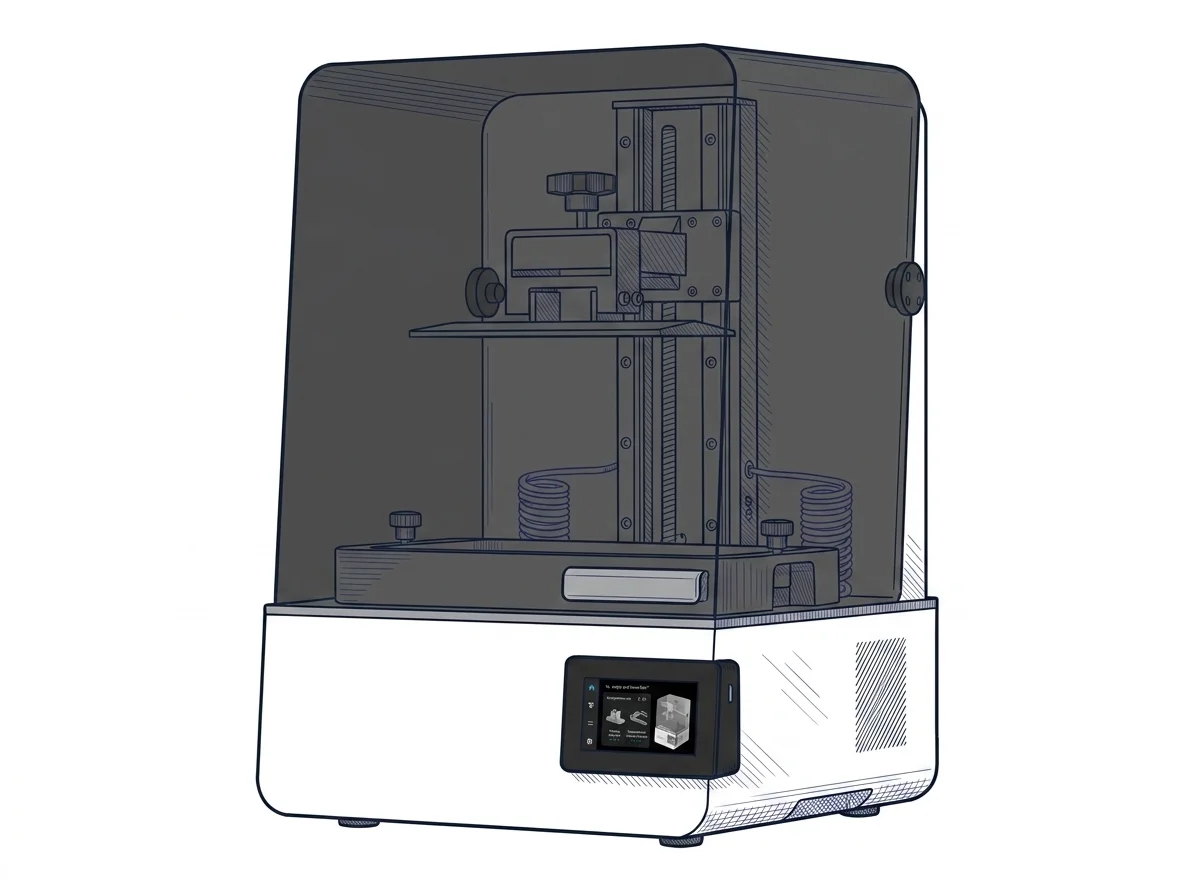
The differences that matter
- Build area: 223×126 mm vs 285.5×214 mm → the P1 Max prints much wider and deeper parts.
- Z height: 230 mm vs 300 mm → the P1 Max prints taller models in one piece.
- Declared XY resolution: 16.8 µm vs 24.8 µm → the Mono M7 renders finer detail on miniatures.
- Price: €499 for the Mono M7, not yet listed for the P1 Max.
Which one to choose
Choose Photon Mono M7 if…
Anyone printing miniatures or fine details in standard resin gets a declared XY resolution of 16.8 µm on the Mono M7, finer than the P1 Max's 24.8 µm, at a known price of €499. The trade-off is a smaller build area of 223×126 mm and a 230 mm Z axis.
Choose Photon P1 Max if…
Anyone printing larger or taller parts gets a build area of 285.5×214 mm and a 300 mm Z axis on the P1 Max, against 223×126 mm and 230 mm on the Mono M7. The declared trade-off is a 24.8 µm XY resolution, coarser than the Mono M7's 16.8 µm; the price isn't yet listed in the official data.
Where to buy
Paid link: the price for you does not change. Methodology
MakerSpecs is an independent atlas. We don't sell products: the purchase links are the same as on the two product sheets and don't influence the verdict. The sheets have the complete data.